A world model is not a video generator and not a game engine. It renders a world frame by frame while you move inside it, and it answers when you change the rules. Genie 4, announced by Google DeepMind on October 27, 2026, is the clearest public example yet, and it is also the clearest test of where the idea breaks, because DeepMind discloses the breakage itself: details drift as runs lengthen and edits pile up.
The definition that actually helps
Most explanations of world models fail because they describe what the output looks like, not what the system does. The useful definition is operational: a world model maintains a simulated state, renders it continuously, accepts interventions while it runs, and updates the state in response. A video generator does the first half of that job once and stops. A game engine does the whole job, but only inside a world someone built by hand, asset by asset, rule by rule. A world model tries to do the whole job inside a world it invents from a prompt, which is why it can surprise you and why it can also forget what it just showed you. The table below keeps that distinction concrete.
| System | Input | Output | What breaks first |
|---|---|---|---|
| Video generator | A prompt, once | A fixed clip | Nothing live: you cannot change the clip while it plays |
| Game engine | Built assets and hand-coded rules | An exact, repeatable world | Scope: only what was built exists |
| World model | A prompt, plus live edits | A running simulation that answers back | Coherence: details drift over time and edits |
The loop, step by step
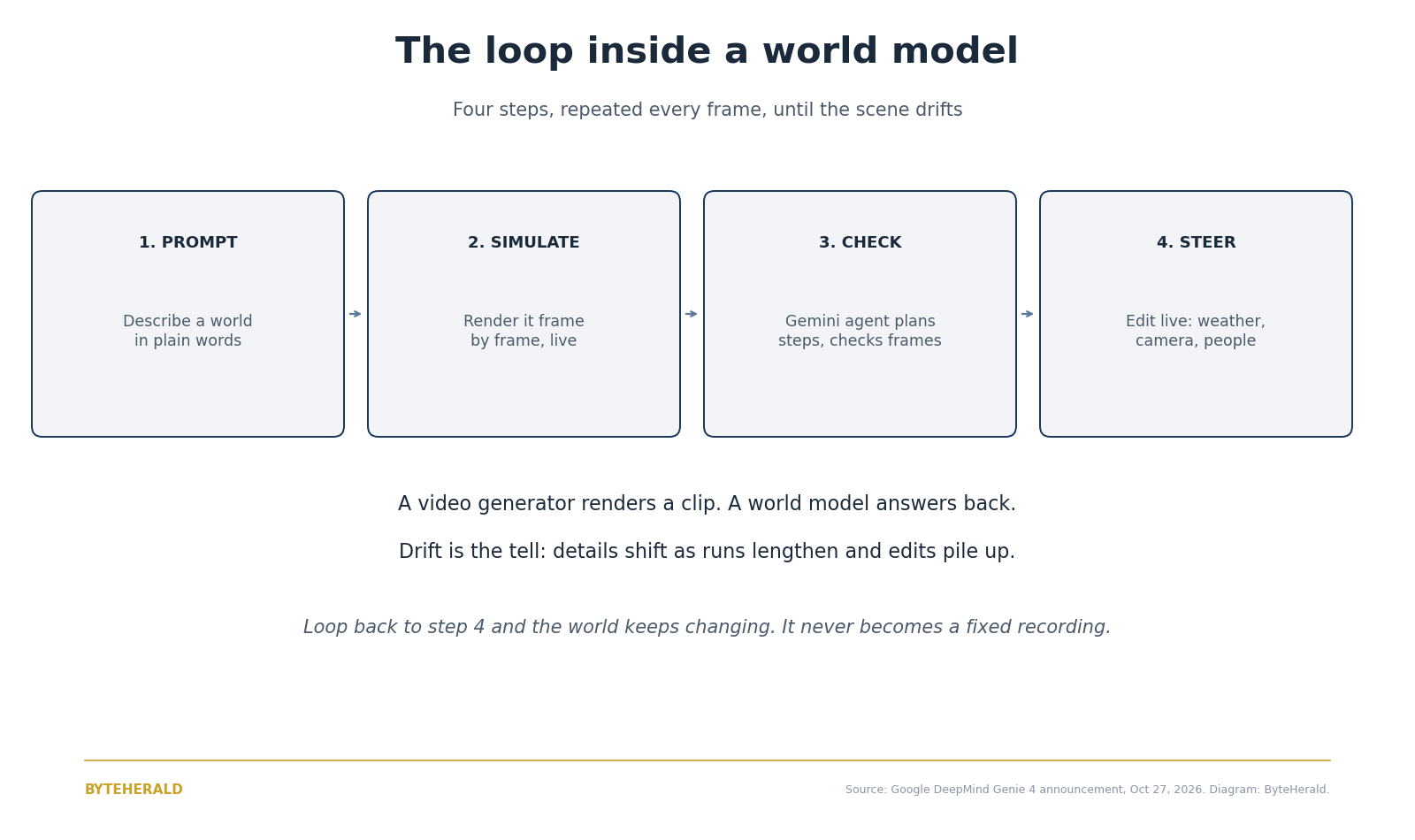
Every world model, Genie 4 included, runs the same four-step loop. First, prompt: the user describes a world in plain words. Second, simulate: the model renders that world frame by frame, live, rather than rendering a clip in advance. Third, check: an agent inside the loop plans the next steps and checks each frame against the plan, which is the job DeepMind gives to Gemini 3.8 Flash in Genie 4. Fourth, steer: the user edits the running world, changing weather, camera or characters, and the loop starts again from the new state. The checking step is where the transformer machinery that predicts the next piece meets a harder problem than text, because a wrong word in a paragraph is a blemish while a vanished object in a simulation is a broken world. Genie 4's contribution is not the loop itself, which researchers have chased for years. It is the combination of native audio inside the same loop, live steering through natural language, and a doubled coherent runtime of up to two minutes, all checked by a reasoning agent rather than left to the renderer alone.
Three tests before you trust a world model
Launch demos are edited, short and steered by people who know the model's habits. Independent judgment needs tests the demo cannot pass by selection. The first test is persistence: run for the full claimed duration, move the camera away, return, and count what changed without being asked to change. A model that silently swaps objects fails, even if every individual frame looks beautiful. The second test is edit coherence: change one thing, the weather, and check whether everything else still obeys the scene's own rules, including the new person you added two edits ago. A model that rewrites the world to accommodate each edit is not steering, it is restarting. The third test is physics consistency: drop, collide and move objects, and check whether the same action gives the same kind of result twice. DeepMind claims better physics for Genie 4, including aerodynamics and collisions, and more natural human characters, but a claim is not a measurement, and no public drift benchmark accompanies the announcement. Until reviewers publish persistence, edit and physics scores on the same scenes, every world model announcement should be read as a demo of a loop, not proof of a world.
Where world models will matter first
DeepMind lists filmmaking, journalism, gaming and manufacturing, plus safe training environments for robots and agents. The ordering matters, and the honest ordering is different from the marketing ordering. Robotics and agent training will matter first, because simulation failure there is cheap and real failure is expensive, and a robot that learns in a simulated warehouse can be reset a thousand times before it touches a real shelf. Filmmaking and games will matter second, because both need minutes of coherence, not seconds, and both punish drift visibly: an audience notices when a character's coat changes color between shots. Manufacturing training follows the same logic as robotics, with simulated plants and procedures before real ones. What connects all four is not prettiness. It is the ability to rehearse a future, change one variable, and watch the consequences, which is a capability no fixed clip provides. That is also why the consolidation around simulation matters: when AMD buys a world model lab and a carmaker buys a simulation team, they are buying rehearsal capacity, not video quality.
How generation differs from simulation
The confusion between image generation and world models is understandable, because both start from a prompt and both produce pictures. The difference is what happens after the first picture. Image generation plans a picture before rendering it, and once the picture exists, the job is done. A world model never finishes in that sense: each frame is both an output and the input to the next frame, and each user edit rewrites the state the next frame must honor. That is why audio matters more in a world model than in a video generator. Sound that arrives with the scene, characters who converse in real time, and ambient noise that matches the weather are not decoration. They are evidence that the model's state includes more than pixels, and that its checking loop tracks that state across senses. When the sound contradicts the picture, or a character answers a question the scene never posed, the loop has failed in a way a still image never could. Judge world models by their state, not their screenshots.
What Genie 4 does not settle
Genie 4 settles the question of whether native audio and live steering can coexist in a public research preview. It does not settle cost, because no price, frame rate or inference cost is disclosed. It does not settle fidelity, because no resolution is disclosed and no independent drift benchmark exists. It does not settle access, because trusted testers go first and subscribers and API partners follow on an undisclosed schedule. And it does not settle trust, because every output carries SynthID, which helps attribution after the fact but does not prevent a convincing simulated scene from being mistaken for a real one in the moment. The right verdict on Genie 4 is therefore narrow and useful: the loop is real, the runtime doubled, the audio is native, and the drift that defines the field is still disclosed as a limit. A world model earns the name when it passes the persistence, edit and physics tests in independent hands. Until then, call it what DeepMind calls it: a research preview of a world, not a world itself.
By ByteHerald Staff. Google DeepMind, October 27, 2026, announced Genie 4 with native audio, real-time natural-language steering, Gemini Omni anchoring, Gemini reasoning for coherence, and Gemini 3.8 Flash as the guiding agent, with a coherent runtime of up to two minutes and SynthID watermarking on every output. TechCrunch, October 27, 2026, reported the doubled runtime against Genie 3, the Gemini Robotics simulation experiment, and the Runway, World Labs, Decart and Third Dimension developments in the world model field.
Comments
Post a Comment