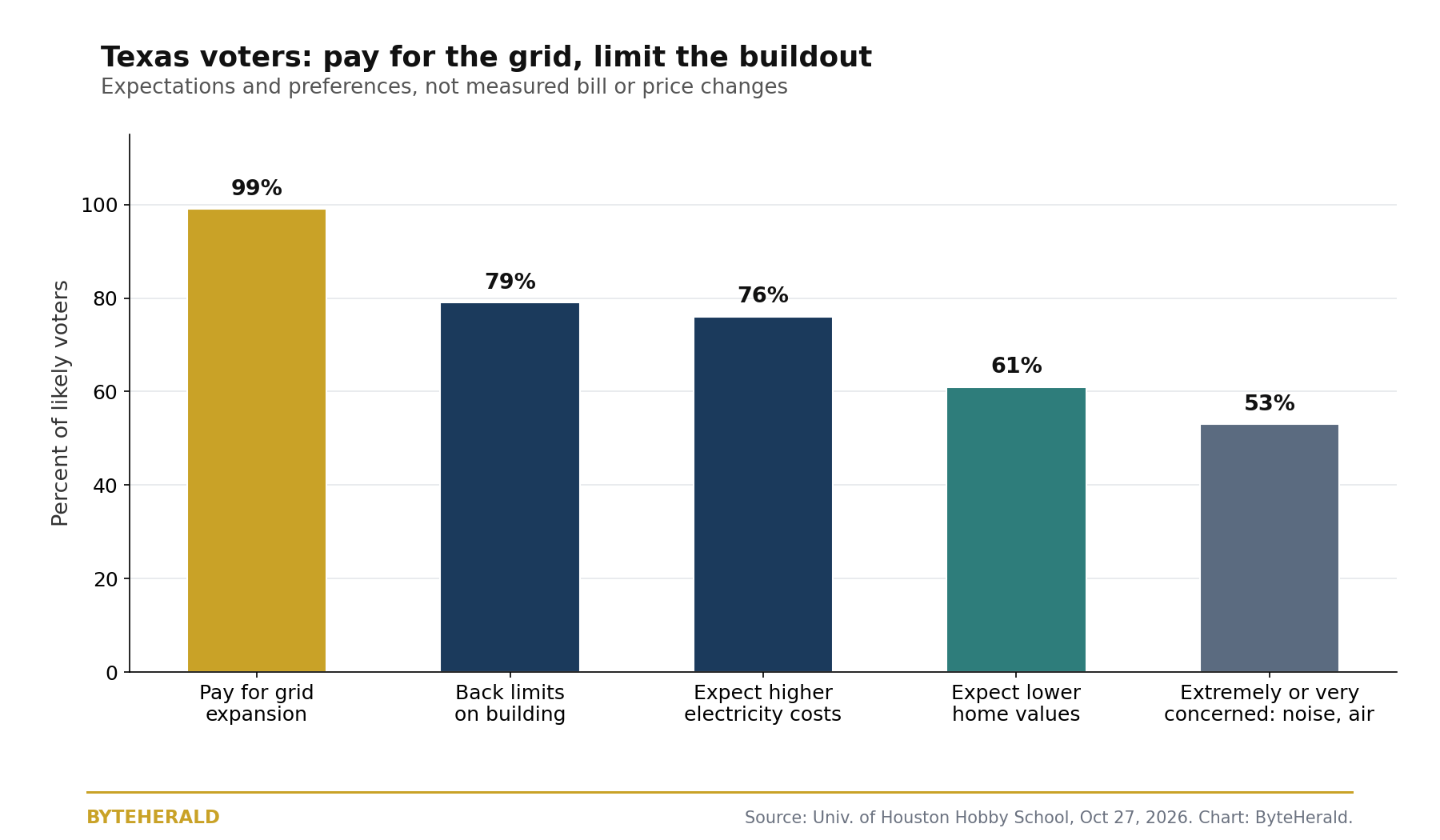
Nearly eight in ten likely Texas voters want limits on how many data centers can be built in Texas, and 99 percent say a proposed data center should pay for any expansion of the electric grid needed to power it, according to a University of Houston survey released on October 27, 2026. The survey, fielded October 10 to 14 among 2,000 likely voters with a margin of error of plus or minus 2.19 percentage points, turns a familiar local fight over power bills and water into a statewide election issue days before the November 3 election.
What the poll actually found
The headline numbers are unusually lopsided for a policy question. Support for limiting data center construction reached 79 percent. Support for making developers pay for grid expansion reached 99 percent, with 1 percent opposed in the reporting of that question. Those are expectations and preferences, not measurements of what any particular data center has done to a bill or a water supply, and the survey itself is best read that way.
| Question, in plain terms | Result | What it is not |
|---|---|---|
| Limit how many data centers are built in Texas | 79 percent support | Not a vote on any single project |
| Proposed data centers should pay for needed grid expansion | 99 percent support | Not a settled rule for who pays for transmission |
| A new local data center would raise household electricity costs | 76 percent expect a rise, 7 percent a fall, 17 percent no effect | Not a measured change in rates |
| A new local data center would cut nearby home values | 61 percent expect a fall, 20 percent a rise, 19 percent no effect | Not a property appraisal |
| Data centers would not benefit job creation | 40 percent say no benefit, 33 percent say a benefit | Not a jobs count |
| Data centers would not benefit tax revenue | 38 percent say no benefit, 33 percent say a benefit | Not a revenue audit |
Concern runs deeper than the headline support for limits. More than 80 percent of voters said they are concerned about the impact of data centers on electricity prices, the water supply, and power outages, and about two thirds said they are extremely or very concerned. Fifty three percent said they are extremely or very concerned about noise and air pollution. Fewer than 20 percent said they are not very or not at all concerned about the main effects.
The partisan split is real, and so is the overlap
The survey's most useful political finding is that concern crosses party lines even where its intensity does not. Among voters who are very or extremely concerned about electricity prices, the share was 93 percent of Democrats, 70 percent of independents, and 51 percent of Republicans, according to Mark P. Jones, a political science fellow at Rice University's Baker Institute and a senior research fellow at the Hobby School. A 51 percent majority of Republicans at the highest concern level is what makes this a statewide issue rather than a single party's talking point.
The same pattern shows up in attitudes toward artificial intelligence itself. Sixty five percent of voters said AI will do more to hurt society than to help it over the next 10 years, while 29 percent said it will help more and 6 percent said it will make no difference. On the economy, 54 percent said AI will hurt more than help over the next decade and 37 percent said it will help more, but that split was 81 percent hurt among Democrats, 56 percent among independents, and 32 percent among Republicans. Voters were split on their own lives: 37 percent said AI will hurt them personally, 35 percent said it will help, and 28 percent said it will make no difference.
That nuance matters for anyone quoting the poll. Voters are not simply anti technology. Forty five percent said data centers will have an extremely or very beneficial impact on technological advancement in their communities, and 40 percent said the same for electrical infrastructure, with another 26 percent expecting a somewhat beneficial infrastructure impact. The complaint is narrower and more specific: voters doubt the jobs and tax story, and they do not want to carry the grid bill. Renée Cross, senior executive director of the Hobby School, put it plainly in the university's release: public officials who supported the buildout touted jobs, tax revenues, and the overall economy, but the majority of Texas voters clearly disagree.
What voters want done, in policy terms
A poll result is not a law, so the next question is what Texas already has in motion. Texas passed Senate Bill 6 in its 89th Legislature, directing the Public Utility Commission of Texas to set standards for large load interconnections and the costs of serving those facilities. Reporting on the poll notes that Texas has begun requiring large electricity customers to make financial commitments, but the rules for their share of broader transmission costs remain unfinished. A proposed rule in Project No. 58000 would set how large loads pay for transmission service in the ERCOT region, with one proposal requiring 20 years of transmission payments, and the commission expects to give final consideration to the proposed transmission cost rules by the end of 2026.
That unfinished rule is the gap the 99 percent figure points at. Connecting a facility is one cost. Reserving transmission capacity for a project is another. The risk voters are being asked about is what happens if a developer delays construction, uses less power than expected, or abandons a project after other customers have already funded capacity for it. Until the transmission cost rule is final, the poll's near unanimous answer is a demand for a principle, not a description of a settled system.
The tax side has its own price tag in the reporting. Texas officials estimated the state's data center sales tax exemption would cost 3.2 billion dollars over two years, and Governor Greg Abbott has backed ending it. That figure sits alongside the poll's skepticism: 38 percent see no tax revenue benefit and 33 percent see a benefit. Readers should not merge the two numbers. The exemption estimate is a fiscal projection, and the poll percentages are voter expectations. Together they explain why the exemption is now a live political question, not why any single project is or is not worth its tax treatment.
How a data center becomes an election issue
The university's release says data centers have emerged as a potent campaign issue for the November 3 election, and that many candidates who previously were all in on landing projects have tempered their support. Local fights explain why. Reporting around the poll cites San Marcos, which in June became the first Texas city to prohibit future data center development under a change to its development code, and Temple, where backlash fueled recall efforts against the mayor and council members. Taylor residents fought a proposed facility on land intended as a park. A separate Texas Politics Project poll found 57 percent of voters opposed building a data center in their community, against 30 percent in support.
The air side of the same tension has already been modeled in Texas. Texas air modeling covered by ByteHerald found data center growth could erase two decades of clean air progress, with nitrogen oxides rising 136 percent and fine particulate matter more than tripling under the modeled path. That is a forecast, not a poll, and it answers a different question: what the atmosphere does if the buildout proceeds. The Hobby School poll answers the political question: what voters say they will tolerate while it proceeds. The two together are why a project that once arrived as a jobs announcement now arrives as a contested permit.
What to watch on November 3, and after
Three checkable events will test whether this poll was a mood or a mandate. First, the November 3 election itself: do candidates who tempered their data center support outperform those who did not, in the places where projects are actually proposed. Second, the Public Utility Commission's final transmission cost rule by the end of 2026: does it make developers pay for reserved capacity for a long enough period to match the 99 percent demand, or does it leave the abandonment risk with other customers. Third, the 2027 Texas Legislature: does it revisit the sales tax exemption, and does it take up statewide limits of the kind 79 percent of voters support.
Until those events happen, the honest summary is narrow. Texas voters are not waiting for a technical briefing on grid engineering. They have already formed a view: limit the buildout, make developers pay for the grid, and do not sell the project on jobs and taxes that voters do not believe. A developer or a candidate who answers that view with another jobs announcement is answering a question voters did not ask.
By ByteHerald Staff. The University of Houston Hobby School of Public Affairs released its survey on October 27, 2026, finding that 79 percent of likely Texas voters support limiting data center construction, 99 percent say proposed data centers should cover grid expansion costs, more than 80 percent are concerned about electricity prices, water supply, and outages, and 65 percent say artificial intelligence will do more to hurt society than to help it over the next 10 years. The survey was fielded October 10 to 14, 2026, among 2,000 Texas likely voters, with a margin of error of plus or minus 2.19 percentage points. TechTarget reported on the poll and on Texas transmission cost rules, noting that Senate Bill 6 directed the Public Utility Commission of Texas to set large load interconnection standards and that a proposed rule in Project No. 58000 addresses how large loads pay for transmission service in the ERCOT region.
Comments
Post a Comment