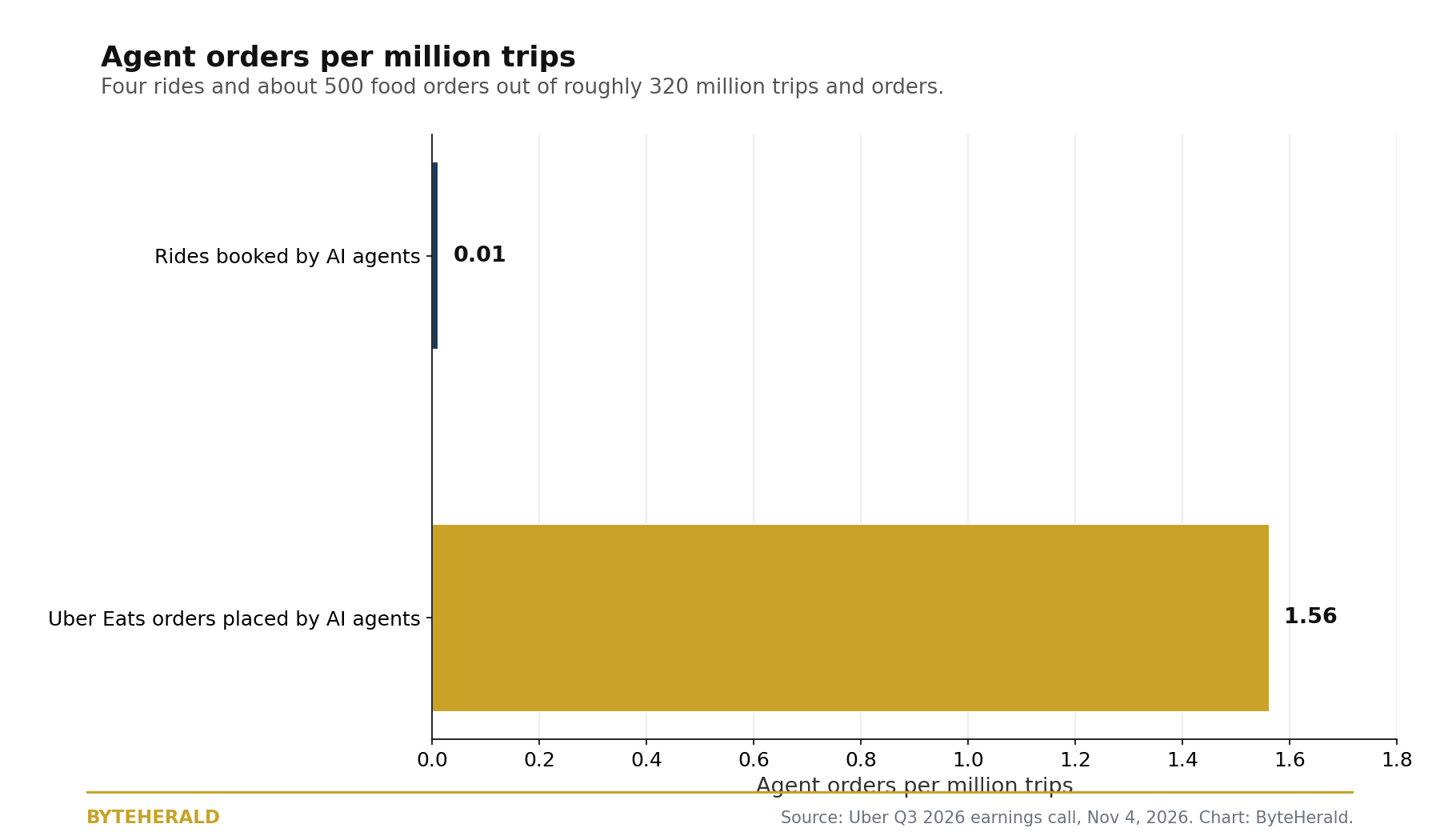
On November 4, 2026, Uber told Wall Street a number nobody expected it to say out loud. In its busiest week of October, the week of Halloween, AI agents booked four rides. Four. Not four thousand, not four million. Four rides, out of roughly 320 million trips and orders Uber and Uber Eats handled that week. The same week, agents placed about 500 Uber Eats orders. Chief financial officer Balaji Krishnamurthy gave the numbers on the third-quarter earnings call, and chief executive Dara Khosrowshahi described the result plainly: "very, very early and very limited traction." It was the first time Uber has broken out how much of its business comes from third-party AI agents, and the answer is the clearest measurement yet of how far agentic commerce is from everyday behavior.
The numbers, and the math behind them
The raw figures are small enough to hold in one hand. Four agent-booked rides. About 500 agent-placed food orders. Roughly 320 million trips and orders in total across Uber and Uber Eats in the same week. The shares that follow are ByteHerald arithmetic, computed from the figures Uber disclosed. Four rides out of 320 million is one ride in 80 million, or 0.00000125 percent of the week's volume. Five hundred food orders out of 320 million is one order in 640,000, or about 0.00016 percent. Put together, agents placed 504 orders out of 320 million, or about one in every 635,000.
The comparison inside the numbers is the interesting part. Food orders through agents ran 125 times the ride count, 500 against 4, even though rides are the larger business. That gap has a plausible reason, and Uber's chief executive supplied it on the same call: booking a ride in the company's app takes an average of 50 seconds, and re-ordering a favorite meal takes roughly 90 seconds. There is very little friction for an agent to remove, and an agent that has to ask, confirm, and pay is doing more work than the app it replaces.
DoorDash says the same thing
Uber is not alone in the count. DoorDash said on its earnings call last week that it has received only a few hundred orders from AI agents so far, with most customers still ordering through its app. Two marketplaces, the same answer: the agents exist, the capability exists, and almost nobody is using them to buy anything yet.
That matters because the agentic commerce story has been told the other way for a year. Assistants that book, order, and pay on a user's behalf were supposed to be the next checkout, and the infrastructure to take their money has been built ahead of them: universal carts, agent checkouts, and payment rails for software buyers. Uber's disclosure is the first hard count of what that infrastructure is actually carrying, and the count is four rides in the busiest week of the year. The quarter around it was not weak: Uber's gross bookings reached $59.8 billion in the third quarter, up 20 percent year over year, on revenue of $14.8 billion, according to the earnings release filed with the Securities and Exchange Commission. The agents are not failing because the business is failing. They are failing to show up in a business that is growing.
| Uber, week of Halloween 2026 | Volume | Share of the week |
|---|---|---|
| Total trips and orders | About 320 million | 100 percent |
| Uber Eats orders placed by AI agents | About 500 | About 1 in 640,000 |
| Rides booked by AI agents | 4 | About 1 in 80,000,000 |
| All agent-placed orders | About 504 | About 1 in 635,000 |
What agentic commerce is, and why the count is low
Agentic commerce is the name for software buying things on a user's behalf: an assistant that books the ride, orders the food, or pays the bill, instead of the user opening an app and doing it. The pitch is convenience. The problem, visible in Uber's numbers, is that the convenience has to beat an app that already takes 50 seconds to book a ride. An agent that needs permission, confirmation, and a payment method for a 50-second job is not saving time. It is adding steps, and the user can see the steps.
There is a second reason, and Khosrowshahi named it too. Uber is now negotiating terms with the companies that build assistants, and it wants to avoid depending on any single one. That is the platform side of the same count: the marketplaces have not yet decided what an agent is allowed to do on their systems, what it pays for access, or who is liable when it books the wrong thing. Until those terms are settled, the agents stay in the experimental budget, and the counts stay in the hundreds.
What would change the count
Three things would show up in the numbers before anything else. First, a task where the agent is actually faster than the app, not merely able to do the job: a multi-stop trip, a group order, a booking that needs checking across services. Second, a marketplace that treats agent bookings as first-class, with terms and liability settled, so the assistant companies can invest in the flow. Third, a count that grows week over week in the same disclosure, because a single week of four rides is a baseline, not a verdict. Uber's chief executive said he expects adoption to grow, and the next earnings call is where that expectation gets its first test.
The money question sits underneath the count. Our map of the agentic commerce money trail worked out who gets paid at each layer when an agent buys something, from the cart to the card rails to the missing agent cut. The fee stack only matters if anyone uses it, and Uber's four rides are the first measurement of how little of it is being used. The infrastructure is built. The customers have not arrived.
By ByteHerald Staff. TechCrunch, November 4, 2026, reported that Uber disclosed on its third-quarter earnings call that AI agents booked four rides and about 500 Uber Eats orders during the week of Halloween, out of roughly 320 million trips and orders, with chief financial officer Balaji Krishnamurthy giving the figures and chief executive Dara Khosrowshahi calling the traction very, very early and very limited. TechCrunch also reported that DoorDash said on its earnings call the prior week that it has received only a few hundred orders from AI agents, and that Khosrowshahi noted booking a ride takes an average of 50 seconds in Uber's app while re-ordering a favorite meal takes roughly 90 seconds. Uber's third-quarter 2026 earnings release, filed with the Securities and Exchange Commission, reported gross bookings of $59.8 billion, up 20 percent year over year, on revenue of $14.8 billion.
Comments
Post a Comment