A Google researcher said this week that a team of 48 AI agents had found a previously unmapped Maya site in Mexico. Within days, archaeologists showed the site had already been published in a 2025 academic paper, and the researcher revised his claim from a discovery to a rediscovery. The episode is a small story with a large lesson in it: an AI system can find a pattern in data and still be wrong about what it found, because finding is not the same as knowing.
The claim
Pietro Miotti, a researcher at Google, said he used a team of 48 AI agents to comb NASA lidar data for signs of undocumented Maya sites. Lidar is a laser-based mapping technology that produces detailed three-dimensional images of the environment, and it can see through dense rainforest canopy to the ground below. Miotti said the idea came to him while traveling in Peru, and that he shifted his focus to the Maya region because Peru is not well covered by public lidar data. He described the work to The Verge as a personal side project, done without any Google compute or resources.
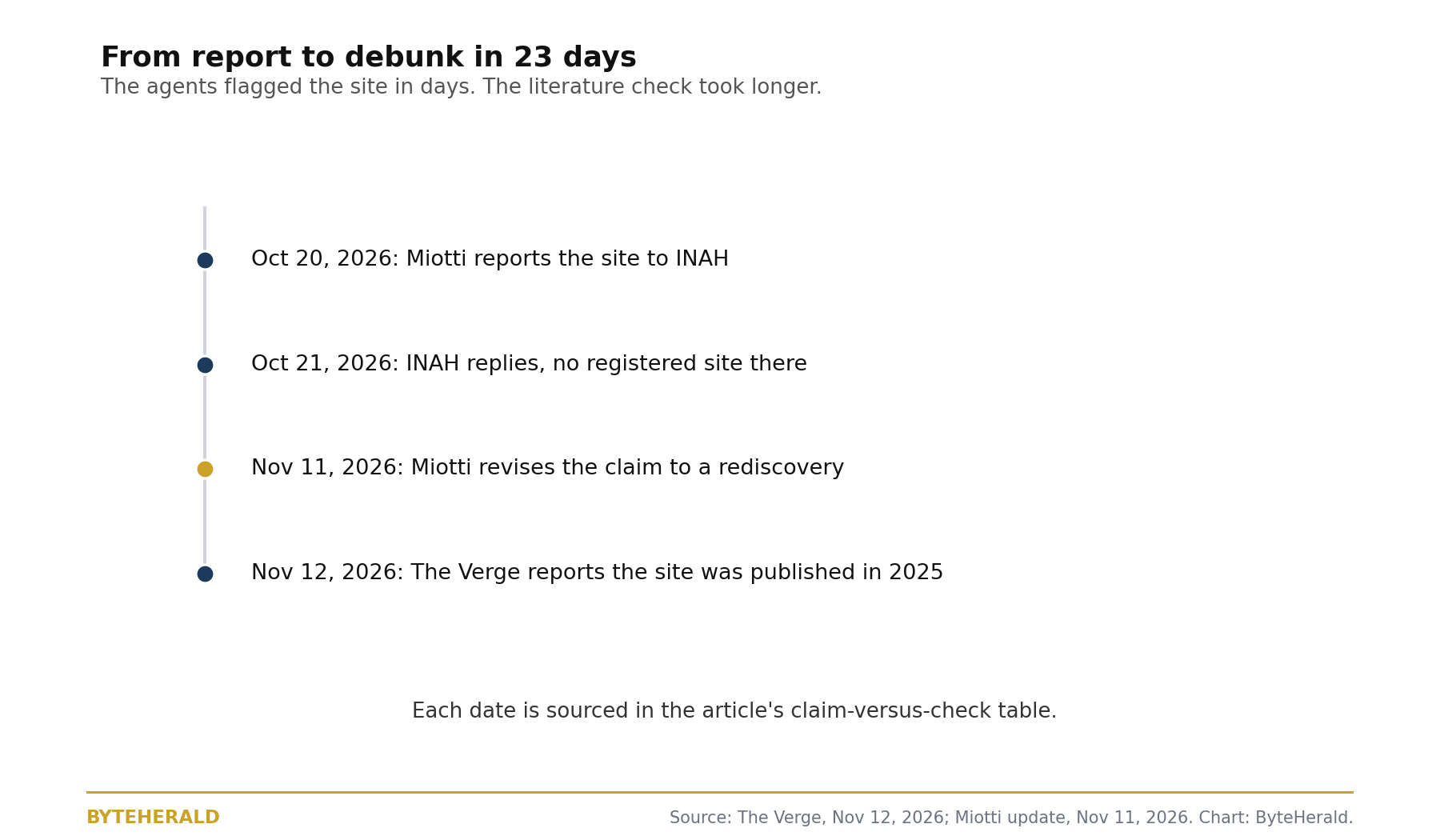
The agents flagged several promising locations, including what Miotti described as "one major village [that] doesn't seem to have been registered" in existing records. On his blog he wrote: "I woke up and checked the agents' reports. 'DAMN!' They had found lots of villages and other regular shapes that looked like structures or houses." He contacted Mexico's National Institute of Anthropology and History, known as INAH, using the agents to translate his correspondence into Spanish, and asked whether the site was already known. He sent the report on October 20. On October 21, INAH replied that it had no record of a registered site at that location. Miotti took that as confirmation. "It took less than 72 hours to go from a random thought while traveling to an official reply from the Mexican government," he wrote.
The check
The check took less time than the claim. Archaeologists pointed out on social media that the site had already been documented in an academic journal more than a year earlier, in a 2025 paper by Francisco Estrada-Belli, Marcello A. Canuto, Ivan Sprajc, and Juan Carlos Fernandez-Diaz. That paper analyzed NASA lidar covering 95,000 square kilometers of Central America and suggested the ancient Maya population may have peaked above 16 million people. The site Miotti's agents flagged was in it.
| What was claimed | What the check found |
|---|---|
| 48 AI agents found a previously unmapped Maya site | The site was already documented in a 2025 paper by Estrada-Belli, Canuto, Sprajc, and Fernandez-Diaz |
| INAH had no record of a registered site there | A site's absence from a government registry does not mean it is unknown or unmapped |
| The agents found a major village, a pyramid 8 to 12 meters tall, and a possible reservoir | The features are speculative interpretations of lidar shapes; no fieldwork has confirmed them |
| The discovery was ready to announce | The claimed match to the 2025 paper is unverified, because the exact coordinates were kept in a confidential annex |
Sarah Parcak, a professor of archaeology at the University of Alabama at Birmingham, called the claim out on Bluesky: "This is why we have peer review." She noted that a site's absence from a Mexican government database does not mean it is unknown or unmapped. Ivan Sprajc, a professor of archaeology in Ljubljana and a coauthor of the paper that documented the site, said he was not particularly impressed by the agents' work, and that "just spotting something does not add much to our knowledge." Elizabeth Graham, a professor of Mesoamerican archaeology at University College London, told The Verge: "Our 'problem' is not discovering new sites."
Miotti revised the claim on November 11. "The agents missed it while going through the literature, so they rediscovered it rather than discovered it," he wrote. The agents had reviewed images made from lidar strips covering about 1,200 square kilometers, and he had used no specialized archaeological classifier. He also acknowledged the limitation that had tripped him up: archaeologists generally do not publish site coordinates, so checking whether a site is known requires matching images to the figures printed in papers, which is hard for agents to do. He said expert knowledge "is needed to verify what the agents find."
What the agents actually did
It is worth saying plainly what the agents did well, because the debunk does not make the tool useless. Lidar data is enormous, and screening it by hand takes months. The agents scanned 1,200 square kilometers of it and returned a shortlist of shapes that looked like structures, including a hilltop with features Miotti interpreted as a plaza, an oval pyramid, and a raised courtyard. That is real work, and it is the kind of work AI is good at: fast, tireless triage of a large pile of data. The failure was not in the scanning. It was in the step after the scanning, the step where a human expert would have asked whether anyone had already published this place, and would have known where to look.
The verification step Miotti used was thin in a specific way. He asked a government registry whether a site was registered, and treated a negative answer as proof that the site was unknown. But a registry records what has been registered, not what has been mapped, and archaeologists do not publish coordinates, so the absence of a registry entry says nothing about the published literature. The 2025 paper was in the literature. The agents were asked to go through the literature and missed it. That is the whole story in one sentence: the system that was supposed to check the work could not check its own work.
The pattern is familiar to anyone who follows AI science claims, and it is why verification has to be a separate step from generation. Our verification ledger for OpenAI's three claimed science breakthroughs used the same test: public artifacts first, then the claim. A formal proof that anyone can run, a dataset anyone can download, a paper anyone can read. The Maya claim failed that test at the first step, because the check that mattered was a paper the agents had already been asked to find.
Why it matters beyond one site
Several archaeologists warned that unverified AI discovery claims could become a flood that shifts the verification burden onto them, and that publicizing locations could attract looters. Both warnings are about scale. One researcher with 48 agents can produce in three days a claim that takes a specialist days to check, and the specialist has to do it for free, in public, against a viral post. If ten researchers do it, the field spends its time correcting claims instead of doing archaeology. And a site location, once public, cannot be made private again.
There is also a quieter point, which is that the archaeologists were not dismissing the tool. They were dismissing the announcement. Lidar plus AI screening is how the field now finds sites under canopy, and the 2025 paper itself used NASA lidar to map 95,000 square kilometers. The difference between that paper and Miotti's claim is the boring part: the literature review, the peer review, the fieldwork, and the willingness to say "candidate site" instead of "discovery." Miotti's own revision gets this right. The agents rediscovered a place that was already known, and the honest name for that is a useful screening run, not a discovery. The next person who runs 48 agents over lidar data should start by reading the 2025 paper, and should keep the coordinates private until a specialist has looked.
By ByteHerald Staff. The Verge reported on November 11, 2026, that Google researcher Pietro Miotti said he used 48 AI agents to identify a potentially unmapped Maya site in Mexico, and its follow-up reported that the site had already been documented in an academic journal more than a year earlier. Miotti sent a report to Mexico's National Institute of Anthropology and History on October 20, 2026, and received a reply on October 21 saying no registered archaeological site was identified at the location. Sarah Parcak, a professor of archaeology at the University of Alabama at Birmingham, wrote on Bluesky that a site's absence from a government database does not mean it is unknown or unmapped. Ivan Sprajc, a coauthor of the 2025 paper that documented the site, said spotting something does not add much to knowledge. Elizabeth Graham, a professor of Mesoamerican archaeology at University College London, said discovering new sites is not the field's problem. Miotti wrote on November 11, 2026, that the agents missed the earlier research while going through the literature and rediscovered the site rather than discovering it. The 2025 paper was written by Francisco Estrada-Belli, Marcello A. Canuto, Ivan Sprajc, and Juan Carlos Fernandez-Diaz, and analyzed NASA lidar covering 95,000 square kilometers of Central America.
Comments
Post a Comment