After the Nvidia spy scandal forced out Jensen Huang, Congress is moving to tighten China's access to American AI chips, and the vehicle is the annual defense bill. Lawmakers are pressing to attach four bills, each closing one route by which advanced chips reach China, to the fiscal 2027 National Defense Authorization Act. Three of the four are in the Senate's version; the fourth is drawing renewed interest but is not in the package. None is law yet. One similar bill already died this way, passing the Senate in 2025 and vanishing from the final text that December. The next four weeks decide whether these four share its fate.
The four bills, side by side
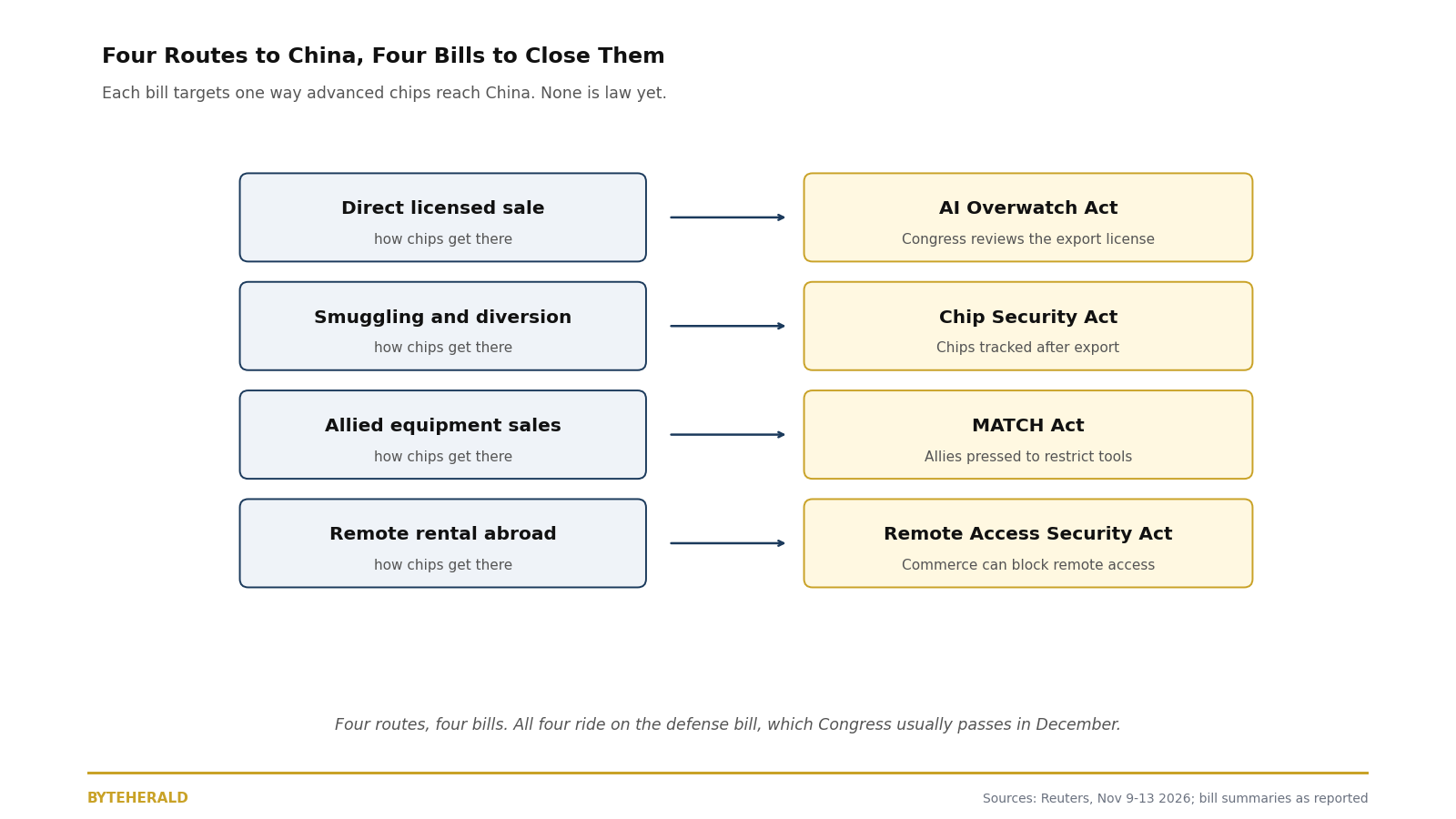
The four measures do different jobs, and that is the point of the push: each one targets a different route. The AI Overwatch Act would give Congress power over advanced chip exports. The Chip Security Act would require companies to track the location of advanced AI processors to prevent smuggling. The MATCH Act would pressure United States allies to restrict sales and maintenance of advanced chipmaking equipment destined for China. The Remote Access Security Act would give the Commerce Department the tools to stop Chinese firms from renting overseas data centers to access Nvidia chips.
| Bill | What it changes | Route it targets | Status | Opposition |
| AI Overwatch Act | Congress gains power over advanced chip exports | Direct licensed sale | In Senate defense-bill package; House Foreign Affairs advanced it earlier in 2026 | Nvidia opposes |
| Chip Security Act | Companies must track chip locations | Smuggling and diversion | In Senate defense-bill package; House Foreign Affairs advanced it earlier in 2026 | Nvidia opposes |
| MATCH Act | Allies pressed to restrict chipmaking equipment | Allied equipment sales | In Senate defense-bill package; House Foreign Affairs advanced it earlier in 2026 | Not stated in reporting |
| Remote Access Security Act | Commerce can stop remote rentals | Remote rental abroad | Not in the Senate package; House bill from April 2025, stalled in the Senate, renewed interest in November | Not stated in reporting |
The package is bipartisan in a way few technology bills are. Senators Elizabeth Warren, a Democrat from Massachusetts, and Jim Banks, a Republican from Indiana, asked Congress in a joint statement on November 9 to pass the AI Overwatch Act inside the defense bill. Senate Democratic Leader Chuck Schumer called for passage of the three measures the next day. House China Committee Chairman John Moolenaar, a Republican, said restrictions on chip exports should be included in the annual military spending bill. And House Speaker Mike Johnson, a Republican, said on November 12 that "there's a developing consensus in Congress" on limiting chip exports.
The fifth idea: freeze the chip rules
Separate from the four bills, Senators Banks and Warren are pressing for an 18-month freeze on the rules governing which Nvidia chips may be sold to China, building on an earlier proposal for a two-generation limit that would keep Chinese buyers behind America's newest processors. The two senators said in their joint statement that the Huang affair "makes these national security concerns even more urgent," and in March they urged the Commerce Department to suspend or reconsider Nvidia's export licenses to China and conduct a full security review. The H200 is the chip at the center of the current argument: President Trump let Nvidia sell it in China in December 2025, with 25 percent of sales going to the United States government, and the licenses require each chip to pass through United States territory for third-party inspection before re-export, terms formalized in January. An 18-month freeze on the sales rules is a blunter instrument than the four bills, and it is the one Nvidia would feel first.
The calendar is the real opponent
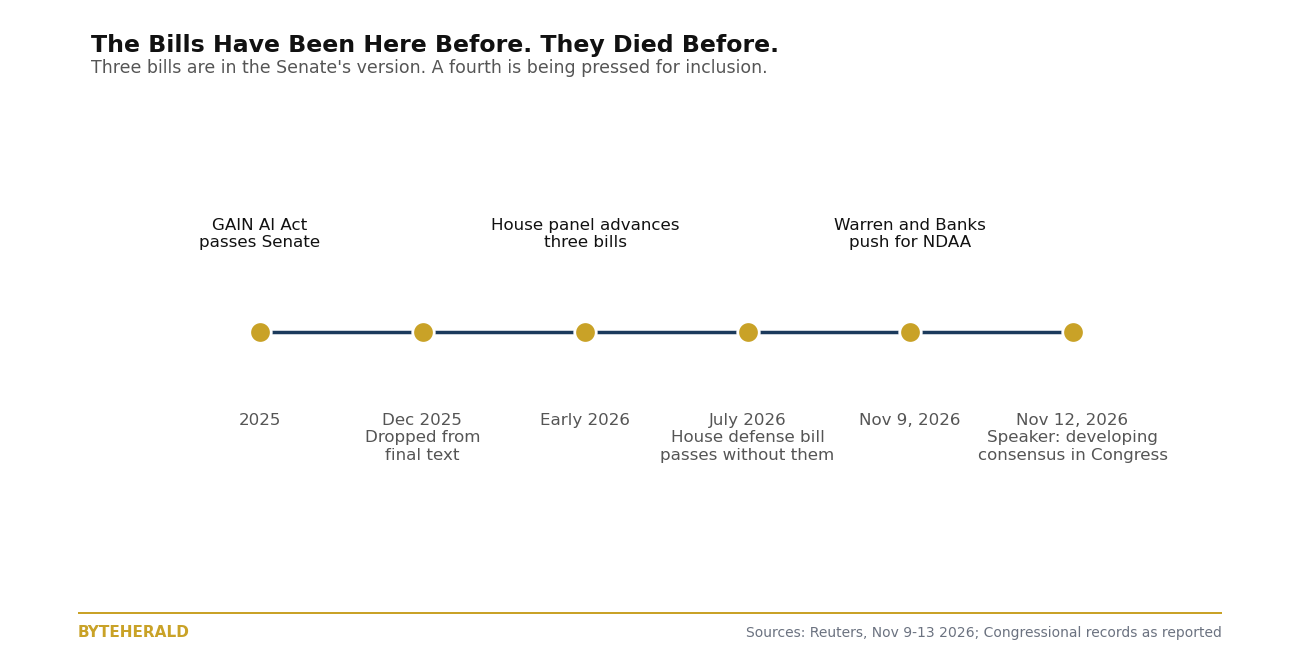
The bills ride on the National Defense Authorization Act, the annual defense bill, because it is a must-pass measure that funds the military and typically attracts bipartisan support. The House version, passed in July, does not include them. The Senate has not passed its version. Government funding runs out on December 11. The House plans to stop work for the year on December 17 and the Senate a day later, and Congress usually passes the defense bill in December. That leaves roughly a month from the November push to a final text, and the same vehicle has killed a similar bill before: the GAIN AI Act passed the Senate in 2025 and was dropped from the final text that December. There is a second complication the reporting barely notes. Democrats won both chambers in the November 3 midterm and take over in January, so the bill is being negotiated by a lame-duck Congress. A veto would need two-thirds majorities in both chambers to override, and the White House has not taken a separate position on the measures. The key to passage, the reporting agrees, is whether the White House backs the effort.
Why this time might be different
Three things favor the bills. First, the sponsorship is bipartisan in both directions, from Warren and Banks to Schumer, Moolenaar and Johnson. Second, the scandal gave the bills a deadline: Huang is expected to testify before Congress before Thanksgiving, which falls on November 26, and House Foreign Affairs Chairman Brian Mast said congressional staff spoke with Nvidia on the Wednesday night before about a date and location. Third, the route the Remote Access Security Act targets is already in use: Reuters reported that Chinese AI companies are trying to rent Nvidia-powered computing capacity outside China because they worry the Huang allegations could spur Washington to tighten restrictions on remote access. The smuggling ledger we published on November 12 lists five charged diversion cases worth about 3.02 billion dollars; the Chip Security Act's location tracking is aimed at the cases that never get charged. Our map of every AI export control shows the controls as written; these four bills are the attempt to close the routes the map leaves open. The Lutnick rule the midday run covered is the executive-branch version of the same fight, a narrower rule with notifications where Congress wants licenses and tracking.
How to read the December outcome
Three questions decide whether the package worked. First, did the Senate's final defense bill include all four bills in its text? Second, did the conference version, the merged House and Senate text, keep them? Third, did the White House sign the bill, or veto it and force Congress to find two-thirds? A bill that survives all three is law. A bill that falls at any step joins the GAIN AI Act in the record of export-control ideas that came close. The testimony before Thanksgiving is the first public marker: what Huang says under oath about the relationship and the chips will set the tone for the lame-duck negotiation that follows. Until then, the four bills are a push with a vehicle, a deadline, and a precedent that says vehicles do not guarantee arrival.
By ByteHerald Staff. Reuters reported on November 13, 2026, via the Korea Times, that House Speaker Mike Johnson said on November 12 there was growing consensus in Congress on limiting chip exports to China, that lawmakers are pressing to pass at least four bills on chip exports, that the AI Overwatch Act would give Congress more power over advanced chip exports, the Chip Security Act would require companies to track chip locations, the Match Act would pressure allies over chipmaking equipment, and the Remote Access Security Act would give the Commerce Department tools to stop Chinese firms renting overseas data centers, and that Jensen Huang is expected to testify before Congress before Thanksgiving on November 26. Reuters reported on November 9, 2026, via the Chosun Ilbo, that the controversy around Huang increased the chances an export-control bill would pass Congress, that lawmakers are considering folding three related bills into the fiscal 2027 National Defense Authorization Act, that Nvidia opposes the AI Overwatch Act and the Chip Security Act, and that the White House has not taken a separate position. Reuters reported on November 10, 2026, via BusinessWorld, that Senate Democratic Leader Chuck Schumer called on Congress to pass the three measures, that House China Committee Chairman John Moolenaar said restrictions should be included in the annual military spending bill, and that Nvidia won approval to sell the H200 in China with 25 percent of sales going to the United States government. Readhunch reported on November 10, 2026, that the GAIN AI Act passed the Senate in 2025 and was dropped from the final text in December, that government funding runs out on December 11, that the House plans to stop work on December 17 and the Senate a day later, and that the House version of the defense bill passed in July does not include the bills. Asia Daily reported on November 16, 2026, that the Chip Security Act, the MATCH Act and the AI Overwatch Act have entered the Senate's fiscal 2027 defense bill negotiations, that Senators Banks and Warren are pressing for an 18-month freeze on the rules governing which Nvidia chips may be sold to China, building on an earlier two-generation limit proposal, and that the Remote Access Security Act was first introduced in the House in April 2025 and subsequently stalled in the Senate.
Comments
Post a Comment