Commerce Secretary Howard Lutnick is pushing a narrower version of the United States' AI chip export rules, and the data centers the narrower version would spare include clients of Cantor Fitzgerald, the financial firm he ran for decades before joining the Trump administration and which his sons now run, according to a New York Times investigation published on November 15, 2026. The Times found no evidence that Cantor's business influenced Lutnick's decisions, and the Commerce Department says he has complied with all ethics agreements. The overlap is the story anyway, because Lutnick is the official writing the rules that decide whether those data centers keep renting American chips to Chinese companies.
What the narrower rule would do
The United States bans direct sales of its most advanced AI chips to Chinese firms. It does not ban Chinese companies from renting the computing power of those chips in data centers located in other countries, and that gap is what the new rule is about. Inside the administration, China hawks want the rule to cover the whole world. Lutnick has been pushing the narrower version, according to the Times, and the difference between the two versions is the difference between a rule with teeth and a rule with a map of the holes.
| Part of the rule | Lutnick's narrower version | What the hawks want |
| Countries covered | Seven: Singapore, Malaysia, Thailand, Indonesia, Brazil, South Africa, Norway | Global coverage |
| Existing data centers | Exempt; only future chip shipments covered | Covered, not exempted |
| Chinese customers training AI models | Operators notify the US government | Operators obtain a license first |
| Effect on Nvidia's Asian sales | Smaller cut; rental business continues | Larger cut; rental route narrowed |
The proposal was first reported by The Information, according to the Times' account, and the details above come from people familiar with the deliberations as reported by the Times and by Seeking Alpha. A Commerce Department spokeswoman told the Times that Lutnick makes policy decisions based on the best interests of the United States, that he does not discuss departmental matters with his sons, and that they do not discuss Cantor Fitzgerald business with him.
The data center at the center of it
The Times' investigation centers on a data center called A201, in Johor in southern Malaysia, which is set to open next year packed with hundreds of millions of dollars in Nvidia's most advanced AI servers. The center is run by Bitdeer, a Singaporean firm, and will likely serve Tencent, the Chinese internet giant, according to a person with knowledge of the arrangement cited by the Times. The setup is legal and profitable, and it sidesteps the American rules that ban sales of the most advanced chips directly to Chinese firms, because renting computing power from a third country is not a sale.
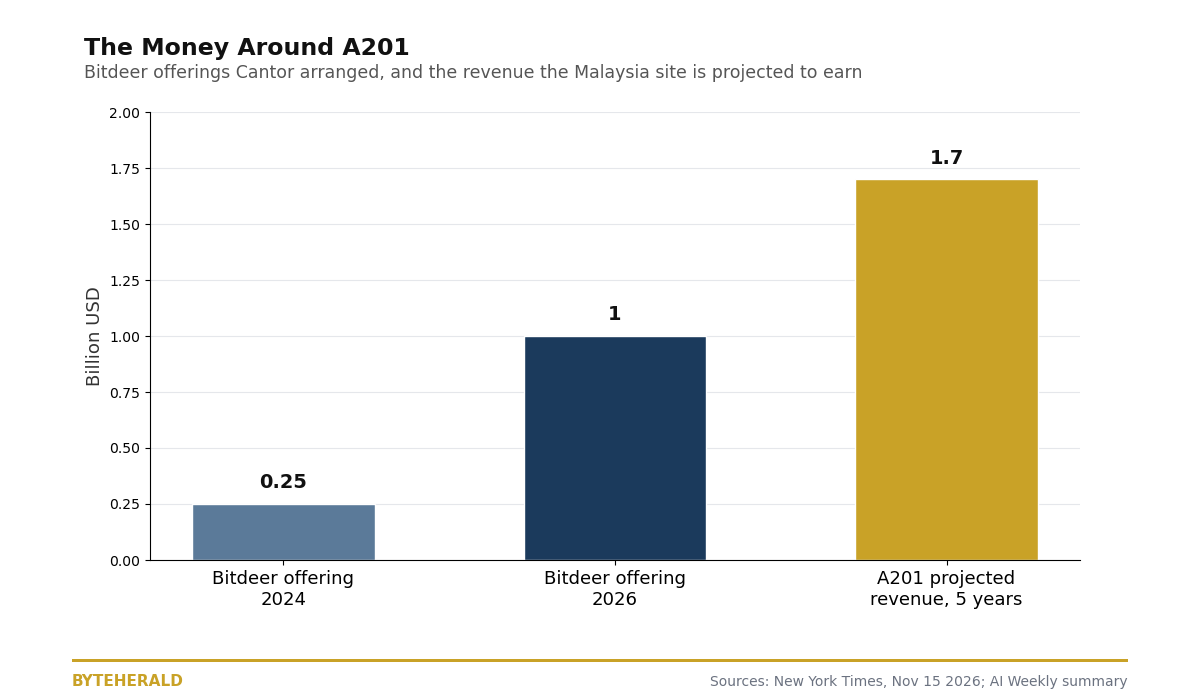
Cantor Fitzgerald served as a designated sales agent for an equity offering of up to 1 billion dollars by Bitdeer this year, and helped arrange a stock offering of up to 250 million dollars in 2024, the Times found. The site is projected to generate 1.7 billion dollars in revenue over five years, according to coverage of the Times investigation. Cantor also holds a stake in Bitdeer through its investment in the crypto company Tether, according to the same coverage. Lutnick steered Cantor Fitzgerald for decades before recusing himself when he joined the Trump administration last year, and he transferred his remaining ownership stake in Cantor to his family as of October 2025.
What the Times did and did not find
The finding that matters most is the one the Times states plainly: there is no evidence that Cantor's investments influenced Lutnick's deliberations. That is also the direct answer to the question people ask first about Lutnick, what he has been accused of: nothing. The investigation documents an overlap, not a wrongdoing. That sentence has to stay attached to every other sentence in this story, because without it the overlap reads as a conclusion the reporting does not support. What the reporting does establish is the overlap itself: the official writing the rules has a family firm with business ties to the data centers the rules would affect, the firm is run by his sons, and the version of the rules he favors is the version that leaves those data centers the most room. The Commerce Department's position is that the ethics agreements cover this, and that Lutnick has complied with them.
The timing adds pressure from a second direction. The report lands in the middle of the Nvidia scandal, days after Jensen Huang's resignation, with Democrats already investigating how the administration handled Nvidia's H200 chip sales to China, an inquiry our November 12 report covered in full, and with Huang expected to testify before Congress before Thanksgiving. Senator Tim Scott has asked both Huang and Lutnick to testify before the Senate Banking Committee. Lutnick's rule is not the only chip question in Washington this month, and it is now the one with his name on it twice: as the author, and as the former head of the firm whose clients it spares.
How the rental loophole works
The mechanism behind A201 is simple enough to state in one sentence, and it is the reason this rule fight matters more than most export-control debates. American law controls where a chip is sold, not where its computing power is rented. A Chinese company cannot buy Nvidia's most advanced chips, but it can rent time on them in a data center in Malaysia, and the data center's operator can buy the chips legally because the operator is not in China. Our map of every AI export control shows the controls as written; A201 shows the route around them that the controls never covered. Lutnick's narrower rule would put a notification requirement on that route for seven countries and leave the rest of the world, and every data center already built, untouched.
What happens next is a decision inside the administration, not a vote. The hawks want a global rule with licenses; Lutnick wants a seven-country rule with notifications. The version that wins decides whether the A201 model, renting top American chips to Chinese customers from a third country, stays a legal business or becomes a licensed one. The Huang exit audit listed the chip questions Congress is already asking; this rule is the one the Commerce Department will answer first.
By ByteHerald Staff. The New York Times reported on November 15, 2026, in an investigation by Ana Swanson, Aaron Krolik and Paul Mozur, that Commerce Secretary Howard Lutnick has pushed for a less stringent version of US controls on advanced AI chips sold to overseas data centers, that the data center A201 in Johor, Malaysia, run by Bitdeer, is set to open next year with hundreds of millions of dollars in Nvidia servers and will likely serve Tencent, that Cantor Fitzgerald served as a designated sales agent for a Bitdeer equity offering of up to 1 billion dollars this year and a stock offering of up to 250 million dollars in 2024, and that the Times found no evidence Cantor's business influenced Lutnick's decisions. Seeking Alpha reported on November 15, 2026, that the Commerce Department proposal would cover seven countries, Singapore, Malaysia, Thailand, Indonesia, Brazil, South Africa and Norway, apply only to future chip shipments, and require notification rather than an automatic license when Chinese customers use overseas facilities to train AI models. AI Weekly reported on November 15, 2026, in its account of the Times investigation, that A201 is projected to generate 1.7 billion dollars in revenue over five years and that Cantor holds a stake in Bitdeer through its investment in Tether.
Comments
Post a Comment