Senator Ron Wyden and Representative Richard Neal opened a formal investigation on Thursday, November 12, 2026, into how the Trump administration approved sales of Nvidia's H200 artificial intelligence chips to China, calling the arrangement a scheme to approve and tax exports to Chinese companies with ties to the Chinese government, military, and sanctioned entities. Wyden, the top Democrat on the Senate Finance Committee, and Neal, the top Democrat on the House Ways and Means Committee, wrote to Commerce Secretary Howard Lutnick asking him to preserve every record behind the decision, the same day Jensen Huang resigned as Nvidia's chief executive and a day after a second pair of Democratic senators made a parallel preservation demand. The inquiry is the second congressional investigation into Nvidia's China sales since reports of an alleged Chinese intelligence operation involving Huang broke, and it lands the same day a Republican senator demanded a Chinese memory maker be blacklisted, which means the Commerce Department now faces pressure from both parties over the same set of chip sales.
The scheme, as the letter describes it
The Wyden-Neal letter lays out the arrangement in a single paragraph, and it is worth quoting the mechanics rather than paraphrasing them, because the legal question turns on the sequence. President Donald Trump, the letter says, would allow Nvidia to sell its Taiwan-manufactured H200 chips to companies in China, provided that those chips be sent to the United States to undergo a security review and receive an export license before being re-exported to China. Trump then used Section 232 authority, a statute written to let the president act against imports that threaten national security, to impose a 25 percent tariff to be collected when the chips entered the United States, effectively taking a cut of Nvidia's sales to China through what the letter calls an unconstitutional export tax system. The Commerce Department would then grant Nvidia export licenses so the chips could be sold to Chinese companies.
Two parts of that story were already public. In August 2025, Nvidia and AMD agreed to share 15 percent of their revenue from chip sales to China with the United States government as part of a deal to secure export licenses, the Associated Press reported at the time. And the letter says Trump granted Nvidia permission to sell the H200 chips to China in December 2025 in exchange for a cut of the export sales. What the letter adds is the allegation that the approval came after Trump learned of Huang's compromised position, and after Nvidia directed at least $26 million toward Trump's personal priorities, including the White House ballroom, and it asks whether political considerations improperly influenced the decision. The letter does not prove that connection; it asks Lutnick to preserve the records that would show it, including the Section 232 report the letter says was allegedly transmitted to the president on December 22, 2025, and it notes that federal law punishes destroying records relevant to a congressional investigation with fines and imprisonment of up to five years under one statute and up to 20 years under another.
The letter also questions the vetting behind the approvals. It says the Commerce Department approved sales to Chinese companies with government and military ties, including Chinese cutout companies with no physical presence at their listed addresses, and it says the department suspended, after outreach from Nvidia, a separate investigation into Megaspeed, the Singapore-based Nvidia customer that United States officials suspect of helping route advanced chips into China. Megaspeed is the company at the center of the charged smuggling cases in our ledger, and the letter cites reporting that Megaspeed's executive Alice Huang, who United States intelligence officials identified as a Chinese intelligence asset, was in a close relationship with Jensen Huang and was funneling information to the Chinese government. Huang has not been charged with any crime, and the letter's claims about the relationship rest on press reports, which it cites, not on findings of its own.
Three letters in two days
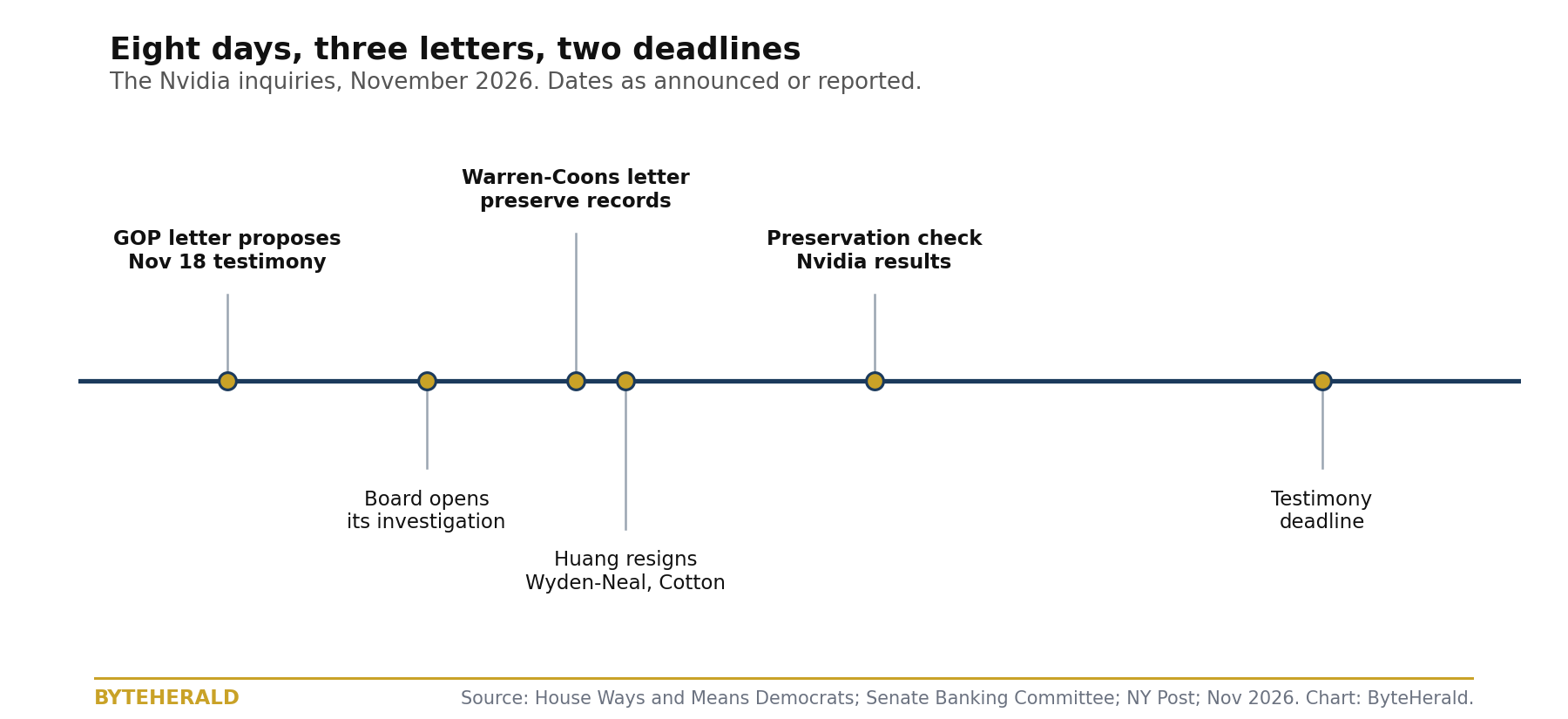
The Wyden-Neal letter was the third congressional letter on Nvidia's China sales in two days, and the three together show how the pressure is organized. The first came on Wednesday, November 11, from Senators Elizabeth Warren and Chris Coons, who wrote to Lutnick, Secretary of State Marco Rubio, and White House Chief of Staff Stephen Miller directing them to preserve all documents, communications, and records related to Nvidia's exports of advanced AI chips to China and the reported intelligence operation. Warren is the ranking Democrat on the Senate Banking Committee and Coons is the ranking Democrat on the East Asia, Pacific, and International Cybersecurity Policy Subcommittee, and their letter asks for written confirmation by Tuesday, November 17, that preservation directives have been issued, plus a briefing for Congress on the national security risks. Their letter states that Megaspeed has purchased more than $4.8 billion in advanced Nvidia chips since June 2024.
| Letter | Date | Who sent it | What it asks for |
| Warren-Coons preservation demand | Nov 11, 2026 | Sens. Warren (D-Mass.) and Coons (D-Del.) | Preserve all Nvidia chip-export records; confirm by Nov 17; brief Congress on risks |
| Wyden-Neal investigation | Nov 12, 2026 | Sen. Wyden (D-Ore.) and Rep. Neal (D-Mass.) | Investigate the H200 approval-and-tariff scheme; preserve Section 232 and license records |
| Cotton CXMT letter | Nov 12, 2026 | Sen. Cotton (R-Ark.) | Add ChangXin Memory Technologies to the Entity List; explore banning its products in America |
| Republican testimony demand | Nov 4 letter; agreement Nov 12 | House Foreign Affairs, Select Committee on China, Intelligence | Huang to testify in a closed briefing before Thanksgiving, Nov 26 |
| Board investigation probe | Nov 8, 2026 | Nvidia board | Whether secrets were compromised; led to Huang's resignation on Nov 12 |
| Justice Department probe | Reported Oct 28, 2026 | US Department of Justice | Whether Nvidia's $12.93 billion Hugging Face acquisition harms competition; an inquiry, not a finding of wrongdoing |
The third letter, from Senator Tom Cotton, an Arkansas Republican who chairs the Senate Intelligence Committee, is the one that shows the pressure is not only Democratic. Cotton wrote to Lutnick on Thursday urging him to add ChangXin Memory Technologies, known as CXMT, to the Commerce Department's Entity List, which would bar most American firms from supplying it without a license, and to explore banning the sale of its products in America. Cotton wrote that CXMT, one of Communist China's national memory chip champions, poses a growing risk to our economic prosperity and military superiority. CXMT is the world's fourth-largest maker of DRAM chips and sits on the Pentagon's list of companies tied to China's military, a designation that carries few restrictions on its own. Lawmakers from both parties have pressed Commerce to blacklist CXMT since early 2025, and Reuters reported on November 12, 2026, that the United States has not posted any additions to the Entity List since October 2025, the longest stretch in more than a decade.
Why Lutnick is the focus
Every letter lands on the same desk because the Commerce Department runs the export controls, and the criticism of Lutnick now comes from both parties for different reasons. The Democrats say the department approved sales it should have blocked and taxed them in a way the Constitution does not allow. The Republicans say the department failed to blacklist the companies it should have restricted. Axios reported on Wednesday, November 11, that Lutnick stalled Trump's crackdown on companies suspected of diverting Nvidia chips to China, and Reuters reported on June that the administration held off adding DeepSeek, CXMT, and more than 100 other companies flagged as national security risks to the trade blacklist. The United States has not posted any additions to the Entity List since October 2025, the longest stretch between new postings in more than a decade.
The White House said on Thursday that Trump continues to back Lutnick, which means the secretary is not being pushed out, but the backing does not answer the letters. The Wyden-Neal letter is an investigation, not a request for a briefing: as the ranking members of the two committees with jurisdiction over taxation and tariffs, Wyden and Neal are asking for the records behind a revenue arrangement they call an export tax, and they are doing it in writing, with a preservation demand attached, on the day the chief executive at the center of the story resigned. The board's own investigation, which opened on Sunday, November 8, ended four days later in a resignation with no stated reason, two days after the Wall Street Journal reported the board was preparing to oust Huang, which leaves the congressional letters as the only public process still asking what happened.
How the tariff argument is supposed to work
The legal argument in the Wyden-Neal letter is narrow, and it is worth stating plainly because it is easy to misread. Section 232 of the Trade Expansion Act of 1962 lets the president restrict imports that threaten national security, and the letter argues Trump used that import power in reverse: the tariff was collected when the chips entered the United States on their way to China, so the government took a cut of an export sale by taxing the chips at the border. The Constitution gives Congress the power to lay taxes, and the letter says the arrangement appears to be an unconstitutional export tax system, which is why the two committees with jurisdiction over taxation and tariffs opened the inquiry. That is an allegation about the structure of the deal, not a finding, and no court has ruled on it.
The export controls themselves work differently from the tariff, and the distinction matters for the Cotton letter. The Entity List is the Commerce Department's main tool for restricting technology transfer: a company on the list needs a license before American firms can sell it anything, and those licenses are routinely denied. Huawei has been on the list since 2019 and SMIC, China's leading chipmaker, since 2020. Adding CXMT would cut a memory maker out of American equipment and technology, which is why the letter frames it as a national security step rather than a trade penalty. The H200 sales, by contrast, were approved under licenses the department itself issued, which is the contrast the Wyden-Neal letter is built on: the same department that approved the sales is now being asked to explain them, and the same week the administration is being pressed to blacklist a company it has left off the list for more than a year.
What happens next
The Wyden-Neal letter sets no deadline of its own, but the calendar around it does the work. Warren and Coons asked for written confirmation that preservation directives have been issued by Tuesday, November 17, and a briefing for Congress on the national security risks. Nvidia reports its third-quarter results on Wednesday, November 19, and the market will be listening for whether the company says anything about the H200 approvals, the Megaspeed investigation, or the board's findings. Huang is due to testify in a closed briefing before Thanksgiving, November 26, under the agreement reached with the House committees, and the testimony is closed, so the public may not learn what he says. The Commerce Department has not said whether it will comply with the preservation demands, and Lutnick has not responded publicly to the Wyden-Neal letter. The investigation is open, the records are the subject, and the next public move belongs to the department that approved the sales.
By ByteHerald Staff. Senator Ron Wyden and Representative Richard Neal opened a formal investigation on November 12, 2026, into Nvidia H200 chip sales to China, calling the arrangement a scheme to approve and tax exports to Chinese companies with ties to the Chinese government, military, and sanctioned entities, and wrote to Commerce Secretary Howard Lutnick asking him to preserve every record behind the decision, according to the letter dated November 12, 2026. Nvidia chief executive Jensen Huang resigned on November 12, 2026, according to reporting on November 12, 2026. Senators Elizabeth Warren and Chris Coons wrote on November 11, 2026, to Lutnick, Secretary of State Marco Rubio, and White House Chief of Staff Stephen Miller, directing them to preserve records related to Nvidia's exports of advanced AI chips to China. Senator Tom Cotton wrote on November 12, 2026, to Lutnick urging him to add ChangXin Memory Technologies to the Entity List and explore banning the sale of its products in America. Reuters reported on November 12, 2026, that the United States has not posted any additions to the Entity List since October 2025, the longest stretch in more than a decade. Axios reported on November 11, 2026, that Lutnick stalled a crackdown on companies suspected of diverting Nvidia chips to China. The Wall Street Journal reported that Nvidia's board was preparing to oust Huang.
Sources: Democrats' Ways and Means Committee letter to Commerce Secretary Howard Lutnick, November 12, 2026; Senators Warren and Coons letter to Lutnick, Rubio, and Miller, November 11, 2026; Senator Tom Cotton letter to Lutnick, November 12, 2026; House Foreign Affairs Committee letter to Nvidia board, November 4, 2026; Reuters reporting on Nvidia's board investigation and Commerce Department Entity List activity; Axios reporting on Commerce Department enforcement; Associated Press reporting on Nvidia and AMD revenue-sharing agreements.
Comments
Post a Comment