Nvidia announced on November 12, 2026, that Jensen Huang has resigned as president, chief executive officer, and a member of the board, effective immediately, ending a 33-year run as the co-founder who built the company into the center of the artificial intelligence trade. Colette Kress, Nvidia's chief financial officer since 2013, takes over as interim chief executive while keeping the finance job, and the board named Harvey C. Jones as its first-ever chair. Nvidia shares fell 12.2 percent in premarket trading, and the selloff spread to the neocloud companies that rent Nvidia chips by the hour, because the market is pricing not just a resignation but a succession with no named heir, five days before earnings.
What Nvidia announced
The announcement is short and gives no reason for the resignation, and it carries no statement from Huang. The board accepted his resignation on Wednesday, November 11, and announced it on Thursday morning. Kress will continue as executive vice president and chief financial officer while serving as interim chief executive until a permanent successor is named, and the board says it is initiating a search that will consider internal and external candidates. Jones, a director since 1993 and a former chief executive and executive chairman of the chip design software company Synopsys, becomes the board's first chair, a role Nvidia had never filled before. Nvidia will report third-quarter fiscal 2027 results on Tuesday, November 17, at about 1:20 p.m. Pacific time, as previously scheduled, followed by the earnings call at 2 p.m. Pacific time.
Kress has run Nvidia's finance organization since joining in September 2013, and before that she spent nearly 25 years in finance roles at Texas Instruments, Microsoft, and Cisco. She is the person who has signed off on the capital plans behind the AI buildout, which is why the board picked continuity over a fresh face for the interim job. The choice also tells you what the board is worried about: not the product roadmap, which the announcement says will continue without interruption, but the five days between now and the earnings call, when the company must face analysts without the chief executive who has fronted every one of those calls for three decades.
The market's verdict
Nvidia closed on Wednesday, November 11, at $173.73, up 2.92 percent on the day. By 9:06 a.m. Eastern on Thursday the shares stood at $155.40 in premarket trading, down 10.55 percent, and StockAnalysis put the premarket fall at 12.2 percent as of 9:16 a.m. Eastern. At the open they traded near $150.99, down 13.09 percent, before recovering to about $160.36, down 7.69 percent. In early trading the shares were down 8.2 percent to a more than 16-month low, with the market value on track to close below $4 trillion for the first time since July 2025. Reuters reported that Nvidia has lost more than $550 billion in market value since the board announced its investigation on Sunday, November 8. Taiwan Semiconductor Manufacturing, which makes Nvidia's chips, fell 5.0 percent, Nasdaq 100 futures were down 1.2 percent, and CNBC counted six analyst downgrades between Wednesday night and Thursday morning.
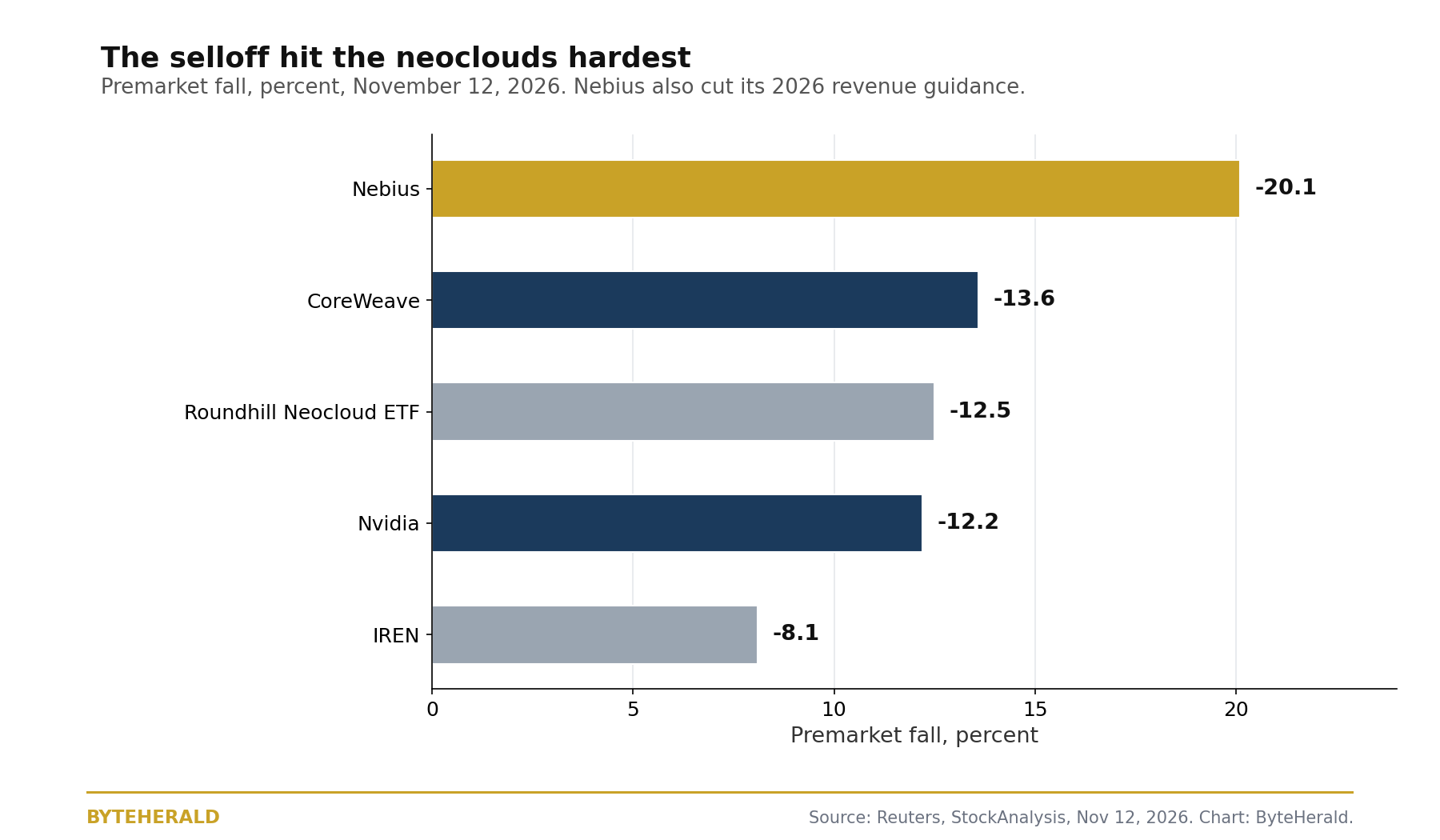
| Stock | Premarket move, Nov 12 | What else was moving it |
| Nebius | -20.1% | Said 2026 revenue would come in at the low end of its previous forecast |
| CoreWeave | -13.6% | Had surged more than 27% in the previous session on earnings |
| Roundhill Neocloud ETF | -12.5% | Basket of AI cloud infrastructure stocks |
| Nvidia | -12.2% | The resignation, plus six analyst downgrades overnight |
| IREN | -8.1% | AI infrastructure peer, no company news |
Read the table with the caveats attached, because two of the five moves are not pure Huang shock. Nebius fell partly on its own guidance, saying 2026 revenue would land at the low end of its forecast, and CoreWeave was giving back part of a 27 percent earnings surge the day before. The cleaner read is the pattern: every company whose business is renting Nvidia-powered compute fell by double digits before the open, and the ETF that bundles them fell 12.5 percent. That is the market treating Nvidia's leadership as the AI trade's single point of failure, which is the same concentration risk we tracked when Nvidia fell 4.3 percent on the market's best day since April. The challenger side of the trade did not benefit: the startups trying to take Nvidia's customers are priced on the same AI spending cycle, as our ledger of 10 chip startups shows, and a leadership crisis at the incumbent reads as a demand shock for the whole sector, not a window for rivals.
Why the board acted
Nvidia's announcement states no reason, so the reason has to be assembled from reporting, and it should be read as reporting. The Wall Street Journal reported on November 11 that the board was preparing to oust Huang, and the New York Times reported the same day on a second extramarital affair, with Kimberly Powell, a Nvidia vice president for health care. Tom's Hardware reported, citing US intelligence, that Huang had a romantic relationship with Alice Huang, a businesswoman alleged to be a Chinese spy, and that she was linked to a company accused of smuggling $2 billion in AI chips. The board opened its investigation on Sunday, November 8, and said at the time it had no reason to believe secrets were compromised. Huang has not been charged with any crime, and the board has not said the resignation is connected to any of these reports. That is the full verified picture: a board that moved from investigation to resignation in four days, without explaining why, and a set of reports that the company has not confirmed. Our follow-up to the Journal's report, published November 11, has the board, governance, and succession details as they stood then, and the resignation changes the ending of that story, not the facts in it.
What happens next
The succession question is now the whole story. Reuters reported that Kress and longtime Nvidia engineer Ian Buck had already emerged as the leading internal candidates among investors and analysts before Huang's departure, and the board says it will consider external candidates too. President Donald Trump weighed in on Thursday, saying former Apple chief executive Tim Cook should take over, in his words, "A legend replaces a legend." The Trump suggestion is not a board process, but it shows how quickly a governance decision at Nvidia becomes a political one, and the board's first chair, Jones, now owns that process in public for the first time. House Speaker Mike Johnson said it was critically important for the right successor to be chosen, and Commerce Secretary Howard Lutnick is facing growing questions, reported by Reuters, over the administration's oversight of chip sales to China.
The other clock running is congressional. Huang has agreed to testify before Congress before the Thanksgiving holiday on November 26, House Foreign Affairs Committee Chairman Brian Mast told reporters on Thursday, after senior lawmakers threatened to subpoena him. The agreement was reached on Wednesday night, hours before the resignation was announced. The session, expected to be a closed-door briefing with three committees, the Foreign Affairs Committee, the Select Committee on China, and the Intelligence Committee, expected to be under oath and recorded, with no final date set and a subpoena still an option if the voluntary appearance falls through. The questioning is expected to cover Huang's reported ties to the alleged Chinese intelligence asset and Nvidia's internal security protocols and export controls. The resignation does not end that scrutiny, and the testimony, not the announcement, is where the public will learn what the board knew and when. Update, November 12: Senators Wyden and Neal have now opened a formal investigation into the H200 sales; our follow-up has the letters, the tariff mechanics, and the probe scoreboard.
How a CEO transition moves a chip stock
A founder-chief executive's exit hits a chip company harder than most, for a reason that has nothing to do with sentiment. Chip companies sell roadmaps years in advance: customers commit to future architectures, data center operators plan power and cooling around specific accelerators, and investors price the stock on the next two product generations. The chief executive is the person who has personally guaranteed those roadmaps in public, so the market discounts the roadmap by the uncertainty of the successor. An interim chief executive can keep operations running and keep the earnings call on schedule, which is what Kress is there to do, but cannot credibly guarantee a roadmap two generations out, which is why the stock fell on the announcement rather than on any change in orders or revenue. The test of that discount comes on November 17, when Nvidia reports and Kress, not Huang, takes the questions. If the numbers and the guidance hold, the discount narrows to the succession question alone. If either wobbles, the market will read it as the roadmap itself being in doubt. That is the substance of the question everyone is asking, whether Nvidia can survive without Huang: the company survives and the roadmap survives, but the premium the stock carried for a founder who personally guaranteed that roadmap does not survive until a permanent successor is named and re-guarantees it in public. The export-control question runs alongside: Reuters reported on November 12 that Chinese AI firms are rushing to rent Nvidia-powered computing capacity outside China, worried the scandal could spur Washington to tighten restrictions on their remote use of advanced processors. The chips keep moving that way, which is why the enforcement record matters to this story: the rules are enforced case by case, and the record of charged smuggling cases, not the announcement, is what decides how much compute actually reaches China. Our smuggling ledger, published with this post, compiles every charged case.
By ByteHerald Staff. Nvidia announced on November 12, 2026, that Jensen Huang resigned as president, chief executive officer, and a member of the board, effective immediately, that Colette Kress, executive vice president and chief financial officer since September 2013, will serve as interim chief executive officer while remaining chief financial officer, and that Harvey C. Jones was appointed as the board's first-ever chair, and the board is initiating a search for a permanent chief executive considering internal and external candidates, with third-quarter fiscal 2027 results on November 17, 2026. StockAnalysis reported on November 12, 2026, that Nvidia shares fell 12.2 percent in premarket trading as of 9:16 a.m. Eastern, after closing at $173.73 on November 11, and that Taiwan Semiconductor Manufacturing fell 5.0 percent while Nasdaq 100 futures fell 1.2 percent, Reuters reported November 12, 2026, that Nvidia has lost more than $550 billion in market value since the board announced its investigation on November 8, 2026.
Comments
Post a Comment