Ten companies trying to break Nvidia's grip on AI chips have raised about 15.1 billion dollars in private capital between them, according to ByteHerald’s compilation of company announcements and press reporting as of November 11, 2026. One of them is now a public company. One is bankrupt. Four have put hardware into customers' hands. The rest are selling a promise, and the market is pricing the promise as if the hardware already shipped.
The ledger
Every figure below comes from a company announcement or a press report, and the figures marked "reported" rest on reporting rather than a company statement. Totals are private capital raised, not cash on hand, and valuations are the latest priced round unless noted. The ByteHerald sums in this article are our own arithmetic from the table.
| Company | Chip and bet | Total raised | Latest valuation | Status |
| Fractile (UK) | DRAM-stacked inference | About 1.09B dollars | About 7B dollars, Nov 2026, reported | Pre-silicon; ships 2027 |
| Etched (US) | Sohu transformer ASIC | About 1.9B dollars | 21B dollars, Aug 2026, reported | One rack shipped; 1B dollars plus contracts claimed |
| Tenstorrent (US/Canada) | RISC-V Blackhole | At least 2.2B dollars | 6.2B dollars, Oct 2026 | Galaxy servers shipping |
| Positron (US) | Memory-first inference, Asimov | About 1.18B dollars | 5B dollars, Sep 2026 | 50 plus racks at Oracle |
| Cerebras (US) | Wafer-scale systems | About 2.8B dollars private | Public, about 43B dollars market cap, Sep 2026 | Listed May 2026; 2025 revenue 510M dollars |
| SambaNova (US) | RDU systems | About 2.5B dollars | 11B dollars, Jul 2026, reported | Enterprise systems; JPMorgan partner |
| Groq (US) | LPU inference | About 2.75B dollars | 3.5B dollars, Aug 2026 | Licensed chip tech to Nvidia for about 20B dollars, Dec 2025, reported; raised 1B dollars in 2026 as a cloud operator |
| d-Matrix (US) | Corsair inference | About 450M dollars | 2B dollars, Nov 2025 | Hyperscale deployments |
| Tendrils (UK) | Interaction-nets CPU | 30M dollars | Undisclosed | Founded 2026; no silicon |
| Untether AI (Canada) | runAI200 inference | 165M dollars | Not applicable | Bankrupt Oct 2025; team to AMD |
The total, about 15.1 billion dollars, is ByteHerald's sum of the table's private-capital figures. It excludes Cerebras's 5.55 billion dollar IPO raise in May 2026 in the base deal, 6.38 billion dollars including the underwriters' over-allotment, which is public capital, and it counts Tenstorrent only at the two large rounds disclosed since December 2024, so the true total is higher. The point of the sum is scale: ten challengers have raised roughly a third of what one hyperscaler spends on data centers in a single quarter, and they have raised it against a company that dominates training with more than 90 percent market share.
The valuation staircase
The valuations are rising faster than the money. Etched went from 5 billion dollars in December 2025 to 10.3 billion in July 2026 to a reported 21 billion in August, roughly quadrupling in eight months. Fractile went from about 1.1 billion in May 2026 to about 7 billion in November, more than six times in six months. Positron went from over 1 billion in February 2026 to 5 billion in September, more than quadrupling in seven months. The chart below divides each company's latest valuation by the private capital it raised, which is the cleanest way to see how much belief each dollar is carrying.
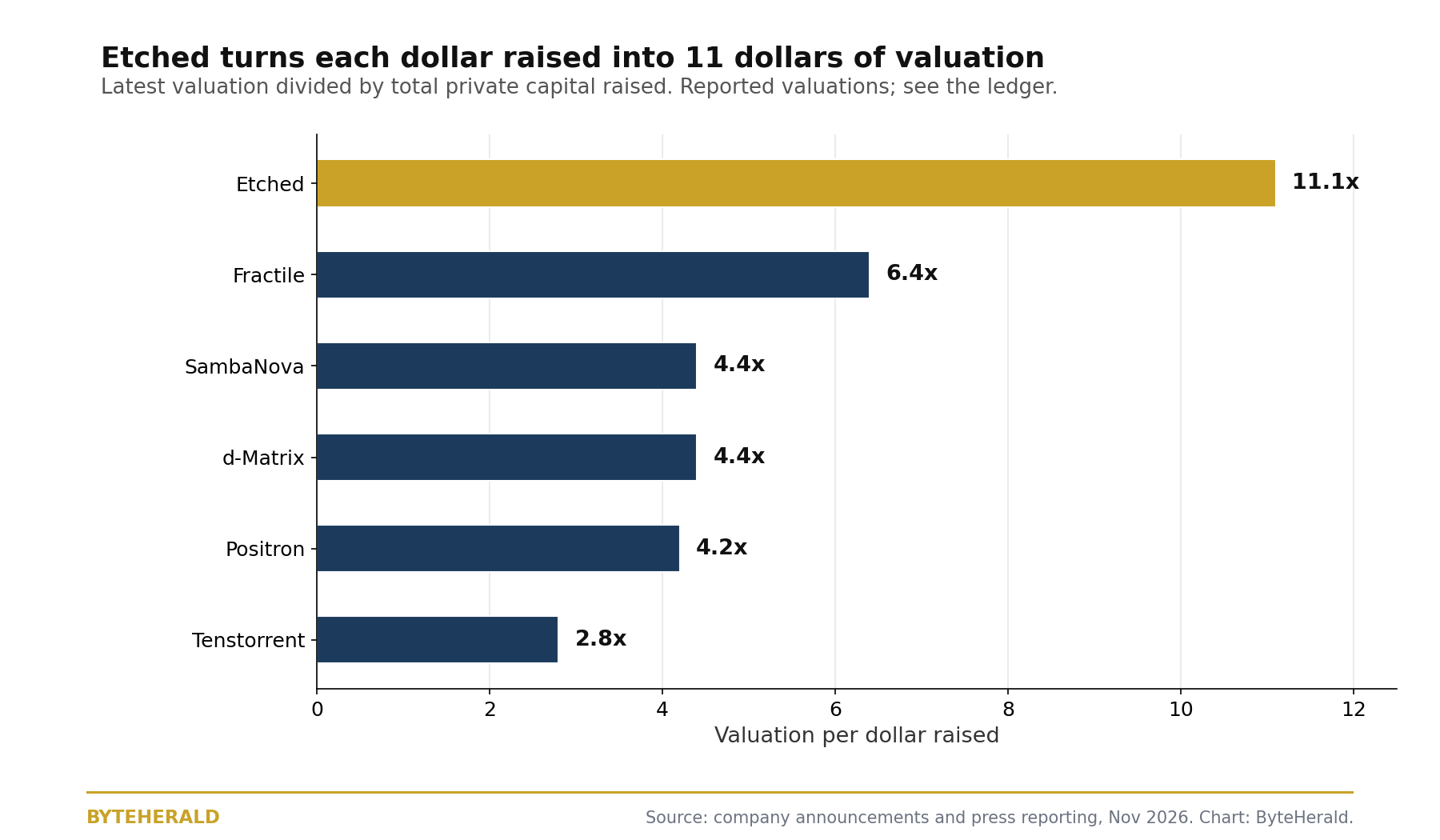
Etched turns each dollar raised into 11.1 dollars of valuation, the highest in the field, and it is also the company with the thinnest public proof: one rack delivered to one customer, Jane Street, which also led its latest round, and performance claims of 500,000 tokens per second on Llama 70B that no independent lab has verified. Fractile is next at 6.4 times, with no shipped silicon at all. The two numbers say the same thing: in this market, investors are paying for the next chip, not the current one, and the price assumes the next chip works.
The proof ladder
Money is the easy part to count. Proof is harder, and the ledger splits cleanly when you ask what each company has actually put into a customer's hands. Four have shipped hardware: Cerebras, which lists on Nasdaq and publishes audited revenue of 510 million dollars in 2025 with a 25.4 billion dollar order backlog as of June 30, 2026, anchored by a 20 billion dollar OpenAI deal; Tenstorrent, which closed a 1.5 billion dollar Series E in October 2026 at a 6.2 billion dollar valuation and whose Galaxy servers began shipping in April 2026; Positron, with more than 50 Atlas racks deployed at Oracle Cloud Infrastructure; and Etched, with exactly one rack delivered, to Jane Street. Two are pre-silicon: Fractile, which promises first chips in 2027, and Tendrils, founded in 2026, which has no silicon and no benchmarks. One, Groq, no longer sells chips at all in the old sense: Nvidia licensed its technology for about 20 billion dollars in December 2025 and hired its founder and senior team, while the remaining company sells inference as a cloud operator. and raised 1 billion dollars in 2026 to fund the pivot. One, Untether AI, is bankrupt. The remaining two, SambaNova and d-Matrix, sell enterprise and hyperscale systems, but neither publishes a shipment count, so they sit between the shipped group and the pre-silicon group.
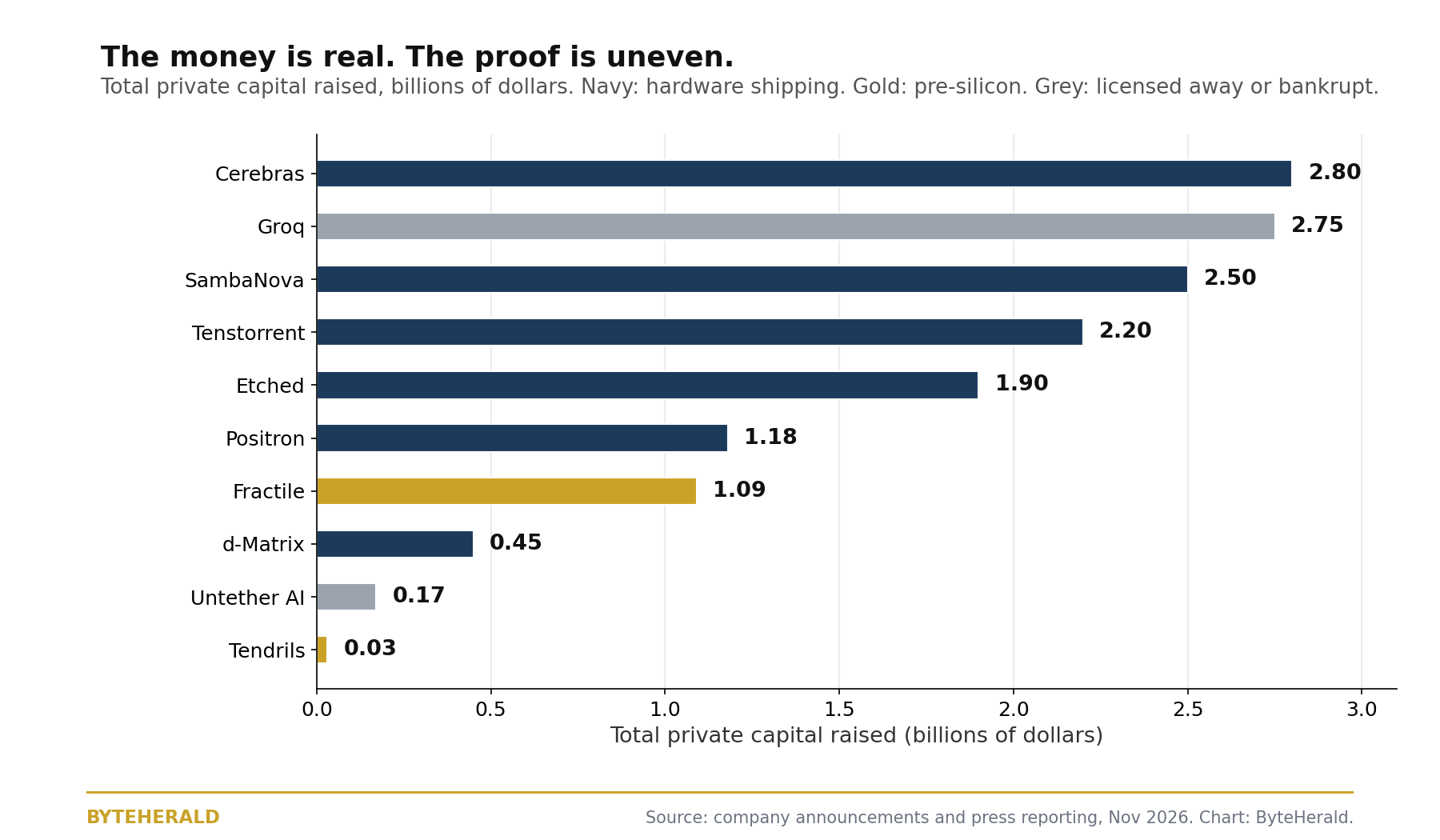
The gap between the two charts is the story of this ledger. The companies with the most money are not the companies with the most proof, and the company with the highest valuation per dollar raised has the least public evidence of any of them. Only Cerebras, the public one, lets an outsider check its revenue, its backlog, and its customer concentration, and even Cerebras once depended on a single customer, G42, for 87 percent of its revenue in the first half of 2024. The buyers for all of this hardware are the hyperscalers, whose spending we tallied in our 828 billion dollar 2026 AI capex ledger, and the distribution those buyers control is what we mapped in our pillar on who controls the open AI stack. A challenger has to beat Nvidia on the chip and on the channel, and the channel is the harder half.
The graveyard
Untether AI raised 165 million dollars, including an oversubscribed 125 million dollar round in July 2021 co-led by Intel Capital, and filed for bankruptcy in October 2025, with AMD hiring its engineering team that June. Graphcore, the last British challenger before Fractile, raised about 700 million dollars, peaked near a 3 billion dollar valuation in 2020, and was sold to SoftBank in July 2024 for a price it never disclosed. Both companies had real chips and real engineers. Both ran out of the one thing no valuation provides: a customer willing to pay, at volume, before the money ran out. Every challenger in the ledger depends on the same scarce inputs, and the scarcest is memory: the high-bandwidth memory every one of these chips needs is the bottleneck we tracked in our Memory Wall pillar. A funding round buys time. It does not buy tape-out, yield, or a second customer.
How to read the next raise
When the next round lands, read it against this ledger. A higher valuation means little if the money is the first round to arrive since the previous one doubled. A shipment count means more than a performance claim. A second customer means more than a bigger contract with the first. A licensing deal means the company has decided it cannot win alone. The two numbers to watch are the valuation per dollar raised, which runs 2.8 to 11.1 times across the field, and the amount of public proof behind each valuation, which runs from audited revenue to a single rack. The question is not whether a challenger can raise money. The question is whether the money can buy a customer, and whether that customer will buy a second time. Those are the numbers this ledger will update.
Source notes
Rounding is to the figures in the table; where two sources disagree, we followed the more recent or the company announcement. Sums are ByteHerald's own arithmetic, and this ledger replaces the figures in our earlier drafts. The figures are as of November 11, 2026.
Comments
Post a Comment