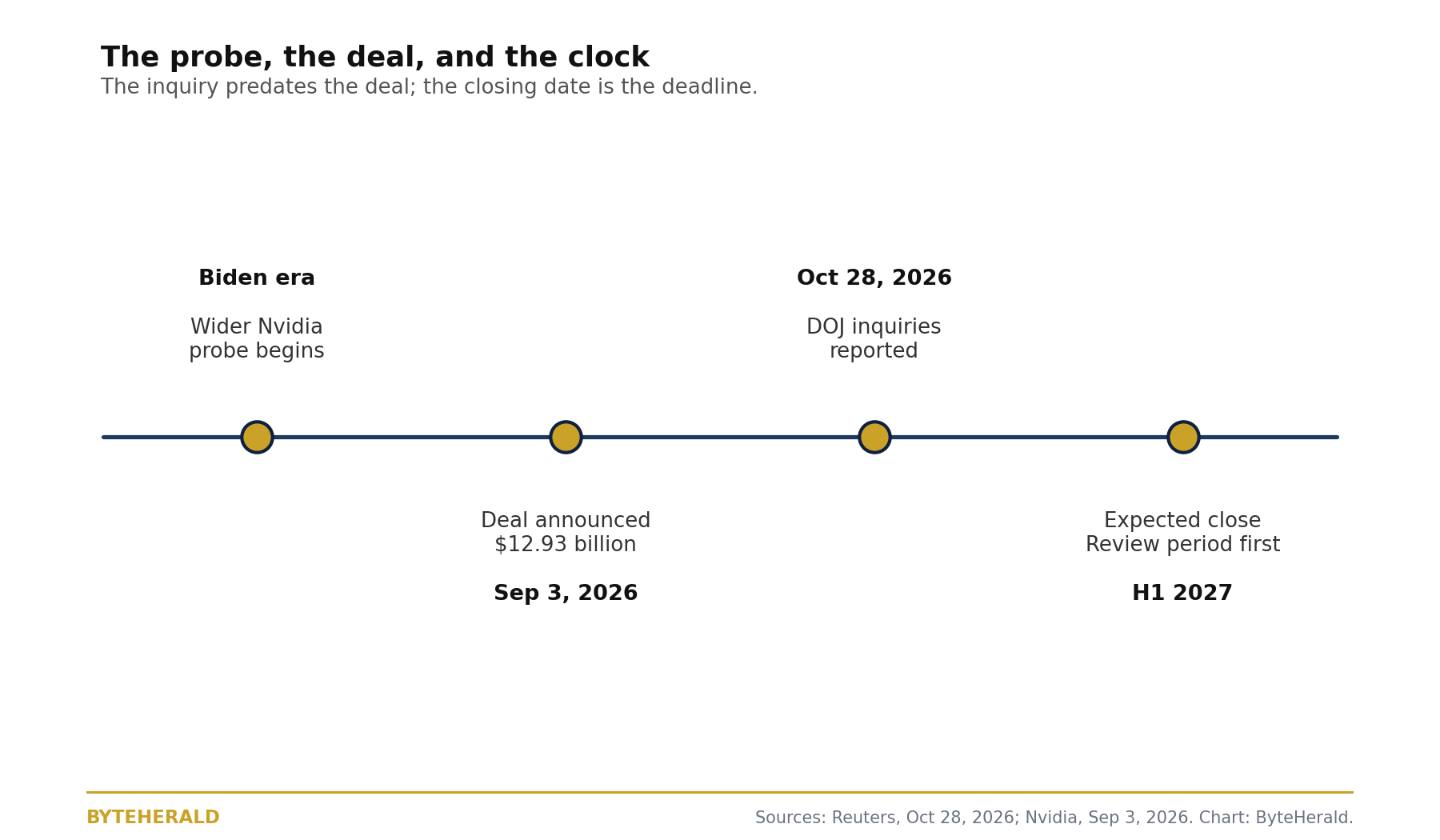
On October 28, 2026, Reuters reported that the United States Department of Justice has made inquiries about how Nvidia's $12.93 billion deal to buy Hugging Face would affect competition in artificial intelligence. Two people familiar with the matter said Justice Department officials have asked whether the deal would let Nvidia capture a fundamental distribution point for AI. The acquisition, announced September 3, 2026, is expected to close in the first half of 2027. The questions themselves were reported for the first time that day, and they land on top of a wider examination of Nvidia's conduct that began under one president and continued under the next. The question underneath the probe is the one this article maps: who controls the open AI stack, layer by layer, and what happens when one company starts to own more than one layer at once.
What the Justice Department is asking
The Reuters report is precise about what the inquiry is and what it is not. The department's recent questioning covers Nvidia's acquisitions, investments, sales practices, and whether the chip designer has exerted pressure on its customers, according to the two people familiar with the matter. On Hugging Face, officials have asked whether the deal would let Nvidia capture a fundamental distribution point for AI, whether Nvidia could use the newly acquired business to gain leverage, and whether it could use the platform to harm rivals in the AI market. CNBC independently confirmed the inquiry with an unnamed source.
Three limits on the story matter as much as the questions. First, a Justice Department spokesperson declined to comment on any matters before the department, citing longstanding policy, and both the department and Nvidia declined to comment on the inquiries. Hugging Face did not respond to requests for comment. Second, government investigations are not evidence of wrongdoing and do not necessarily result in lawsuits, as Reuters noted, and the probe may not result in any Justice Department action. Third, there is no indication that President Donald Trump has any involvement in the examination, which started under former President Joe Biden and has continued under his successor.
The control map
Hugging Face is the layer that makes the deal different from an ordinary acquisition. It operates the central repository where software developers host, share, and test open-source artificial intelligence models, code, and datasets. It is where a developer finds a model, tries it, and deploys it. Nvidia is the company that sells the chips most of those models run on. The Justice Department's question is what happens when the company that sells the chips also owns the place where the models are found.
| Layer of the stack | Who owns it | What the Justice Department is asking |
|---|---|---|
| AI chips | Nvidia | Whether Nvidia pressured customers or tied access to scarce graphics processors to the purchase of networking equipment and software |
| Model distribution hub | Hugging Face, under a $12.93 billion agreement to be bought by Nvidia | Whether owning the hub lets Nvidia capture a fundamental distribution point for AI, gain leverage, or harm rivals |
| Workload software | Run:ai, acquired by Nvidia | Examined in the wider conduct probe; no specific question reported |
| Scheduling software | SchedMD, bought December 2025 | Examined in the wider probe; the purchase sparked worries among AI specialists about access to its open-source software |
| Licensing and hiring | Groq, $20 billion licensing agreement in 2025 | Whether the agreement was structured to avoid antitrust review |
The map is the citable part of this article, and it is also the part that shows why the probe is not about one deal. The department is not only asking about Hugging Face. It is asking about a pattern: a chip company that has bought a workload optimizer, a scheduler, a licensing deal with a chip startup, and now the largest open model hub, while its conduct in selling chips is under examination at the same time. Each transaction on its own is small next to Nvidia. Together they describe a company assembling the layers around its chips.
The transaction ledger
| Deal | Date | Value | Status |
|---|---|---|---|
| Hugging Face acquisition | Agreement September 3, 2026 | $12.93 billion | Expected to close first half of 2027; Justice Department inquiries reported October 28, 2026 |
| Groq licensing and hiring | 2025 | $20 billion licensing agreement | Justice Department examining whether it was structured to avoid antitrust review |
| SchedMD purchase | December 2025 | Not disclosed in the reporting | Examined in the wider probe |
| Run:ai acquisition | Date not stated in the reporting | Not disclosed in the reporting | Examined in the wider probe |
Two numbers in the ledger do the most work. The first is the price of Hugging Face itself: $12.93 billion, according to the reporting, or about $13 billion on Bloomberg's figure. Hugging Face had annualized revenue of about $150 million, according to earlier reporting. Divide the price by the revenue and the multiple is about 86 times. That is the price of a distribution point, not the price of a revenue line, and it is worth comparing with the other control-point price reported this week: Palo Alto Networks is reported to be paying about 50 times revenue for Clutch Security, a startup that maps the credentials AI agents hold. Both multiples are scarcity prices. Nvidia's is higher, and the asset is bigger: the hub where the models live, against the startup that watches the keys.
The second number is the date. The deal is expected to close in the first half of 2027, and a purchase of this size requires a filing that gives the Justice Department and the Federal Trade Commission a formal period to review it before completion. The clock on that review is the real deadline in this story, and it is why the inquiries were made now, while the deal is still pending, rather than after it closes.
What "capture a distribution point" would look like
The phrase the Justice Department used, "capture a fundamental distribution point for AI," is abstract, and the reporting gives it three concrete forms. The first is leverage in commercial negotiations: the owner of the hub could use it as a bargaining chip with customers and rivals. The second is harm to competing chipmakers: a hub that favors one company's hardware, in placement, performance, or access, would steer developers toward that hardware without any rule saying so. The third is disadvantage to alternative model repositories: a hub that becomes the default place to find models can set the terms on which every other repository competes.
Nvidia's answer, given when the deal was announced, is that Hugging Face would continue to support work with a range of chip, cloud, and AI providers. Chief executive Jensen Huang said the platform would remain open to third-party processors, frameworks, and cloud services. That is a promise about behavior after the close, and it is the promise the review period exists to test: whether it is written into the deal, whether it is enforceable, and whether the company's conduct in the wider probe gives regulators reason to trust it.
There is a parallel in the licensing world that ByteHerald has covered before. Our comparison of every major AI license showed that a permissive license is not permission to use a model however you like, and that a government order can still restrict a model the license allows. The same distinction applies here: Hugging Face staying open as a matter of policy is not the same as Hugging Face staying open as a matter of structure, and the Justice Department's questions are about structure, not about the press release.
The wider probe
The Hugging Face inquiries sit inside an examination that is broader than one deal and older than this administration. The broad Nvidia examination started under former President Joe Biden and has continued under President Donald Trump, during which time Nvidia has been the most valuable company in the world and a singular force in AI, according to Reuters. The department has examined Nvidia's acquisition of SchedMD, the December 2025 purchase that sparked worries among AI specialists about their access to its open-source software. It has scrutinized the 2025 deal to license technology from chip startup Groq and hire its engineers. It has looked at the acquisition of Run:ai, which makes software that helps AI chips run more efficiently.
That history is also the reason the Hugging Face questions carry weight. A single inquiry about a single deal, made in isolation, would be a routine merger review. The same questions, asked as part of a years-long examination of the same company's acquisitions, investments, and sales practices, describe a regulator building a picture of how one company assembles control over the layers around its core product. Our map of every AI export control showed the other side of the same question, which governments can ship AI to whom; this probe asks who, inside the industry, decides where the models go.
What happens next
Three outcomes are possible, and the reporting gives no basis for picking one. The departments could clear the deal, and it closes in the first half of 2027 as Nvidia expects. They could block it, which would leave Hugging Face independent and Nvidia's $12.93 billion unspent. Or they could approve it with conditions, which is where the promise about staying open would be tested in writing, with obligations that outlive the press release. The filing review period is the window in which that choice is made, and it runs before the expected close, not after it.
What to watch is not the price. It is the language around the hub. If the review produces conditions, they will be about access: whether rival chipmakers' models are listed on equal terms, whether the hub's data stays available to competing clouds, and whether the promise that Hugging Face supports a range of providers is a commitment or a slogan. If the review clears the deal without conditions, the watch shifts to conduct: whether the hub's behavior after the close matches the promise made before it. Either way, the number that will matter in a year is not $12.93 billion. It is how many developers still find their models through a hub owned by the company that also sells them the chips.
Five questions to ask about any AI control claim
First, is the question about a deal or about conduct? The Hugging Face inquiries are about a deal, but they sit inside a conduct probe, and the two have different remedies. Second, who owns the layer your model depends on? The hub, the chips, and the cloud are different layers, and control of one is not control of all three. Third, what did the seller promise about staying open, and is the promise in the deal or only in a press release? Fourth, what would capture look like in practice: preferential placement, throttled rival access, or leverage in a negotiation, each of which is observable if you know where to look. Fifth, what is the deadline? A deal expected to close in the first half of 2027 has a review period that runs before it, and after the close, the only remedy left is conduct enforcement, which is slower and harder.
By ByteHerald Staff. Reuters, October 28, 2026, reported that the United States Department of Justice has made inquiries about how Nvidia's $12.93 billion deal to buy open-source platform Hugging Face would affect competition in artificial intelligence, citing two people familiar with the matter, with officials asking whether the deal would let Nvidia capture a fundamental distribution point for AI, whether it could gain leverage or harm rivals, and with the acquisition expected to close in the first half of 2027. The same Reuters reporting stated that the broad Nvidia examination started under former President Joe Biden and continued under President Donald Trump, that the department has examined Nvidia's acquisition of SchedMD, its 2025 Groq licensing deal, and its acquisition of Run:ai, and that government investigations are not evidence of wrongdoing and do not necessarily result in lawsuits. CNBC independently confirmed the inquiry with an unnamed source, as reported by SiliconReport on October 29, 2026. Nvidia announced the agreement to buy Hugging Face on September 3, 2026, with chief executive Jensen Huang stating the platform would remain open to third-party processors, frameworks, and cloud services. CPI reported the purchase price at $12.93 billion, Bloomberg at about $13 billion, with Hugging Face at about $150 million in annualized revenue, and noted that a purchase of this size requires a filing giving the Justice Department and the Federal Trade Commission a formal period to review it before completion.
Comments
Post a Comment