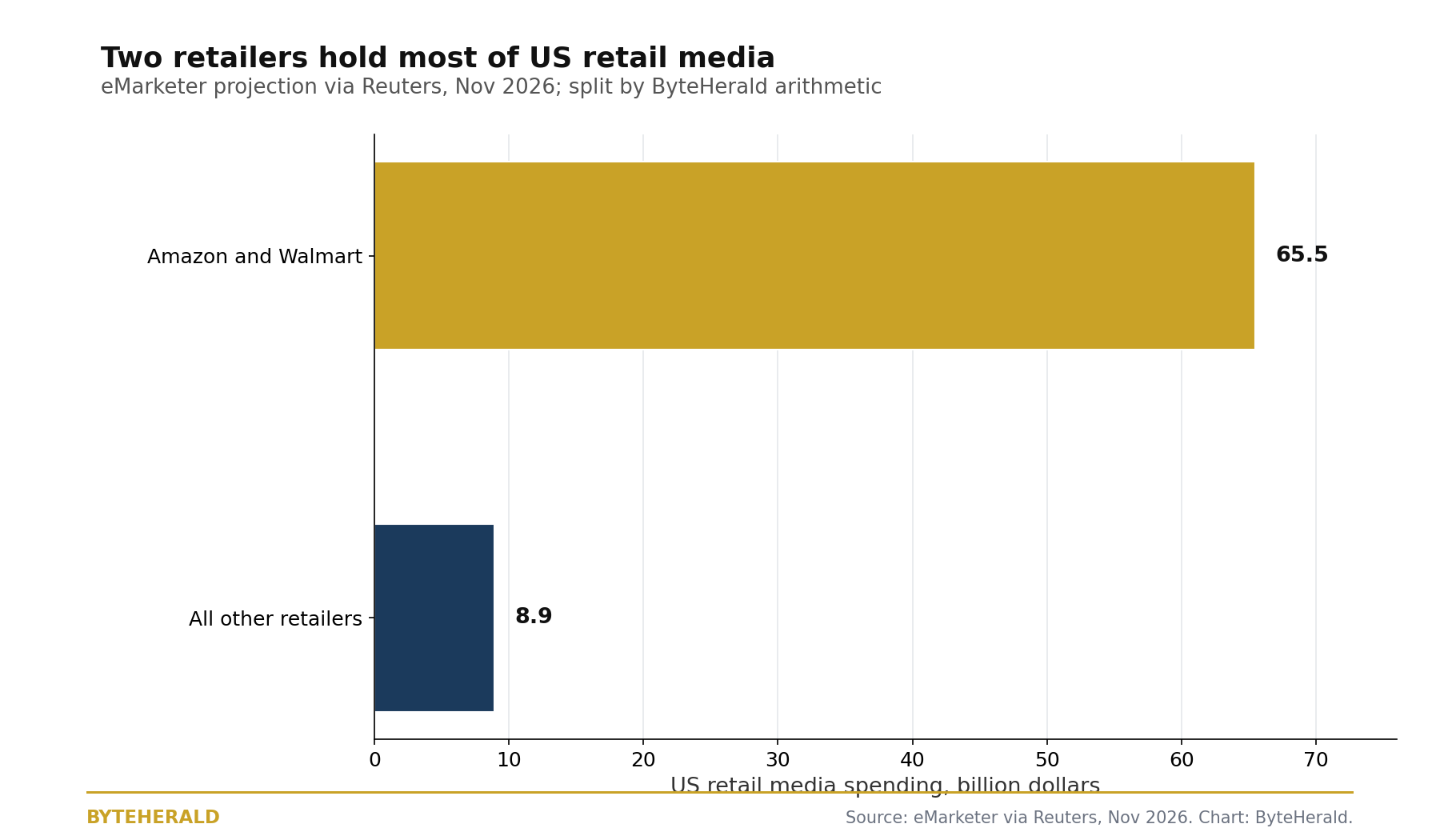
Reuters reported on November 4, 2026, that AI shopping agents could threaten the advertising businesses of Amazon and Walmart, the world's two largest retail media businesses, which together hold a combined 88 percent share of an estimated 74.4 billion dollars in US retail media spending, according to projections from data firm eMarketer. The threat is not that people stop shopping, it is that the buyer stops being a person browsing a store, and a sponsored placement only works when a person is looking at it.
The money table, in one place
Retail media is the business of brands paying retailers to promote products on their websites and apps, through sponsored listings, search placement inside the store, and display slots a shopper passes on the way to checkout. It is lucrative precisely because the shopper is already at the point of purchase, and it is that position, not the ad format, that an agent disrupts. The table below gathers every money figure Reuters reported for this story, with ByteHerald arithmetic labeled as such, so the size of the stake can be checked rather than taken on trust.
| Figure | Value | What it is |
|---|---|---|
| US retail media spending | 74.4 billion dollars | eMarketer projection, via Reuters |
| Amazon and Walmart combined share | 88 percent | eMarketer projection, via Reuters |
| Combined Amazon and Walmart stake | 65.5 billion dollars | ByteHerald arithmetic: 88 percent of 74.4 billion |
| All other retailers combined | 8.9 billion dollars | ByteHerald arithmetic: 74.4 minus 65.5 |
| Amazon advertising, share of net sales | About 10 percent | Reuters, segment consistently about 10 percent |
| Amazon Q3 advertising growth | 11 percent year over year | LSEG data via Reuters, slowest pace in nearly four years |
| Agents' share of US e-commerce by 2030 | 10 to 20 percent | Morgan Stanley projection, July 2026, via Reuters |
| Walmart advertising, membership, and marketplace | 45 percent of quarterly operating income growth | Walmart CFO John David Rainey, August 2026, via Reuters, three businesses combined, not ads alone |
Two cautions belong inside the table, not after it. The 65.5 billion dollar combined stake is ByteHerald arithmetic from rounded projection inputs, so it is an order of magnitude, not a reported total, and it inherits the uncertainty of the eMarketer projection itself. The Walmart 45 percent figure is the combined contribution of advertising, membership, and marketplace operations to quarterly operating income growth, and any article that calls it "ads drove 45 percent of profit growth" misreads its own source. With those cautions kept, the shape is clear: almost nine tenths of a 74.4 billion dollar market sits with two companies, and the agent question is whether software buyers respect the placement that market sells.
Two retailers, opposite answers
Amazon and Walmart have answered the agent question in opposite ways, and the contrast is the story. Amazon blocked Meta's Muse from its website in September 2026, saying it appeared to have accessed its online store without authorization, capturing and storing customer credentials, and Meta declined to comment. Amazon also won a court order blocking Perplexity's shopping agent Comet in March 2026, but the 9th US Circuit Court of Appeals overturned that ban in August 2026 and the case is ongoing, so the court route did not hold as a lasting block. That dispute already appears in the block map of websites slamming doors on AI agents, where Amazon's move sits among platforms choosing gates over open access. Walmart, conversely, rolled out infrastructure on October 21, 2026, to enable third-party agentic commerce, and is officially partnering with Meta's agentic tool. The same agent, Muse, is therefore blocked at one retailer and welcomed at the other, which means the agent economy will not have one rule, it will have one rule per store, negotiated store by store.
Both companies are also hedging the same way, by putting ads inside their own AI shopping tools. Walmart started testing ads within Sparky, its AI shopping chatbot, just as Amazon has embedded ads in Alexa for Shopping, its AI shopping assistant. That hedge reveals the real question: whether the ad moves with the agent, inside the agent's answer, or dies with the store page the agent no longer shows. A sponsored listing inside an agent's recommendation is still an ad, but it is sold on different terms, to a different buyer, with different disclosure, and the retailer that controls the agent controls those terms.
Why an agent breaks the retail media model
Retail media sells attention at the moment of choice: a shopper searches, sees a sponsored product first, and buys it. An agent changes each step. It researches across retailers rather than inside one store, so a sponsored placement inside one store competes with a better price elsewhere that the agent already found. It purchases on the shopper's behalf, so the shopper never sees the sponsored slot at all. And it optimizes for the shopper's stated criteria, price, rating, delivery time, rather than for the retailer's paid ranking, unless the agent's own answer is itself sponsored. The Morgan Stanley projection that agents could account for 10 to 20 percent of US e-commerce spending by 2030 is a projection, not a measurement, but even the low end, one dollar in ten, is large enough to change what a sponsored placement is worth, because the dollars agents control are precisely the dollars that used to pass a sponsored slot.
Amazon chief executive Andy Jassy told investors last week that there is no meaningful effect yet on Amazon ads from third-party agents, and that sentence deserves as much weight as the warning. The 11 percent third-quarter advertising growth, the slowest pace in nearly four years on LSEG data, is a slowdown, not a collapse, and it has many possible causes besides agents. The honest reading is that the threat is structural and early: the mechanism is visible, the numbers are not yet moving, and the companies with the most to lose are already acting, one by blocking, one by partnering, both by building ads into their own agents.
Retail media and agentic commerce, explained
Retail media, in plain terms, is a retailer renting its own shelves: a brand pays to appear first when a shopper searches inside the store, and the retailer earns money from attention it already owns. Agentic commerce is the shopper delegating the whole trip: an AI agent researches products, compares options, and purchases on the shopper's behalf, across stores if allowed. The collision is simple. Retail media assumes the shopper walks the store; agentic commerce assumes the shopper sends a deputy who may never enter it. Everything else, the blocks, the partnerships, the ads inside chatbots, is a negotiation over whether the deputy must walk the store anyway, or whether the store must pay to be recommended by the deputy.
Three tests for who gets paid
For any shopping agent a reader is offered, three questions settle where the money goes, and they are worth asking before trusting its recommendations. First, does the agent show sponsored listings, and does it label them as sponsored, or does it present paid placement as its own judgment? Second, when the agent buys, who earns the fee, the retailer that stocked the product, the agent's operator, or nobody, because the agent bypassed the store's paid funnel entirely? Third, what customer data does the retailer keep when the buyer is software, since that data is what fuels the targeting retail media sells? An agent that cannot answer all three is not yet a shopping tool, it is an unpriced intermediary, and the retailer blocks and court orders in this story are what happens when an unpriced intermediary arrives at scale. The payment trail matters here in a way ByteHerald has examined before: when an AI agent buys something, who gets paid, traced step by step, shows how many hands already touch an agent purchase before any ad fee is counted.
The outcome to watch is not a single block or partnership, it is the price of a recommendation. If agents start charging brands for placement inside their answers, retail media has simply moved house, from the store page to the agent, and Amazon and Walmart will fight to own the agent rather than the shelf. If agents refuse paid placement and rank purely on shopper criteria, the 65.5 billion dollar combined stake shrinks toward whatever brands will pay for genuine distribution, which is a smaller and harder business. Either way, the next disclosure to read is not a product launch, it is the next quarter's advertising line at Amazon and Walmart, and whether Jassy's "no meaningful effect yet" survives another quarter of agents doing the shopping.
By ByteHerald Staff. Reuters, November 4, 2026, reported that AI shopping agents could threaten Amazon's and Walmart's advertising businesses, that the two companies together hold a combined 88 percent share of an estimated 74.4 billion dollars in US retail media spending per eMarketer projections, that Amazon blocked Meta's Muse in September 2026 and won a court order blocking Perplexity's Comet in March 2026, overturned by the 9th US Circuit Court of Appeals in August 2026 with the case ongoing, and that Walmart rolled out infrastructure on October 21, 2026, to enable third-party agentic commerce. Reuters, November 4, 2026, reported Morgan Stanley's July 2026 projection that agents could account for 10 to 20 percent of US e-commerce spending by 2030, Amazon's third-quarter advertising growth of 11 percent year over year on LSEG data, and Walmart chief financial officer John David Rainey's August 2026 statement that advertising, membership, and marketplace operations together accounted for 45 percent of quarterly operating income growth.
Comments
Post a Comment