Advanced Micro Devices reported third-quarter 2026 revenue of 13.4 billion dollars on November 3, 2026, up 45 percent from a year earlier, with its Data Center segment at 8.5 billion dollars, up 97 percent, and on its earnings call chief executive Lisa Su said the company expects revenue to grow by more than 80 percent in 2027, with server revenue about doubling and data center AI revenue growing significantly more than double. The quarter is the proof, the 2027 guide is the bet, and confusing the two is the easiest mistake a reader can make with this report.
What AMD actually reported
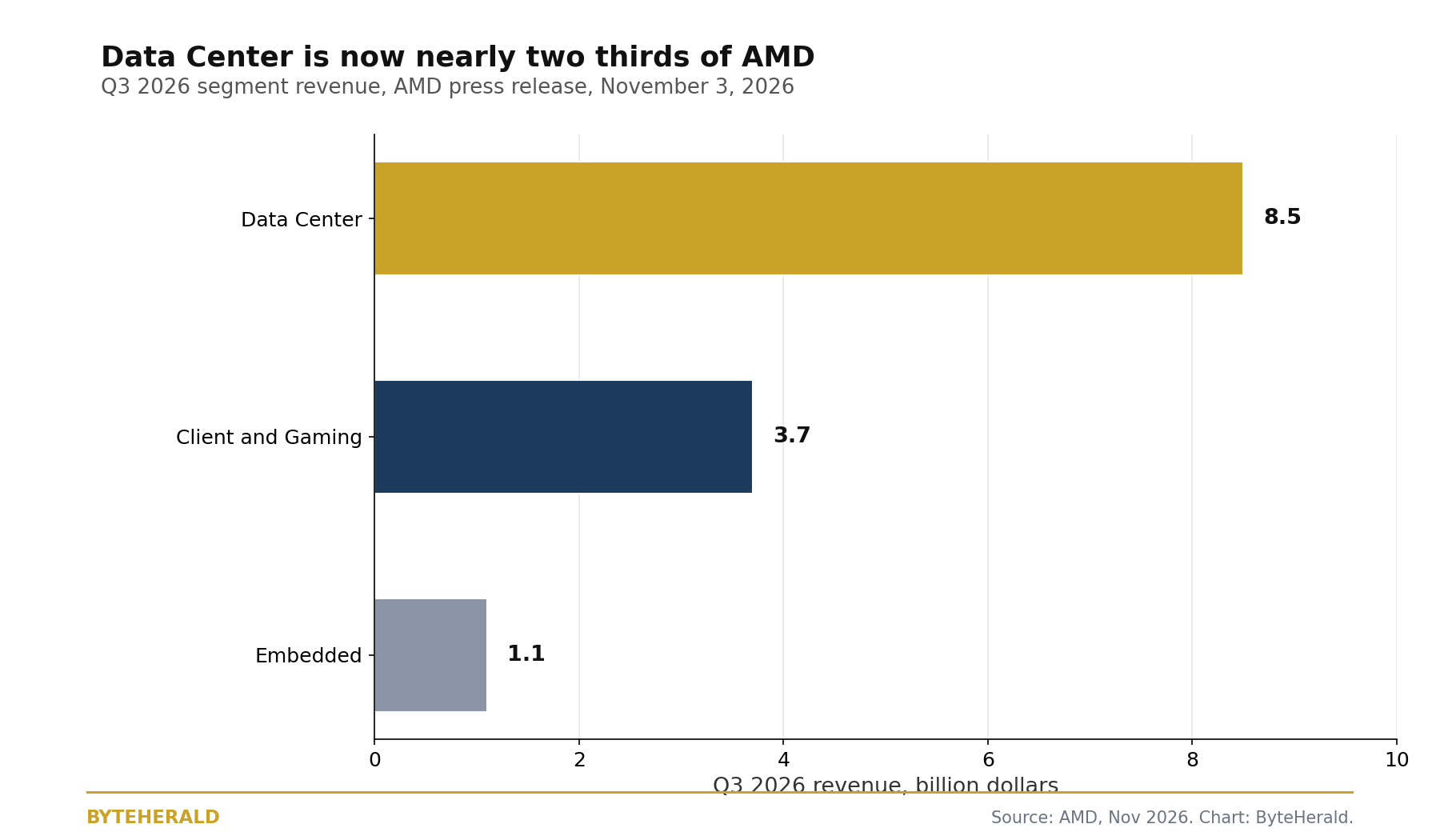
The primary document is AMD's own press release, and its numbers are unambiguous. Third-quarter revenue was 13,377 million dollars, against 9,246 million a year earlier, up 45 percent, and against 11,536 million in the second quarter, up 16 percent. The Data Center segment reached a record 8.5 billion dollars, up 97 percent year over year, which AMD credited to strong demand for EPYC processors and the launch of the Instinct MI450 Series GPUs. Client and Gaming revenue was 3.7 billion dollars, down 8 percent year over year, split between Client at 2.9 billion, up 7 percent on Ryzen mobile processors, and Gaming at 773 million, down 40 percent on lower semi-custom and graphics revenue. Embedded revenue was 1.1 billion dollars, up 29 percent, led by aerospace and defense, automotive, communications, and industrial markets. GAAP diluted earnings per share were 1.46 dollars, while non-GAAP diluted earnings per share were 2.09 dollars, up 74 percent.
| AMD Q3 2026, from the press release | Figure | Change |
|---|---|---|
| Total revenue | 13.4 billion dollars | Up 45 percent year over year |
| Data Center segment | 8.5 billion dollars | Up 97 percent year over year |
| Client and Gaming segment | 3.7 billion dollars | Down 8 percent year over year |
| Embedded segment | 1.1 billion dollars | Up 29 percent year over year |
| Non-GAAP earnings per share | 2.09 dollars | Up 74 percent year over year |
| Q4 2026 revenue guide | About 17 billion dollars, plus or minus 3 percent | About 66 percent year over year at the midpoint |
Two pieces of ByteHerald arithmetic, labeled as such, put the quarter in proportion. Data Center at 8.5 billion dollars is about 64 percent of total revenue, against 47 percent in the same quarter a year earlier on the company's own commentary, and it is larger than the other two segments combined, 3.7 plus 1.1 equals 4.8 billion dollars, by a factor of about 1.8. The fourth-quarter guide, about 17 billion dollars plus or minus 3 percent, is a range of 16.49 to 17.51 billion dollars, or about 27 percent above the third quarter at the midpoint, exactly as the release states. Those are the numbers the release supports; everything about 2027 comes from the call, not from this document, and the article keeps that line visible.
What the 2027 guide actually says
On the earnings call, as reported by Reuters and CNBC, Su said that based on current visibility the company expects revenue to grow by more than 80 percent in 2027, more than double the growth rate in the long-term financial model presented at the analyst day last November. She said server revenue is expected to about double, data center AI revenue will significantly more than double, and data center revenue will account for more than 80 percent of total revenue. Chief financial officer Jean Hu added the crossover that makes the guide concrete: the fourth quarter of 2026 will be the first in which data center AI revenue, meaning accelerators, passes server CPU revenue in dollars. The first Helios rack-scale systems, powered by Instinct MI450 GPUs and sixth-generation EPYC CPUs, are already running models and workloads at Anthropic, Meta, Microsoft, OpenAI, and Oracle Cloud Infrastructure, according to the press release, which is the customer list the guide rests on. That customer list is the demand side of the spending tallied in the five-company, 828 billion dollar AI capex ledger for 2026.
The guide also contains its own warning signs, stated naturally rather than as a separate section. Non-GAAP gross margin is guided to about 55 percent for the fourth quarter, down from 56 percent in the third quarter, because the AI business is dilutive to margin even as it grows gross profit. GAAP earnings took a 1,097 million dollar non-cash charge from the change in fair value of warrant liability, 66 cents per share, tied to warrants issued to certain customers and remeasured as AMD's stock price moved, which is why GAAP earnings per share of 1.46 dollars sit well below the non-GAAP 2.09 dollars. Su said demand exceeds supply and named the queue, wafers, substrates, advanced packaging, and memory, and she said the company is planning for PC unit shipments to fall by a double-digit percentage in 2027. A guide that depends on five named hyperscale customers, on supply that is already constrained, and on a margin that slips as the mix shifts, is a strong guide, not a safe one.
The one sentence that overstates this report
That sentence is "AI chip revenue nearly doubled." The release does not support it, because the Data Center segment combines EPYC server CPUs and Instinct AI GPUs, and AMD did not split the two in the release. What nearly doubled is the segment, driven by both product lines, and the AI-only crossover, accelerators passing server CPUs, is a fourth-quarter call statement, not a third-quarter reported figure. Readers who repeat the segment number as an AI-only number will overstate AMD's AI position by exactly the size of its CPU business, which is the part of the company that has been growing all along. The honest version is stronger anyway: a company whose CPU business and AI business are both growing, selling both into the same rack, is a harder competitor than a company with only one of them.
How to read a chip earnings call
Three distinctions keep a chip report honest, and this one is a good test case. First, segment against product: a segment is an accounting bucket, a product is a chip, and the two are not interchangeable. Second, press release against call: the release gives the quarter and the next quarter's guide, while longer outlooks, like the 2027 numbers here, come from call remarks reported by news outlets, and they carry the usual forward-looking caveat that actual results could differ materially. Third, GAAP against non-GAAP: GAAP earnings include the warrant remeasurement charge, non-GAAP earnings exclude it, and neither is the "real" number on its own; the gap between them, 63 cents per share this quarter, is itself information about how much of AMD's customer strategy runs through equity deals. A reader who checks all three will rarely be fooled by a headline number, including this article's.
AMD's quarter also belongs in the wider buildout accounts ByteHerald has been keeping. The capex ledger counts what buyers are spending; AMD's guide is the supplier's side of the same story: if the spending continues, the chip suppliers grow with it, and if it pauses, the guide, which assumes demand stays ahead of supply, is the first number to fall.
By ByteHerald Staff. AMD, November 3, 2026, reported third-quarter 2026 revenue of 13,377 million dollars, up 45 percent year over year, Data Center segment revenue of 8.5 billion dollars, up 97 percent, Client and Gaming revenue of 3.7 billion dollars, down 8 percent, Embedded revenue of 1.1 billion dollars, up 29 percent, GAAP diluted earnings per share of 1.46 dollars, non-GAAP diluted earnings per share of 2.09 dollars, up 74 percent, and fourth-quarter revenue guidance of about 17 billion dollars, plus or minus 3 percent, with non-GAAP gross margin of about 55 percent. Reuters and CNBC, November 3 and 4, 2026, reported from AMD's earnings call that chief executive Lisa Su expects 2027 revenue growth of more than 80 percent, server revenue about doubling, data center AI revenue significantly more than doubling, and data center revenue above 80 percent of total revenue, and that chief financial officer Jean Hu expects data center AI revenue to pass server CPU revenue in the fourth quarter of 2026.
Comments
Post a Comment