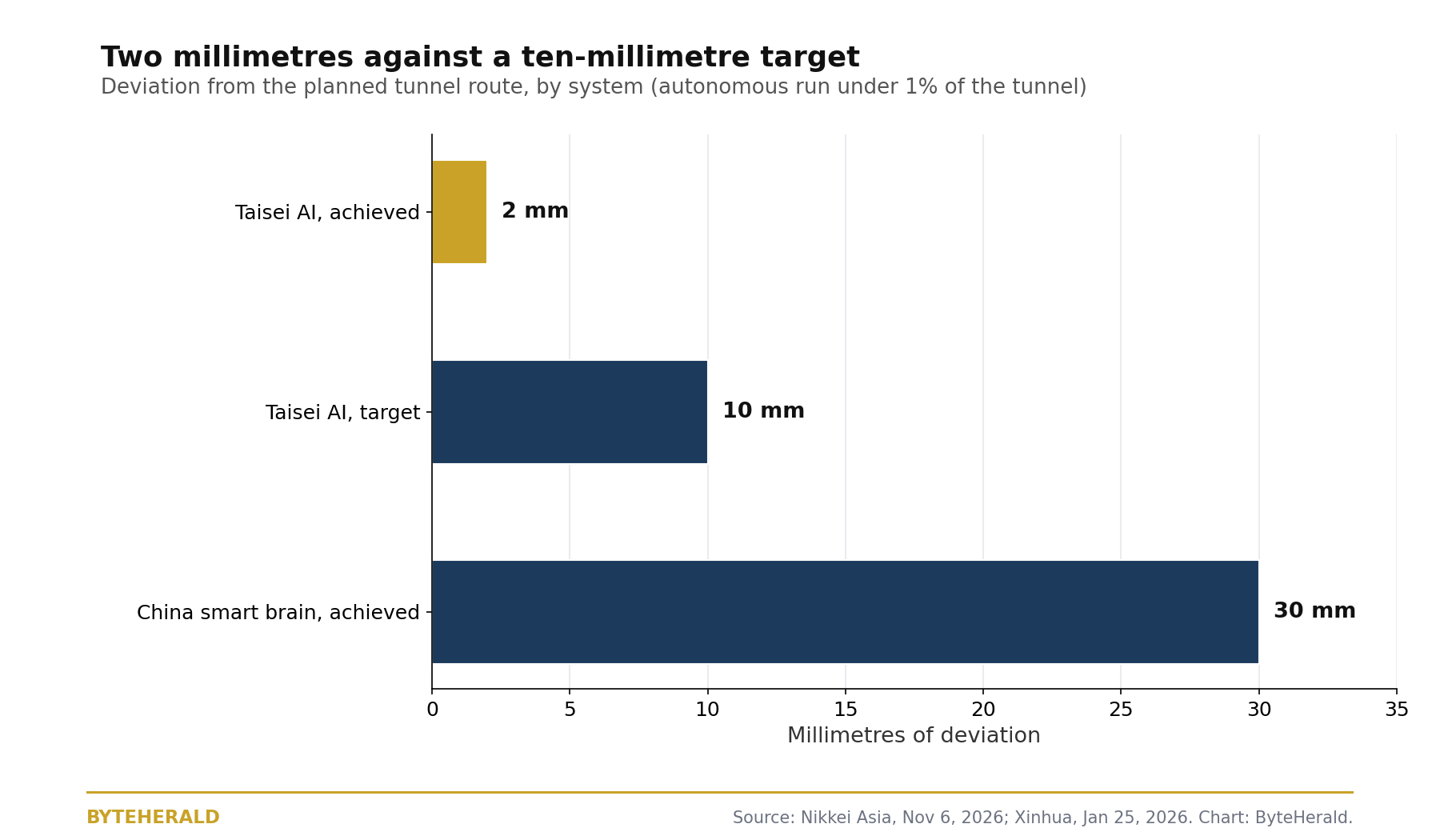
Japanese contractor Taisei has run a tunnel-boring machine with no human hands on the controls, and the machine beat its own precision target by five times. The shield tunneling machine held its line to under 2 millimetres against a 10-millimetre target, in a test on a road project in Kagoshima reported by Nikkei Asia on November 6, 2026. The honest size of the result matters as much as the number: the autonomous run covered 4.5 metres of a 2.3-kilometre tunnel, under 1 percent of the total length, after about 20 years of testing.
What the machine did
The machine is a shield tunneling machine, a cylindrical steel structure that excavates earth while the tunnel lining is built behind it. The one in the test is 11 metres tall, 12 metres deep and weighs 1,400 metric tons, and it steers with 30 hydraulic jacks arranged around the borer's circumference. Steering it is skilled work: the machine checks and corrects its alignment after every 10 or 20 centimetres, and the adjustments have always depended on an operator's experience and intuition. Taisei set the test a simple target, keep the deviation from the planned route within 10 millimetres, and the machine did it in under 2 millimetres, with no human instructions during the run. Tsutomu Taniguchi, an executive fellow in Taisei's civil engineering technology division, told Nikkei the machine had completely surpassed human operators. The system behind it was trained on data from 20 previous sites covering 33 kilometres of construction, from which Taniguchi's team built 800 operational models for the machine to learn from. Taisei began testing autonomous operation about 20 years ago, alarmed by the aging of experienced tunnel-excavator operators, and the test took place on a road project connecting an inland expressway interchange with urban areas linked to Kagoshima port, on the southwestern island of Kyushu.
The scoreboard, and what it does not prove
Taisei is not the only contractor teaching a boring machine to steer itself. In January 2026, a team from Hunan University and China Railway Construction Heavy Industry put an intelligent operating system on a tunnel boring machine in a Shanghai metro project, where it assisted with over 90 percent accuracy in operational decisions and kept deviation in the tunneling direction within 30 millimetres. In a Guangzhou project the same system improved fault diagnosis and maintenance efficiency by 20 percent, boosted equipment utilization by 12 percent and increased monthly progress by 5 percent. On the raw deviation number, Taisei's under-2-millimetre result is fifteen times tighter than the Chinese system's 30 millimetres. But the two numbers describe different things. The Chinese system is deployed on working metro and highway projects, making real operational decisions across full tunnel drives. Taisei's result comes from a 4.5-metre demonstration, under 1 percent of one tunnel, run slowly and under test conditions. A demonstration that beats its target by five times is a milestone, not a product, and the fair comparison is the one Taisei itself invites: the same machine, the same ground, driven by a veteran instead of the model, over a full drive. No such head-to-head figure has been published, so the claim that the machine outperforms veteran operators rests on Taisei's word as reported by Nikkei, not on a published veteran deviation to compare against.
Why a tunnel company spent 20 years on this
The motive is not speed. It is the workforce. Operating a shield machine takes years of experience, and the operators who have it are aging out of the job, which is why Taisei started this program two decades ago. The same pressure is now visible across construction: the skill lives in a shrinking group of people, the work is dangerous and underground, and younger workers are not replacing the veterans fast enough. That is the evergreen half of this story. A shield machine is, in effect, a robot that has always been driven by feel: the operator reads ground conditions, jack pressures and alignment drift, and adjusts 30 jacks in response. Taisei's 800 models are an attempt to write that feel down, learned from 33 kilometres of past drives rather than from one operator's career. If it works at full scale, the gain is not just precision. It is continuity: the knowledge stays in the company when the operator retires. Our October review of seven studies of AI job displacement found the displacement question is usually framed the wrong way round, as machines taking jobs people want to keep. Here it runs the other way: the jobs are emptying on their own, and the machine is the replacement of last resort. The question to ask about Taisei's system is not whether it replaces operators, but whether the next generation of tunnels gets built at all without it.
The catch, stated plainly
Three limits belong in any honest account of this result. First, scale: 4.5 metres of autonomous travel in a 2.3-kilometre tunnel is a proof of steering, not a proof of tunneling. The rest of the drive, varying geology, segment placement, muck removal, water ingress and safety monitoring, remains to be demonstrated. Second, sourcing: Nikkei Asia is the only outlet to have reported the demonstration so far, and the figures in this article are Taisei's as reported by Nikkei, not independently measured results. Third, the veteran comparison: Nikkei reports the machine outperforming veteran human operators in precision, but no veteran deviation figure was published, so the margin over a human cannot be stated as a number. What can be stated is the target, 10 millimetres, the result, under 2 millimetres, the training data, 20 sites and 33 kilometres, and the time spent, about 20 years. Those four numbers are the story. The rest is a promise, and promises in tunneling are verified one metre at a time.
By ByteHerald Staff. Nikkei Asia reported on November 6, 2026 that Taisei demonstrated autonomous operation of a shield tunneling machine that held deviation under 2 millimetres against a 10-millimetre target, trained on data from 20 previous sites covering 33 kilometres, in a 4.5-metre test section of a 2.3-kilometre tunnel in Kagoshima, with the machine 11 metres tall, 12 metres deep and weighing 1,400 metric tons. Xinhua reported on January 24, 2026 that Hunan University and China Railway Construction Heavy Industry developed an intelligent operating system for tunnel boring machines that kept deviation within 30 millimetres in a Shanghai metro project with over 90 percent accuracy in operational decisions, and improved fault diagnosis by 20 percent, equipment utilization by 12 percent and monthly progress by 5 percent in Guangzhou. ByteHerald reported on October 11, 2026 that seven studies of AI job displacement show the displacement question is usually framed as machines taking jobs people want to keep.
Comments
Post a Comment