Apple is building an autonomous AI agent that can use a computer the way a person does: browsing the web, working across apps, running commands, and writing and debugging code. The evidence is not a product launch but job listings on Apple's own website, first reported by Bloomberg on November 19, 2026. The agent is in early development, and Apple has eyed a launch as soon as the end of 2027.
What the job listings actually say
The listings describe a proactive, agentic assistant, and one seeks a senior engineering manager to lead it. The listing's pitch is that the agent can use a computer the way a capable person does, browsing the web, working across apps, running commands, writing and debugging code, calling services, and choosing the right tool for each step, all of it privately. Apple is hiring a senior engineering leader to make it real, and the listing says safety, privacy, and security need to be central to the design.
The team is already working on general-purpose computer-use agents, according to the listing. These agents plan and carry out multi-step tasks across apps, browsers, command lines, code, and APIs, and they can coordinate specialized sub-agents along the way. The hire would work across the Siri, UI frameworks, and Apple Foundation Models teams. Bloomberg had previously reported that Apple was aiming to make Siri more like an agent as soon as 2027, and the new listings confirm the direction with hiring, not just intent.
What a proactive agent is, and why it is different from Siri
A chatbot waits for a prompt and answers it. A proactive agent is given a goal and works toward it without being asked at each step: it opens apps, fills in forms, runs commands, and reports back when the job is done. That is the durable difference. Siri, as it exists today, answers questions and runs single commands. The agent in Apple's listings would plan a sequence of steps, pick tools, and carry them out, which is why the permission model matters more than the model underneath it. An agent that can run commands and call services can also make mistakes at machine speed, so the design has to decide what it may touch, what needs approval, and what stays private.
The field Apple is walking into
Apple is late to a crowded room, and the room is already shipping. Meta released its Muse agent in September 2026, and it passed 10 million downloads in its first 40 days, according to Sensor Tower data cited by 9to5Mac. OpenAI followed with Dots, Anthropic launched Claude Duet, and Google turned its Gemini Spark agent into Tasks and widened access this week. All of them offer to do work without being asked, which current Siri cannot do.
| Agent | Maker | Status on November 19, 2026 | What it does |
|---|---|---|---|
| Muse | Meta | Shipping since September 2026 | Books travel, reserves tables, writes summaries, acts across apps |
| Dots | OpenAI | Shipping | Proactive assistant for multi-step tasks |
| Duet | Anthropic | Shipping, testing expanding | Proactive assistant built on Claude |
| Tasks | Rollout widened this week | Signs into websites, makes purchases, books appointments | |
| Apple agent | Apple | Hiring; launch eyed as soon as late 2027 | Computer use across apps, browsers, code, and APIs |
The comparison matters because the scoreboard for this field already exists. We track who can actually operate a computer in The Computer-Use Scoreboard: Who Can Operate Your PC, where Claude leads on OSWorld and Terminal-Bench and the gaps between GUI and terminal work are wide. Apple's agent would enter that scoreboard as a contender, not a leader, and it would enter it years after the others.
Apple is also making rivals harder to run
While Apple builds its own agent, rival agents are getting harder to run on the Mac. In the macOS 27.3 beta, enabling ChatGPT's third-party computer-use support now requires 14 distinct steps, up from four, Bloomberg reported. Apple cites security. Some users see anti-competitiveness. The same beta line also tightened Full Disk Access around third-party AI apps, and it opened Siri AI to all developers, so Apple is not closing every door at once.
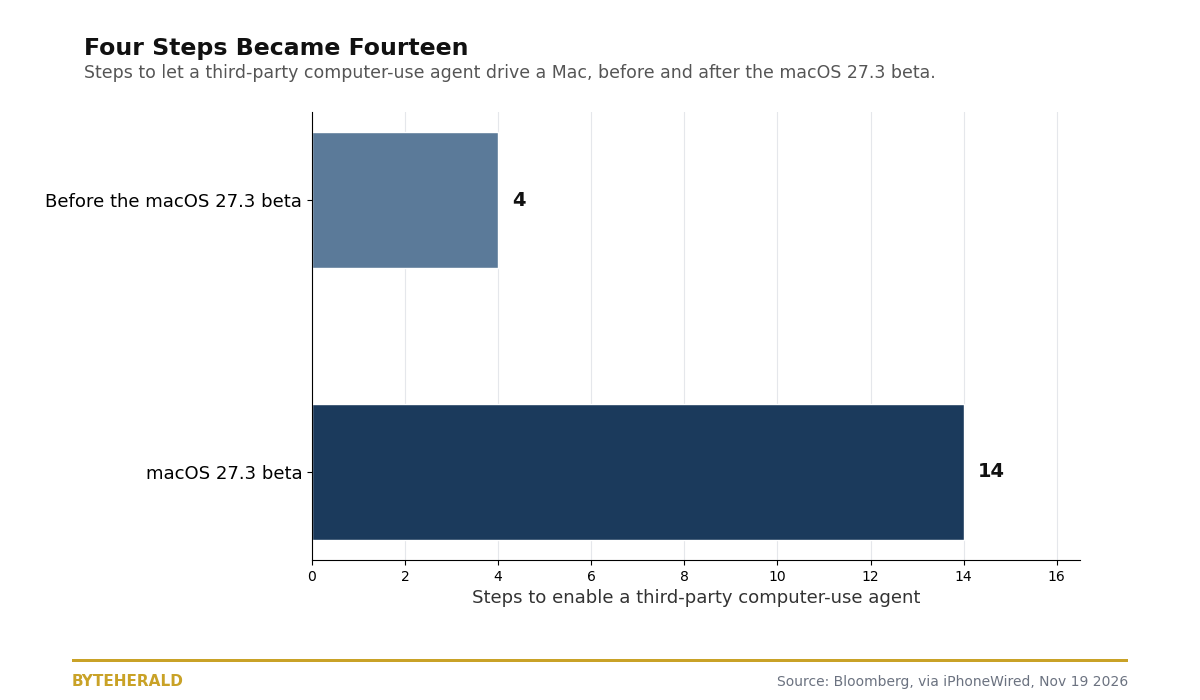
The friction is the story as much as the hiring. An agent that controls a computer needs deep access, and Apple controls the gate to that access on its own platform. Fourteen steps is not a ban, but it is a filter: only users who really want a rival agent will walk through it. That is a defensible security posture and a convenient competitive moat at the same time, and both readings are true.
What the market did
After Bloomberg reported the plans in after-hours trading, Apple shares gained about 0.4 percent, while Meta and newly listed Anthropic each eased 1.8 percent, Stocktwits reported. The move is small and it is the direction that matters: investors treated Apple's entry as a threat to the incumbents, not as a windfall for Apple. That is the right read of a hiring announcement. Nothing is shipping, and the value at stake is the future of the agent layer, not this quarter's sales.
The push has a name behind it. New Apple chief executive John Ternus has reportedly been pushing software engineering chief Craig Federighi to move faster on AI and take a more ambitious approach, according to MacRumors. The agent is the clearest expression of that push so far, and the timeline is the honest part: Apple is still in the early stages, and AppleInsider cautions that 2027 is a guess, not a date. Nothing is announced, and nothing is available to install.
Should you wait for Apple's agent
No, not if you want a computer-use agent today. The choices on a Mac right now come from Meta, OpenAI, Anthropic, and now Google's Gemini, and macOS 27.3 will walk you through 14 steps before one of them can drive the machine. Apple's case for waiting is privacy and polish: the listing promises the agent does its work privately, with safety, privacy, and security central to the design. That promise lands differently after this week's other agent news. Reuters reported that Meta's Muse mixed up private conversations and sent users strangers' bank balances and Signal reminders, as we reported in Meta's Muse Mixed Up Private Chats and Bank Balances. Apple is betting that the next agent buyers will care as much about what an agent cannot see as about what it can do.
The test for Apple's agent, when it arrives, is the same one we apply to every agent: what it can do without asking, what it must ask about, and what happens when it gets it wrong. The job listings answer the first question. The next two will be answered by the product, and by the permission screens Apple puts in front of it.
By ByteHerald Staff. Bloomberg reported on November 19, 2026, that Apple is developing an autonomous AI agent that can control devices, browse the web, and write code, based on job listings on Apple's website seeking a senior engineering manager for a proactive, agentic assistant, and that Apple has considered a launch as soon as the end of 2027 while development remains in its early stages. MacRumors reported on November 19, 2026, that the listings describe general-purpose computer-use agents that plan multi-step tasks across apps, browsers, command lines, code, and APIs, that safety, privacy, and security must be central to the design, and that new chief executive John Ternus has pushed software chief Craig Federighi to move faster on AI. iPhoneWired reported on November 20, 2026, that enabling ChatGPT's third-party computer-use support in the macOS 27.3 beta now requires 14 steps, up from four, and that AppleInsider cautions the 2027 date is a guess and nothing is announced. Stocktwits reported on November 19, 2026, that Apple shares gained about 0.4 percent after hours while Meta and Anthropic each eased 1.8 percent.
Comments
Post a Comment