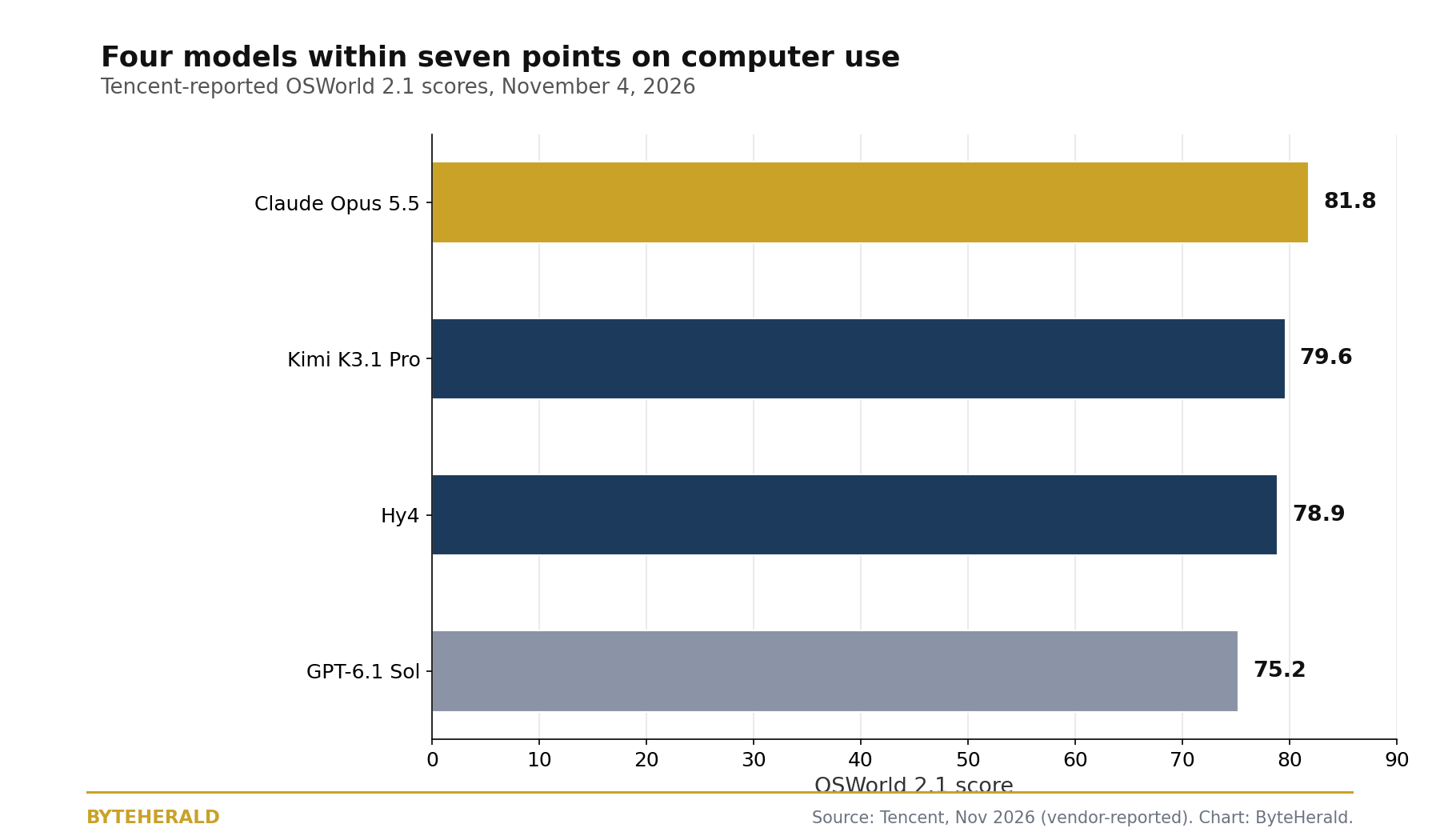
Four models, one test of actually operating a computer, and a seven-point spread: Tencent's November 4, 2026 launch numbers put Claude Opus 5.5 at 81.8 on OSWorld 2.1, Kimi K3.1 Pro at 79.6, Tencent's own Hy4 at 78.9, and GPT-6.1 Sol at 75.2. The gap between first and last is 6.6 points, which sounds close until the second table arrives. On Terminal-Bench 4.0, the same four models score 66.8, 66.4, 55.5, and 44.4, a spread of 22.4 points, with Hy4 trailing Claude by 22.0 points on terminal work after trailing by only 2.9 points on graphical computer use. That split is the story of computer-use AI in November 2026: clicking through apps is nearly a solved contest, and doing long work in a terminal still separates the leaders from everyone else. Every score below is vendor-reported, from Tencent's own launch table, and none of it has been independently reproduced, because the weights for Hy4 are not out yet.
The scoreboard: two tables, two different races
OSWorld 2.1 measures whether a model can operate a real computer: look at a screen, decide what to click or type, run commands, and check whether the result looks right before moving on. Terminal-Bench 4.0 measures the command-line half of that job. Put side by side, the tables below are the citable core of this article, compiled from Tencent's November 4, 2026 launch table, with the vendor-reported flag intact. On OSWorld 2.1, Claude leads Kimi by 2.2 points, Kimi leads Hy4 by 0.7, and Hy4 leads GPT-6.1 Sol by 3.7. On Terminal-Bench 4.0, Kimi leads Claude by 0.4, Claude leads GPT-6.1 Sol by 10.9, and GPT-6.1 Sol leads Hy4 by 11.1. The two tables disagree about who is second and by how much, and that disagreement is information: graphical computer use and terminal work are different skills, and a model can be near the top of one while sitting at the bottom of the other. Tencent's Hy4 launch, with vision and computer use added to a text-only preview, is where these numbers first appeared, and the launch report carries the same vendor-reported warning this scoreboard does.
| Model | OSWorld 2.1 (computer use) | Terminal-Bench 4.0 (terminal work) | Weights |
|---|---|---|---|
| Claude Opus 5.5 (Anthropic) | 81.8 | 66.4 | Closed |
| Kimi K3.1 Pro (Moonshot AI) | 79.6 | 66.8 | Published Nov 2, 2026 |
| Hy4 (Tencent) | 78.9 | 44.4 | Planned, no date |
| GPT-6.1 Sol (OpenAI) | 75.2 | 55.5 | Closed |
What OSWorld actually measures
OSWorld is a benchmark of 369 real computer tasks in real web and desktop applications, with execution-based evaluation: the agent either completes the task or it does not, and the setup and scoring scripts are fixed so results are reproducible. That design is what makes the scoreboard worth compiling, and it is also what limits it. The benchmark has moved through versions: the OSWorld-Verified upgrade arrived in July 2025 with fixed community-reported examples, OSWorld 2.0 arrived in June 2026, and the 2.1 scores in this article come from Tencent's table, not from the public OSWorld leaderboard. The human baseline often quoted for OSWorld, 72.36 percent, belongs to the original version 1 paper, when the best model managed only 12.24 percent, and it is not comparable to the 2.1 scores above, because the task set and the version changed. Anyone comparing a 2.1 score against that human number is mixing two different tests. The right comparison is inside one version, on one measurer's table, which is exactly what the two tables above do, and the right caveat is that the measurer here is a competitor.
The measurer gap: the same model, two different scores
Kimi K3.1 Pro carries two Terminal-Bench 4.0 scores in the public record. Moonshot AI's own reported score is 65.7 percent, 0.7 points behind Claude Opus 5.5 at 66.4. Tencent's run of the same model in its launch table is 66.8, 0.4 points ahead of Claude. The same model, the same benchmark version, two measurers, a 1.1-point gap. That gap is the most useful number in this article, because it sets the noise floor: differences under about a point are measurement, not capability. Read the OSWorld table with that floor in mind, and the ranking softens. Hy4 trails Kimi by 0.7 points on OSWorld 2.1, inside the noise, so the honest description is that Hy4 and Kimi are level on graphical computer use. Hy4 trails Claude by 2.9 points, above the noise but small, so Claude leads and the lead is real but narrow. The terminal table needs no such softening: Hy4 trails Claude by 22.0 points and Kimi by 22.4, gaps twenty times the noise floor, and those are the gaps that decide what the model can actually do for a working day.
The specialist tier: small models built only to click
General models are not the only entrants. Tencent also reports a separate screen-operating model, UI-Mate-27B, released in August 2026, scoring 77.0 on OSWorld-Verified, ahead of Kimi-K2.6 at 73.1 in its published evaluation. That number belongs to OSWorld-Verified, a different version from the 2.1 scores in the tables above, so it cannot be placed on the same ranking, and this article does not place it there. What it shows is a second tier of the market: specialized grounding models trained only to see a screen and click the right element, competing with general models that do everything else as well. A 27-billion-parameter specialist scoring 77.0 on its version's board is a reminder that computer use splits into two problems, knowing what to do and knowing where to click, and the second problem is increasingly solved by small, cheap models. The expensive question is the first one, and the terminal table is where it shows.
What the weights decide
The scoreboard has a second axis that matters more than any single number: whether the model can be downloaded. Moonshot AI launched Kimi K3.1 Pro on October 23, 2026, promised its full weights by November 4, and published them on Hugging Face as moonshotai/Kimi-K3.1-Pro on November 2, two days early, a 2.8-trillion-parameter mixture-of-experts model with 104 billion parameters active per token, a one-million-token context, and API pricing of 2 dollars per million input tokens and 10 dollars per million output tokens, under a custom MIT-style license with extra conditions for the largest API businesses. Kimi K3.1 Pro's launch, with its 65.7 percent Terminal-Bench score and its dated weights promise, is the control case for the whole scoreboard: a promise with a date, kept two days early. Tencent's Hy4 is the opposite order. The full model shipped November 4, 2026 as an API-only service through Tencent Cloud and OpenRouter, with weights and a system card promised in coming days and no date, no license, and no safety report attached to the full version yet. Until those weights land, nobody outside Tencent can rerun OSWorld 2.1 on the exact model, so every Hy4 score in this article stays vendor-reported by necessity, not by choice. Claude Opus 5.5 and GPT-6.1 Sol are closed in the ordinary way: hosted only, priced by the vendor, never downloadable. For a buyer, the weights decide what is possible this month: with Kimi, a team can download and run the model; with Hy4, a team can only call it and wait.
How to buy computer-use today
Three questions sort the scoreboard into a decision. First, is the work graphical or terminal? If it is clicking through apps, four models sit within 6.6 points and the cheapest adequate one wins; if it is terminal work, only Kimi and Claude are in the top tier, and Hy4 is 22 points behind. Second, do you need the weights or an API? Only Kimi offers both, and only Kimi's scores can be checked by an independent rerun today. Third, what does failure cost? Long multi-app tasks are where agents still fail in ways that look like success, which is why the seven failure modes from real agent deployments, with their incident data, belongs next to any scoreboard: a model that scores 81.8 on a benchmark can still delete the wrong file in production, and the benchmark does not test for that. Re-run this scoreboard when Hy4's weights land and someone outside Tencent reruns OSWorld 2.1, when the next OSWorld version ships, or when a new model enters the terminal top tier. Until then, the honest summary is short: graphical computer use is a four-way race inside seven points, terminal work is a two-way race with a 22-point cliff, and the only scores you can verify yourself today belong to Kimi.
By ByteHerald Staff. Tencent, November 4, 2026, released the full Hy4 model with vision and computer use, reporting OSWorld 2.1 scores of 81.8 for Claude Opus 5.5, 79.6 for Kimi K3.1 Pro, 78.9 for Hy4, and 75.2 for GPT-6.1 Sol, and Terminal-Bench 4.0 scores of 66.4 for Claude, 66.8 for Kimi, 55.5 for GPT-6.1 Sol, and 44.4 for Hy4, with a hallucination rate down from 15.76 percent in the preview to 5.45 percent, all vendor-reported and not independently reproduced. Moonshot AI, October 23, 2026, launched Kimi K3.1 Pro and published its weights on November 2, 2026, reporting its own Terminal-Bench 4.0 score of 65.7 percent. OSWorld, the benchmark project, describes 369 real computer tasks with execution-based evaluation, an OSWorld-Verified upgrade in July 2025, OSWorld 2.0 in June 2026, and a human baseline of 72.36 percent for version 1 only. Tencent, November 4, 2026, also reported its UI-Mate-27B screen-operating model at 77.0 on OSWorld-Verified, ahead of Kimi-K2.6 at 73.1, as reported by Startup Fortune on November 4, 2026.
Comments
Post a Comment