OpenAI launched ChatGPT Wallet on Friday, November 13, 2026. The feature lets the company's dots agents complete purchases for users, with a security check before every purchase, and without the agent or the merchant ever seeing the real card number. The wallet solves the payment half of agentic shopping. The other half, permission, is still being fought over, store by store.
How a purchase works
The wallet lives inside dots, the always-on agents OpenAI introduced on September 29, 2026. At launch it is available to a limited number of ChatGPT Pro subscribers in the United States who are at least 18 years old and hold eligible cards issued by Visa, Mastercard, or American Express. OpenAI's own announcement describes the flow in four steps. The user adds a card once. When a purchase is needed, the dot presents a summary showing the items, the total, and the card that will be charged. The user reviews that summary and approves it with a security check such as Face ID or a fingerprint scan. Only then does the payment network issue a payment token, a substitute for the real card details, with its own card number, security code, and expiry date.
The token is what the merchant sees. The agent never sees the real card number, and neither does the store. The charge lands on the card the user selected, and the user keeps the card's existing rewards and its protections for eligible disputes, for example when an item is defective. The user still transacts directly with the business, which keeps control of pricing, fulfillment, returns, and customer service. OpenAI says it is not taking a percentage cut of transactions at launch, according to CNBC's reporting, and is focusing instead on building relationships with merchants and payment networks.
OpenAI is keeping the rollout small on purpose. The company says the limited launch lets it learn from real-world use and work with businesses, banks, and payment networks on compatibility before expanding. Later versions may let users delegate purchases entirely by setting spending limits, purchase categories, or time periods and pre-approving them, with safeguards that build on the biometric checks and the record each approval creates. At launch, no Wallet purchase completes without the user's review and security check.
The wallet solves payment. Permission is the fight.
Payment was the last step a shopping agent could not take on its own. Permission to buy at all is a separate question, and merchants are answering it in opposite directions. Two days before the wallet launched, United Airlines revised its Contract of Carriage to define AI agents and list agent bookings as a prohibited practice. Agents can still search fares on United. They cannot buy, modify, or service a ticket. Amazon blocked Meta's AI agent Muse from buying on Amazon.com on September 20, 2026, and has barred other agents too, steering shoppers toward its own agent, Alexa. Delta blocks agent ticket booking, and Yelp allows agents only through paid data licensing, as we documented in our map of who blocks AI agents.
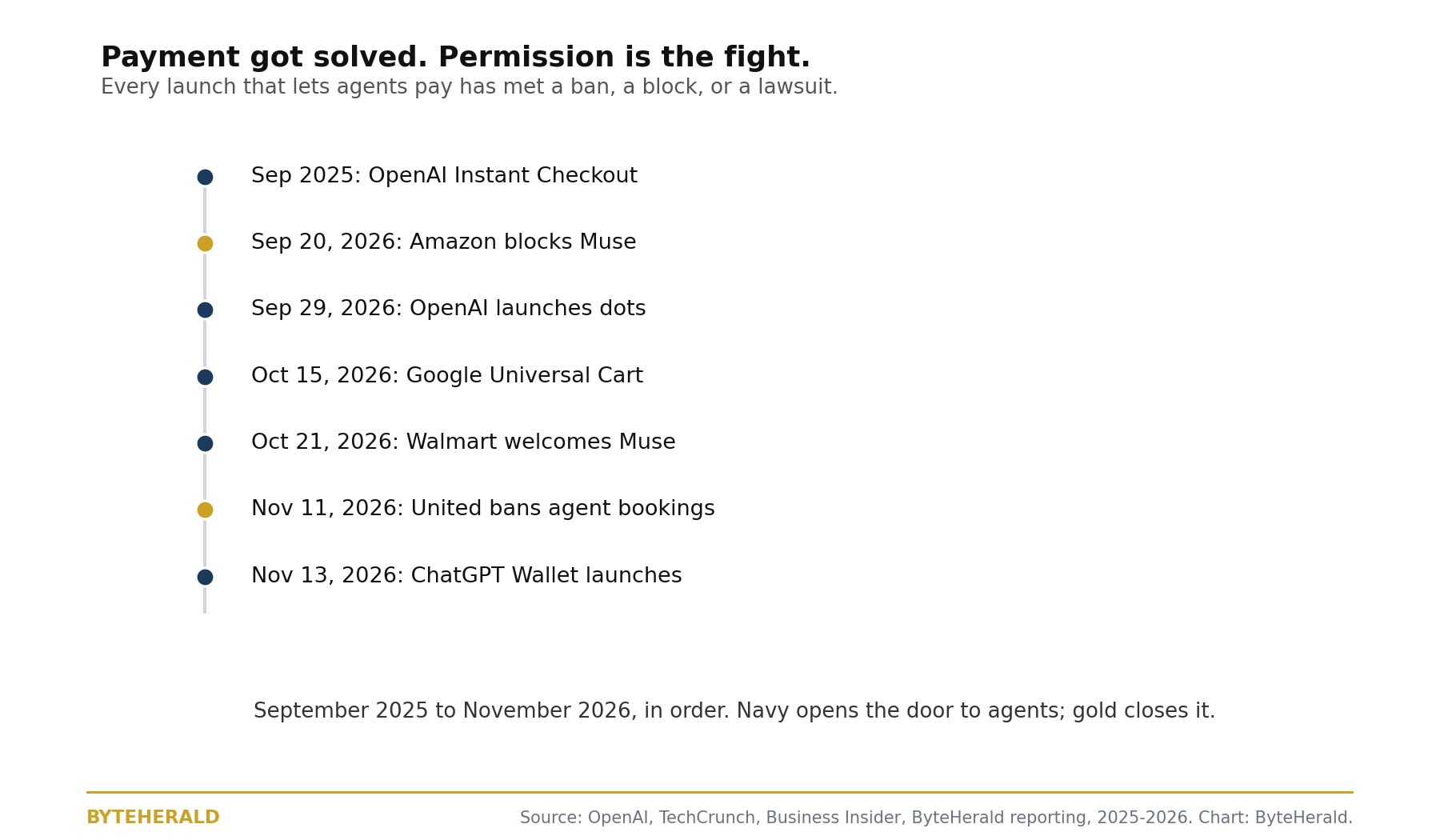
The other side of the same ledger is moving just as fast. Walmart welcomed Muse in October, and Google launched its Universal Cart on October 15, 2026, with Shopify's WebMCP checkout arriving in September. The pattern is now clear enough to state plainly: every launch that lets an agent pay has met a ban, a block, or a lawsuit somewhere else. The wallet closes the payment gap. It does not close the permission gap, and permission is the whole ballgame for a purchase that has to happen on someone else's store.
| Who | What they did | Stance toward agent purchases |
|---|---|---|
| OpenAI | ChatGPT Wallet, November 13, 2026 | Accepts, with per-purchase approval and tokens |
| Universal Cart, October 15, 2026 | Accepts, builds agent checkout infrastructure | |
| Shopify | WebMCP checkout, September 2026 | Accepts, lets agents check out in storefronts |
| Walmart | Welcomed Muse, October 2026 | Accepts, partners with Meta's agent |
| Amazon | Blocked Muse, September 20, 2026 | Blocks, steers shoppers to its own Alexa agent |
| United Airlines | Revised Contract of Carriage, November 11, 2026 | Bans agent bookings; fare search still allowed |
| Delta | Blocks agent ticket booking | Blocks |
| Yelp | Agents only via paid data licensing | Charges for access |
What merchants are being asked to do
Alongside the wallet, OpenAI published a Commerce Partner Playbook with tools and guidance for businesses that want to serve customers who shop through agents. The playbook asks merchants to claim their business in ChatGPT and, once verified, update their details and upload a product feed with current pricing and availability. It asks them to configure their content delivery network or firewall to recognize signed agent requests using Web Bot Auth, so a legitimate agent is not mistaken for a bot. And it asks them to work with their payment and risk providers so agent purchases are recognized as legitimate, because risk systems tuned to detect bots can still decline or cancel a real purchase made by an agent.
OpenAI says it is working with fraud prevention partners Forter, Riskified, Sardine, and Signifyd, and with payment service providers Adyen, Checkout.com, and Stripe, to help their systems recognize legitimate agent purchases. The wallet needs no Wallet-specific integration: the token passes through existing checkout pages and payment forms. But the company is candid that websites can still block agents inadvertently, and that risk systems may still flag valid purchases. The playbook is, in effect, OpenAI asking the internet to stop treating its agents as intruders.
Why OpenAI is doing this now
OpenAI says 1.2 billion people use ChatGPT each week, and many of them already research products, compare options, and decide what to buy inside the chat. The wallet closes the last step: research to purchase without leaving the conversation. The company tried this before with Instant Checkout in September 2025 and reworked the approach after low uptake. This time the pitch is narrower and more careful: payment without handing over card details, approval on every purchase, and no commission while the system proves itself.
The early evidence on agent shopping is mixed, which is why the careful pitch matters. DoorDash and Uber have reported low numbers of orders placed by AI agents so far, while Meta's Muse, which now has more than 10 million users, has seen shopping become a top activity on its app. That split is the bet OpenAI is making: agents will shop where the friction is lowest, and the wallet removes the friction of payment while leaving the friction of permission to the merchants. Readers who want the money side of this story should read our pricing of the whole agentic commerce stack, which mapped the fees at every layer before the wallet existed. And the timing is not accidental: OpenAI reportedly raised 15 billion dollars at a 1.25 trillion dollar valuation the day before the wallet launched, and distribution through shopping is the kind of revenue story that raise was priced on.
A payment token deserves a plain explanation, because the whole wallet rests on it. A token is a substitute card number issued by the payment network for a specific purchase, with its own security code and expiry date. The merchant charges the token, the network maps it back to the real card, and the real number never leaves the network. The agent holds the instruction, not the card. That is the security model: the thing that can be stolen, the card number, is never in the agent's hands.
What to watch next
Four things decide whether the wallet becomes a habit or a demo. First, expansion beyond Pro subscribers, which OpenAI has not dated. Second, the first disputes: a purchase an agent made that the user says they did not approve, and how the approval record holds up. Third, whether Amazon relents or whether the biggest store on the internet stays closed to every agent but its own. And fourth, the delegated purchasing OpenAI has promised, where a user pre-approves spending limits and categories and the agent buys without asking each time. That last step is where the wallet stops being a checkout button and starts being a budget. It is also where the security check that defines the launch today would have to be replaced by something else, and OpenAI has not yet said what that is.
By ByteHerald Staff. OpenAI announced ChatGPT Wallet on November 13, 2026, in a post introducing the feature for dots agents, saying it is the first wallet that lets agents pay without access to users' actual card details, requires a security check for every purchase, and is initially available to ChatGPT Pro subscribers aged 18 and older in the United States with eligible Visa, Mastercard, or American Express cards. TechCrunch reported on November 13, 2026, that the wallet charges the selected card using a payment token, that DoorDash and Uber have reported low numbers of orders placed by AI agents, that Meta's Muse has more than 10 million users with shopping as a top activity, and that Amazon, the largest retailer to ban AI agents, aims to steer users to its own Alexa agent. CNBC reported that OpenAI is not taking a percentage cut of transactions at launch, as relayed in November 13, 2026, coverage of the announcement. Dev.to reported on November 13, 2026, that United Airlines revised its Contract of Carriage on November 11, 2026, to define AI agents and list agent bookings as a prohibited practice, and that Amazon blocked Meta's Muse from buying on Amazon.com on September 20, 2026. Unite.ai reported on November 13, 2026, that dots were introduced on September 29, 2026, as always-on agents with their own cloud computer and browser.
Comments
Post a Comment