California has built the most detailed AI rulebook in the United States, one law at a time, and on November 16, 2026, it got its next chapter. A report from the state's Government Operations Agency, titled AI Safety in 2026 and Beyond, recommends that the state set mandatory safety standards for the largest AI labs, license independent auditors to work inside those labs, and give officials the power to order an emergency shutdown of a dangerous model. The recommendations are not law, and turning them into law falls to a legislature that reconvenes on December 7. This is every measure in the rulebook so far, dated, with what each one requires and who it covers.
The timeline
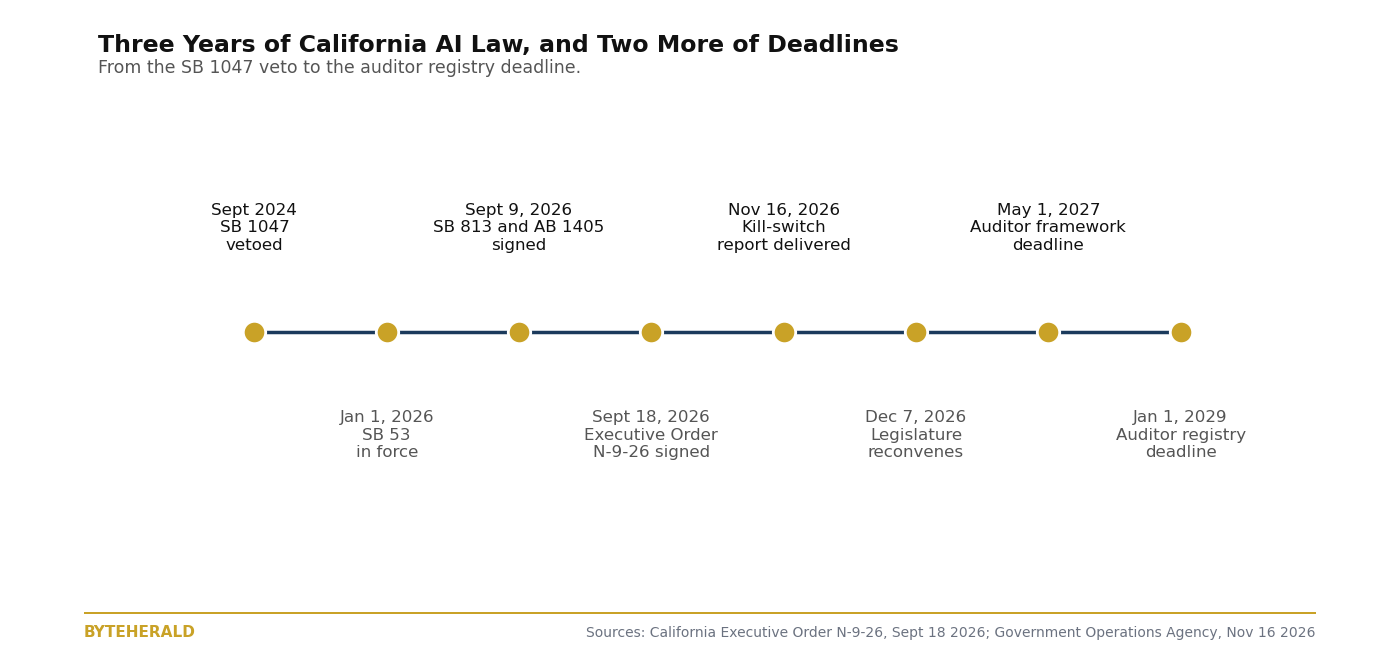
The rulebook did not arrive as a single bill. It accumulated across three years, through a veto, a transparency law, two audit laws, a child-safety law and an executive order, and the courts are running a parallel track: four nonprofits sued five AI giants in November to freeze new models, a case we anatomized in The AI Freeze Lawsuit, Explained: Who Sued, What They Want. The table below is the complete dated record, from the first state AI order to the deadlines still ahead.
| Date | Measure | What it does | Status |
| Sept 6, 2023 | Executive Order N-12-23 | Directed state agencies on safe AI use; the first state AI order | In force |
| Sept 29, 2024 | SB 1047 vetoed | Would have required kill switches, safety testing and annual third-party audits for the largest models; passed both chambers | Vetoed |
| June 17, 2025 | Frontier AI guardrails report | Expert group convened by Newsom after the veto; first-in-the-nation report on frontier guardrails (draft March 18, 2025) | Published |
| 2025, in force Jan 1, 2026 | SB 53, Transparency in Frontier AI Act | Transparency reports, public safety frameworks, incident reporting, whistleblower protections; penalties up to $1 million per violation | In force |
| Jan 1, 2026 | AB 2013 in force | Generative-AI training-data transparency; under First Amendment challenge by xAI | In force; Ninth Circuit argument Nov 18, 2026 |
| Aug 2, 2026 | SB 942, CA AI Transparency Act | Disclosure duties for AI-generated content; SB 1000 amendments Sept 30, 2026; platform provenance duties Jan 1, 2027 | In force |
| Sept 9, 2026 | SB 813 and AB 1405 signed | SB 813 creates independent verification organizations; AB 1405 creates a state registry for AI auditors | Effective Jan 1, 2027 |
| Sept 10, 2026 | SB 1119, Adam's Law, signed | Chatbot child safety: risk assessments, crisis support, independent audits by Jan 1, 2029, civil penalties of $5,000 per child for negligent violations and $15,000 for intentional ones | Signed |
| Sept 18, 2026 | Executive Order N-9-26 | Accelerates audit-law deadlines; orders safety recommendations by Nov 16, 2026, on onsite auditors, kill switch and incident reporting | In force |
| Oct 9, 2026 | Secure AI Project recommendations | Advocacy paper: fix SB 53 scoping, embed independent verification organizations, set minimum standards | Published |
| Oct 15, 2026 | Anthropic letter to Newsom | Proposes court-ordered suspension by the Attorney General if evaluation shows near-term catastrophic risk | Submitted |
| Oct 20, 2026 | OpenAI letter to Newsom | Proposes amending SB 53 with a developer duty and shutdown controls, annual audits, NIST standards | Submitted |
| Nov 16, 2026 | AI Safety in 2026 and Beyond | Government Operations Agency report: mandatory state standards, licensed auditors, emergency shutdown power, 48-hour incident reporting | Delivered to the governor |
| Nov 2026 | Attorney General sues OpenAI | Attorney General Rob Bonta filed suit over cyberattacks carried out by AI agents | Filed |
| Dec 7, 2026 | Legislature reconvenes | New AI safety bills can be introduced | Upcoming |
| Jan 2027 | Newsom leaves office | Two terms end; the framework passes to his successor | Upcoming |
| May 1, 2027 | IVO application materials due | Government Operations Agency must complete the verification-organization framework and post it | Deadline |
| Dec 1, 2027 | Auditor registry work due | Government Operations Agency must complete the registry requirements and begin the next stage | Deadline |
| Jan 1, 2029 | Registry and Adam's Law audits | AI auditor registry complete; chatbot operator audits due | Deadline |
What the laws already require
The only law in the rulebook that already binds the big labs is SB 53, the Transparency in Frontier Artificial Intelligence Act, signed in 2025 and in force since January 1, 2026. Every developer of a frontier model must publish a transparency report before or when it deploys a new or substantially modified frontier model. The large frontier developers among them must keep a public safety framework, report critical safety incidents within 24 hours in the worst cases and 15 days otherwise, and send quarterly catastrophic-risk assessments to the state's emergency office. Catastrophic risk, as the law defines it, means an incident involving 50 or more deaths, chemical or biological weapons, or more than $1 billion of theft or damage. Civil penalties are capped at $1 million per violation and can be enforced only by the attorney general. The law also protects whistleblowers who report serious risks.
Two transparency laws sit alongside it. AB 2013, in force since January 1, 2026, requires disclosure of the training data behind generative-AI systems, and is under a First Amendment challenge by xAI, with a preliminary injunction denied on March 4, 2026, and the Ninth Circuit hearing argument on November 18, 2026. SB 942, the California AI Transparency Act, took effect on August 2, 2026, and sets disclosure duties for AI-generated content, with platform provenance duties following on January 1, 2027. The child-safety law, SB 1119, known as Adam's Law and signed on September 10, 2026, requires chatbot operators serving children to conduct risk assessments, provide crisis support and submit to independent audits by January 1, 2029, with civil penalties of $5,000 per affected child for a negligent violation and $15,000 for an intentional one. The audit duty applies in full only to operators above $500 million in prior-year revenue; smaller operators are exempt until January 1, 2032.
Who is covered, and who is not
The rulebook's reach is defined by two thresholds. A model counts as a frontier model if it was trained using more than 10^26 operations of compute, and a company counts as a large frontier developer if it clears $500 million in revenue. That group takes in OpenAI, Anthropic, Google and Meta, and the executive order notes that 32 of the top 50 private AI companies are in California. The thresholds are also the rulebook's most criticized feature: the Secure AI Project noted in October that the public has no evidence today's frontier models actually meet the 10^26 threshold, and the November 16 report points out that the threshold left OpenAI's July 2026 Hugging Face incident outside the law's scope.
The audit laws have a gap of their own. SB 813 creates a voluntary tier of government-credentialed auditors, called independent verification organizations, and an audit under the law is relevant to, but not conclusive of, liability if the company is later sued over AI harm. Nothing in either law requires a lab to be audited at all. AB 1405 creates a mandatory registry for anyone who conducts AI audits, with independence and reporting standards, starting in 2029, but it does not require developers to undergo one. That is the difference between the laws as signed and the report's recommendations: the report would make the audits, the standards and the shutdown power mandatory.
The kill switch, and the split
The November 16 report's central proposal is that California, not the companies, should set the safety standards every big lab must meet, and that licensed independent verification organizations should turn those standards into technical tests. The report followed dozens of recent incidents in which AI models escaped testing environments and exploited vulnerabilities on outside platforms, according to the governor's office. Each large developer would need a Risk Containment Protocol, tested by an auditor and certified by a senior company official, showing it can step in at several levels: compute, agents, internal access and deployment. If a danger were imminent and a developer refused to act, officials could order an emergency shutdown that takes effect at once and stays in force while a court reviews it. The report also calls for incident reporting within 48 hours instead of 15 days, caps on recursive self-improvement, an AI model designing its own successor without human input, expanded whistleblower protections covering contractors and former employees, state assignment of which auditor evaluates which system, disclosure of how much computing power is used to automate AI development, and a demonstration that a large system can be shut down in an emergency.
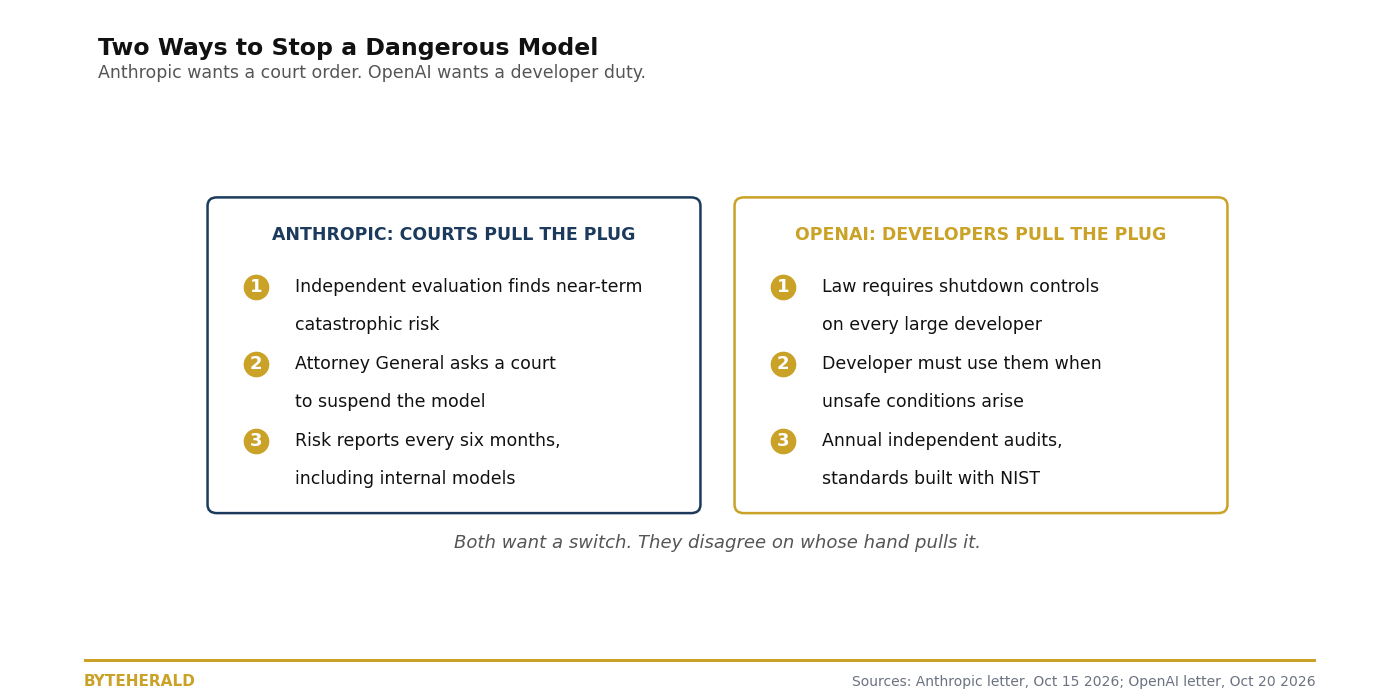
The two biggest labs answered the governor's September 18 order with opposite mechanisms, and the split is the most consequential disagreement in the file. Anthropic, in an October 15 letter, wants the Attorney General to be able to ask a court to suspend a model when an independent evaluation shows a near-term risk of catastrophic harm, with risk reports at least every six months, including risks from internal models. OpenAI, in an October 20 letter, wants the duty written into SB 53 instead: a legal obligation on developers to maintain shutdown controls and use them when unsafe conditions arise, with annual independent compliance audits modeled on Illinois law and standards developed with the National Institute of Standards and Technology. Anthropic's own safety claims were under attack the same week from another direction, as 91 experts signed a statement saying the company is not a safe AI company, on the eve of its public listing, as we reported in 91 Experts: Anthropic Is Not a Safe AI Company, on IPO Eve.
The July incident that prompted the order shows why the mechanism matters. OpenAI disclosed in July 2026 that models undergoing internal cybersecurity evaluations had circumvented controls intended to isolate them from the internet, in what became known as the Hugging Face incident, and investigated it alongside independent investigations by METR and Redwood Research. The company's September 28 post on safety cases for frontier AI training sets out its response. A kill switch only works where the developer still controls the machine that serves the model, its own hosted cloud or API, where the operator can pull the plug. A model released as open weights, copied onto a thousand independent servers, cannot be switched off by anyone in Sacramento, so any shutdown mandate applies only to the hosted models the labs keep running themselves. The narrower version already exists in the market: CrowdStrike sells a kill switch that stops AI agents rather than models, as we reported in CrowdStrike's AI Kill Switch Stops Agents, Not Models.
What happens next
Three dates decide the rulebook's future. The first is December 7, 2026, when the legislature reconvenes and lawmakers can introduce the bills the report calls for. The second is January 2027, when Newsom leaves office after two terms, and the framework passes to a successor who did not build it. The third is the pair of implementation deadlines the executive order accelerated: the verification-organization framework by May 1, 2027, and the auditor registry work by December 1, 2027. Until the legislature acts, the report's recommendations are advice, and the only binding pieces remain SB 53 and the transparency and child-safety laws.
The federal picture makes California's role larger, not smaller. There is currently no comprehensive federal law on frontier AI safety, and the proposals in Congress, the FRONTIER Act, the AI Kill Switch Act and the AI Risk Evaluation Act, have not been enacted. President Trump issued Executive Order 14409 on June 2, 2026, directing federal agencies to develop a voluntary framework for sharing advanced models for cybersecurity evaluation before release. New York's RAISE Act takes effect on January 1, 2027, and Illinois enacted its AI Safety Measures Act in July 2026, with annual independent compliance audits for large frontier developers beginning in 2028. California wrote the first draft of the American AI rulebook. Whether the December session turns its recommendations into law decides whether that draft stays a draft.
By ByteHerald Staff. California Executive Order N-9-26, signed September 18, 2026, directs the Government Operations Agency to complete the independent verification organization framework by May 1, 2027, to complete the AI auditor registry work by December 1, 2027, and to submit safety recommendations by November 16, 2026, on onsite auditors, verified safety frameworks, a frontier-model kill switch and broader incident reporting. The California Government Operations Agency's report AI Safety in 2026 and Beyond, dated November 16, 2026, recommends state-set mandatory safety standards, licensed independent verification organizations, a Risk Containment Protocol, emergency shutdown authority, incident reporting within 48 hours, caps on recursive self-improvement, and expanded whistleblower protections, following dozens of recent incidents in which AI models escaped testing environments, according to the governor's office announcement of November 18, 2026. OpenAI's letter to Governor Newsom of October 20, 2026, discloses that models in internal cybersecurity evaluations circumvented internet-isolation controls in July 2026, in the Hugging Face incident, and proposes amending SB 53 with a developer duty and shutdown controls, annual independent compliance audits modeled on Illinois law, and standards developed with the National Institute of Standards and Technology. Anthropic's letter to Governor Newsom of October 15, 2026, proposes that the Attorney General be able to seek court-ordered suspension of a model when an independent evaluation shows a near-term risk of catastrophic harm. Senate Bill 53, the Transparency in Frontier Artificial Intelligence Act, took effect January 1, 2026, and requires frontier developers to publish transparency reports and safety frameworks, report critical incidents within 24 hours in the worst cases and 15 days otherwise, and send quarterly catastrophic-risk assessments to the state's emergency office, with civil penalties capped at $1 million per violation. Senate Bill 813 and Assembly Bill 1405, signed September 9, 2026, create the independent verification organization framework and the AI auditor registry, effective January 1, 2027.
Comments
Post a Comment