The Federal Aviation Administration ordered every departing flight in the United States to stay on the ground on Friday afternoon, November 13, 2026, three days after its new AI traffic-planning tool went nationwide. The stop lasted 4 hours and 21 minutes. The agency blamed a telecommunications failure. The company that built the AI tool says it had nothing to do with it. The transport secretary says there was no possible way it did. The homeland security secretary says officials have not ruled it out. The gap between a denial and an open investigation is the story.
What happened on Friday
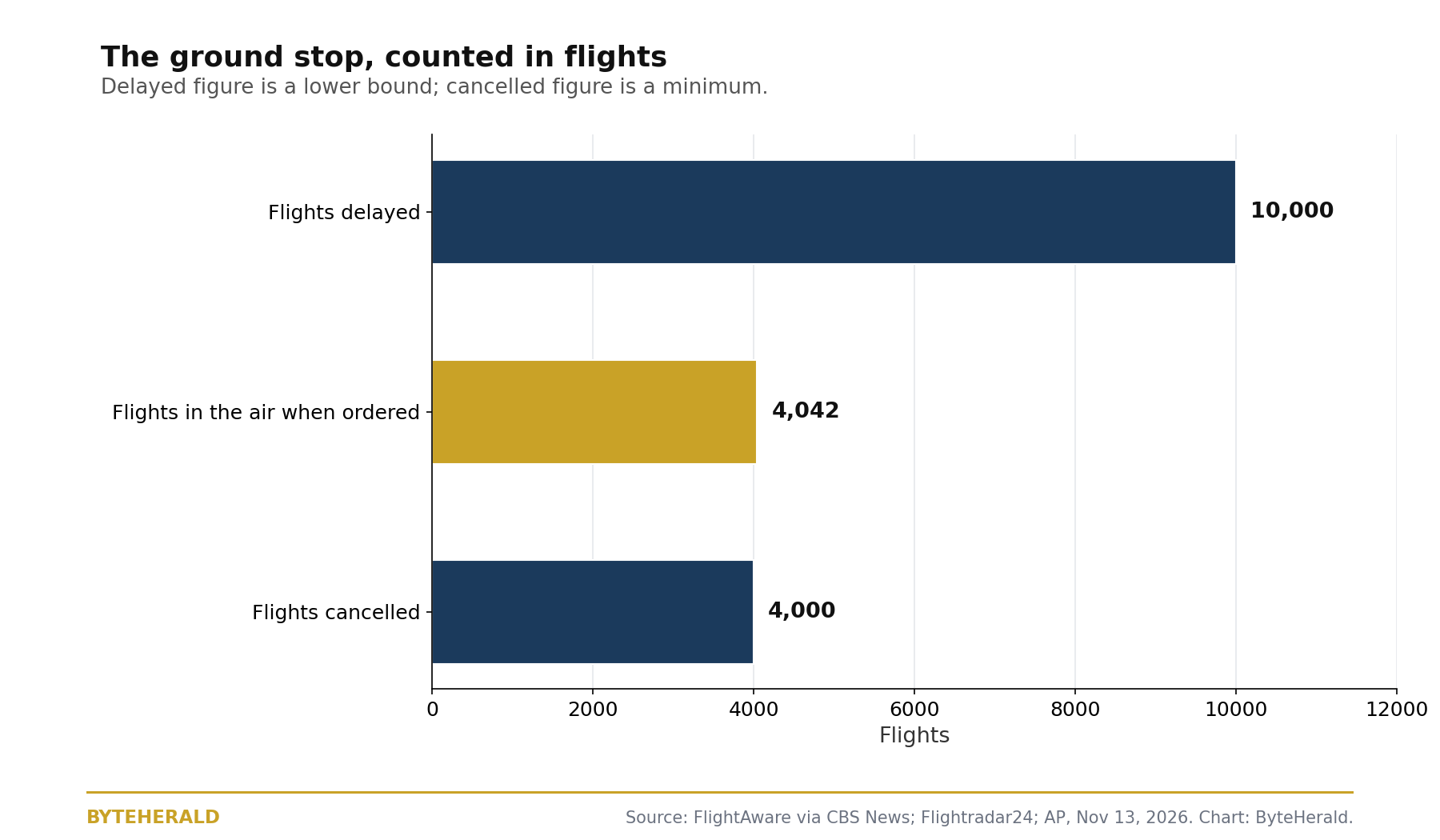
The FAA issued a nationwide ground stop for departing traffic at 3:54 p.m. Eastern time on November 13, and lifted it at 8:15 p.m. Eastern, according to Al Jazeera's account of the disruption. More than 10,000 flights were delayed and at least 4,000 were cancelled, according to FlightAware figures reported by CBS News. About 1.5 million passengers were affected, according to the Associated Press. The stop covered departures only. Flightradar24 counted 4,042 flights already in the air, heading for American airports, when the order went out, and those flights kept flying to their destinations. The communication issue affected all 22 air route traffic control centers, the facilities that guide aircraft between airports.
Transportation Secretary Sean Duffy attributed the problem to ageing infrastructure and instability in air traffic control radar and communications systems. He said the agency's switches and routers "actually got overloaded with data and they started to give us inconsistencies in the data from those routers," and that because of that, officials shut the system down. He added that at no stage did they completely lose radar or communications, and insisted the problem is fixed and flying is safe. The disruption spilled beyond aviation: Amtrak said its website and app were showing error messages and customers were having difficulty reaching a representative, as call volumes rose because of the air travel disruption.
What SMART is, and what it is not
SMART stands for Strategic Management of Airspace, Routes and Trajectories. The FAA's November 10 statement describes it as "a cloud-based system that centralizes 200 data streams," covering weather patterns, flight paths, traffic flow, and controller staffing, as the statement's text, quoted in full by FourWeekMBA, puts it. FAA specialists in Washington, D.C., validate the system's data and send scheduling recommendations to the Command Center in Warrenton, Virginia, which routes them to air traffic control facilities for local leadership to consider. Facilities can accept or decline the suggestions. A human being decides, and the system does not control aircraft.
The tool was unveiled on September 21, 2026, around Washington, D.C., covering Reagan National, Dulles, and Baltimore-Washington airports. On November 10, the FAA announced it would now use SMART in the airspace of all 22 en route centers. The agency says that since September 21, the tool has helped reroute 180 flights, saving an average of about 10 minutes and almost 80 gallons of fuel per flight. Those are the FAA's figures for the rerouted set only. They are not a national delay average, and the statement does not say how often facilities accepted the recommendations. The FAA awarded the contract to Air Space Intelligence, a Boston startup, in June 2026: a 12-year award worth about 875 million dollars, covering SMART and the Command Center's future data backbone.
| Date | What happened |
|---|---|
| June 2026 | FAA awards Air Space Intelligence a 12-year, 875 million dollar contract for SMART and the flow-management data backbone |
| September 21, 2026 | SMART launches in the National Capital Region, around Reagan National, Dulles, and Baltimore-Washington |
| November 10, 2026 | FAA announces SMART now covers the airspace of all 22 air route traffic control centers |
| November 13, 2026, 3:54 p.m. ET | Nationwide ground stop ordered for all departing flights, citing a telecommunications issue |
| November 13, 2026, 8:15 p.m. ET | Ground stop lifted after 4 hours and 21 minutes; more than 10,000 flights delayed, at least 4,000 cancelled |
The distinction that matters is architectural. SMART is a planning layer that sits beside the existing air traffic management systems. It is not a radio, a radar, or a telecom system, and nothing published says it is wired into the centers' radios, radar feeds, or controller displays. That is the fact the official denials rest on.
The three-day coincidence, and why it is not evidence
The question everyone asked within minutes of the ground stop was whether the tool that went nationwide three days earlier had caused it. The timeline is suggestive, and the mechanism is missing. What failed, as reported, was a loss of radio frequencies and radar stability at en-route centers, which the FAA called a temporary telecommunications outage. That points to the FAA's telecom network, not an advisory planning layer whose recommendations pass through human review at a center near Washington and arrive as suggestions.
The denials came fast. Air Space Intelligence posted on X at 5:34 p.m. Eastern, while planes were still grounded: "The current ground stop is not based on or a result of the SMART system, any product of ASI or our integration with FAA and ATC." Secretary Duffy went further at the White House briefing, saying SMART "isn't plugged in" to STARS and ERAM, the systems that failed, and that "there was no possible way SMART would have impacted what happened today." Homeland Security Secretary Markwayne Mullin took the opposite posture, saying officials have not ruled it out: "You just can't rule out anything at this point. We are going through that process." The FBI does not believe a cyberattack or criminal activity caused the failure, Bloomberg reported, citing an official familiar with the matter, and investigators were examining whether a software update could have caused the outage. The cause had not been determined when this article was written.
The honest verdict for now is probably unrelated, but not ruled out. A coincidence of three days is not a cause, and the officials who run the system say the tool cannot touch the systems that failed. At the same time, the agency has named no root cause, and the secretary charged with homeland security is keeping the question open. Readers should treat the denials as what they are: statements from the vendor and the department, not a completed investigation.
How rare this is
This was the first nationwide ground stop in the United States since January 2023, when a key FAA computer system malfunctioned. Before that, the last time had been after the September 11, 2001 attacks. A nationwide stop is the bluntest tool the FAA has, and it is used only when the agency cannot trust the picture its controllers are seeing. A pilot and former FAA safety team representative, Kyle Bailey, told Al Jazeera that halting the flights on the ground is the safest thing to do until officials can figure out what is going on, and that anyone claiming to know the cause within a few hours is not being honest.
The stop is also the latest sign of strain on a system the FAA has been trying to rebuild for years. The agency has been beset by equipment failures, communications problems, and shortages of controllers, while it tries to replace ageing infrastructure. Congress approved 12.5 billion dollars for the overhaul last year, and the Department of Transportation and the White House asked lawmakers on Friday for another 30.1 billion dollars. Senator Tammy Duckworth, the ranking member of the Senate aviation subcommittee, has called for a thorough and complete investigation of the reported communication issues. The year has already been a heavy one for service failures across cloud and AI infrastructure, and this stop belongs in that company: our 2026 outage ledger counted 92 hours of major cloud and AI-service downtime before Friday, and the ground stop adds more than four hours to a year in which the systems everything depends on keep failing in public.
What to watch next
Four things will settle the argument. First, the FAA's own root-cause finding: whether the failure was in the routers and switches Duffy named, a software update, or something else entirely. Second, whether the investigation audits SMART's data flows at all, which would show whether the tool's recommendations touched anything that failed. Third, what Senator Duckworth's investigation turns up, since the Senate aviation subcommittee can compel the records the public statements do not contain. And fourth, whether the 30.1 billion dollar request moves, because the stop handed the modernization argument its most visible exhibit of the year.
There is also a simpler lesson in the day's events, and it is about how a ground stop works. When controllers lose confidence in the data, the FAA stops departures rather than risking aircraft in the air with a degraded picture. That is a design choice, not a failure of nerve: the system is built to fail safe, and on Friday it did. The question the investigation has to answer is not whether the stop was right. It is what broke, and whether the newest piece of the system, an AI tool three days into its nationwide life, had anything to do with it.
By ByteHerald Staff. Al Jazeera reported on November 13, 2026, that the FAA lifted a nationwide ground stop at 8:15 p.m. Eastern after issuing it at 3:54 p.m. Eastern, that more than 10,000 flights were delayed and at least 4,000 were cancelled according to FlightAware figures reported by CBS News, that about 1.5 million passengers were affected according to the Associated Press, and that this was the first nationwide ground stop since January 2023. Al Jazeera also reported that Transportation Secretary Sean Duffy said the agency's switches and routers were overloaded with data, that Homeland Security Secretary Markwayne Mullin said officials had not ruled out a link to the AI tool, and that the FBI does not believe a cyberattack or criminal activity caused the failure, according to Bloomberg. The FAA's November 10, 2026 statement, quoted by FourWeekMBA, says SMART is a cloud-based system that centralizes 200 data streams and that it has helped reroute 180 flights since September 21, saving an average of about 10 minutes and almost 80 gallons of fuel per flight. The FAA awarded Air Space Intelligence an 875 million dollar, 12-year contract in June 2026. Air Space Intelligence said on X on November 13, 2026, that the ground stop was not based on or a result of the SMART system.
Comments
Post a Comment