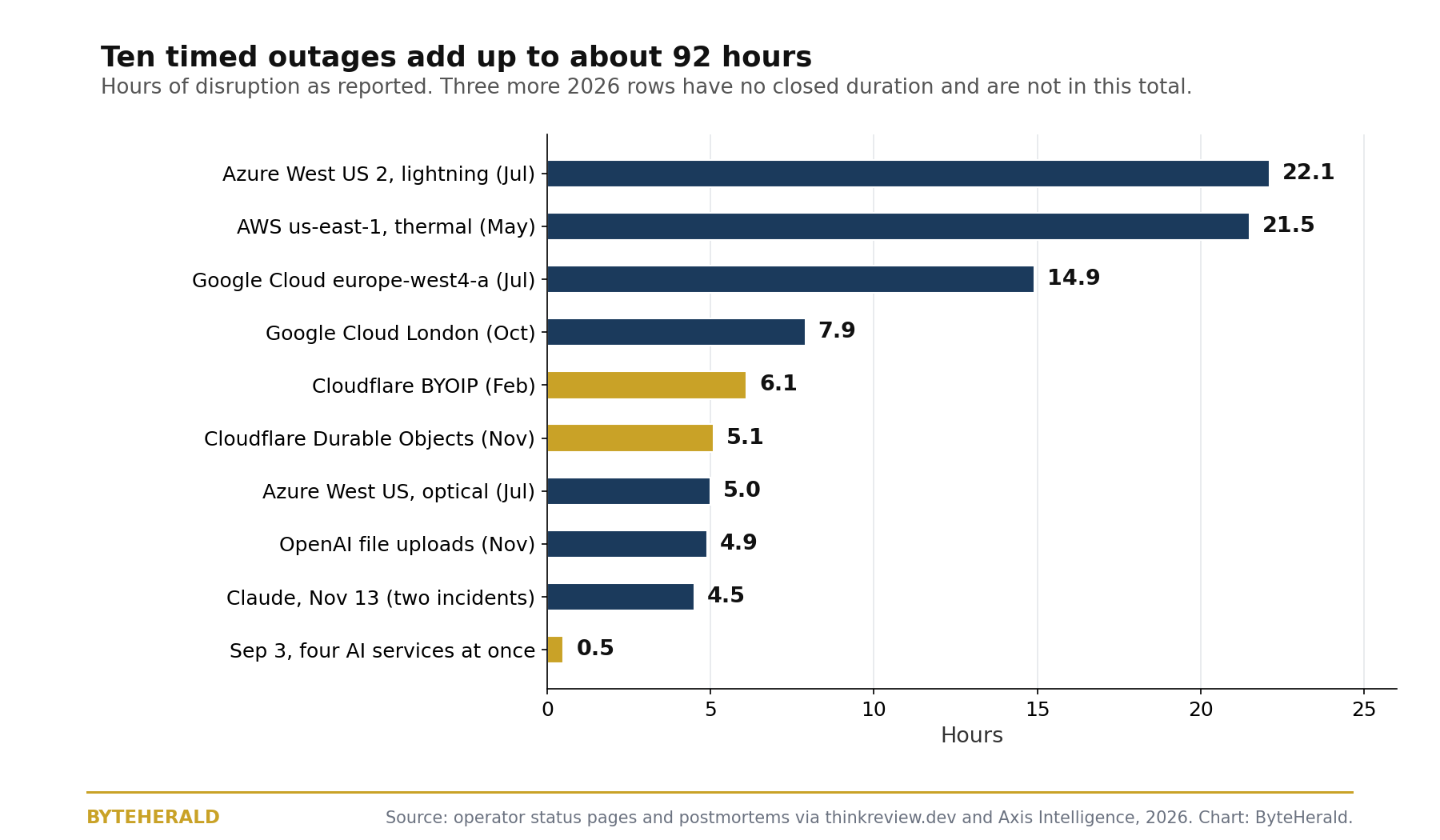
In 2026, the services the AI economy runs on kept going dark. A tracker that reads operator status pages counts 39 major cloud and internet-infrastructure incidents this year, through November 11. We read the postmortems and status pages behind the biggest ones and built the ledger: 13 major outages, ten with fully timed durations that add up to about 92 hours, and one cause behind most of it.
The ledger: thirteen outages, dated and counted
Every row below comes from an operator's own status page, postmortem, or incident review, as logged by the trackers and analyses we cite. Durations are as reported. Three rows have no closed duration, because the operator never published one or the incident was still open at our cutoff, and those rows are excluded from the 92-hour total. The total is our own arithmetic, and we label it as such wherever it appears.
| Date, 2026 | Service | Duration | Cause as reported | Blast radius |
|---|---|---|---|---|
| February 20 | Cloudflare | 6 hours 7 minutes | Config automation deleted prefixes it meant to filter | About 1,100 of 4,306 BYOIP prefixes withdrawn; Bring Your Own IP customers lost routes |
| March 2 | Claude | Not stated | Not stated | Login worldwide; web, apps, and Claude Code down from 11:49 UTC; the API kept working |
| May 7-8 | AWS us-east-1 | 21 hours 30 minutes to majority recovery | Thermal event, automatic shutdowns | Region-wide; recovery measured to majority, not full, service |
| July 15 | Google Cloud europe-west4-a | 14 hours 55 minutes | 3-millisecond utility sag; hall reached 44 degrees C | VMware Engine, Bare Metal Solution, and NetApp Volumes interrupted |
| July 23 | Azure West US | 4 hours 57 minutes | Break-fix on one optical device expanded by a blast-radius defect | Traffic entering or leaving the region failed; traffic inside the region did not |
| July, same week | Azure West US 2 | 22 hours 6 minutes | Lightning locked cooling out | Region cooling failure; longest single outage in this ledger |
| August 24 | Claude | Not stated | Not stated | Claude models across products; 55 percent of user reports were about Claude Code |
| September 3 | Claude, ChatGPT, Codex, Grok | About 30 minutes | Shared Cloudflare fault | Four rival AI services failed in the same half hour; switching providers did not help |
| October 20 | Google Cloud London, europe-west2-b | About 7 hours 52 minutes | Power event in one zone | Lloyds, Halifax, HSBC, Revolut, Royal Mail, Rightmove, DPD, BT, Screwfix; court live streams failed |
| November 3 | OpenAI, ChatGPT file uploads | 4 hours 53 minutes | Not stated | File upload errors in ChatGPT |
| November 12 | Cloudflare Durable Objects | 5 hours 5 minutes | Increased error rates, North America | Durable Objects errors; Workers API also degraded the same week |
| November 12-13 | Microsoft 365 | Still open at Friday noon, Central time | Servers became unexpectedly unavailable; no cyberattack | Outlook, Teams, and Copilot; about 140,000 Downdetector Outlook reports at peak; 74 countries; 430 million plus users |
| November 13 | Claude | Authentication failure 2 hours, resolved 11:58 UTC; degraded performance 13:09 to 15:38 UTC, resolved | Not stated | Two incidents in one day; the Microsoft 365 connector failing since November 12 |
A note on the count. The ledger has 13 rows, and the table above shows 13. Ten of them carry a closed duration, and those ten add up to 92.4 hours, which we round to about 92. The November 13 Claude row carries two separate incident windows, an authentication failure of 2 hours and degraded performance of 2 hours 29 minutes, which together add 4.5 hours to the total. The other three, Claude in March, Claude in August, and Microsoft 365, are listed with the duration the operator actually gave, which is none, or "still open." Adding an estimate for them would make the total a guess, so we did not. One row needs a note on method: Cloudflare's postmortem states a total of 6 hours 7 minutes from 17:48 UTC, while its event table runs 17:56 to 23:03. We use the operator's headline total, as we do for every row.
The pattern: power and cooling
Four of the ten timed rows share one cause, and those four rows account for most of the year's downtime. A thermal event in AWS us-east-1 in May ran 21 hours 30 minutes to majority recovery. A three-millisecond sag on a utility feed in Google Cloud's europe-west4-a region in July tripped breakers, dropped a chiller controller offline, and left a server hall at 44 degrees C for 14 hours 55 minutes. Lightning locked the cooling out of Azure West US 2 the same month for 22 hours 6 minutes, the longest single outage in this ledger. And a power event in one London zone took Google Cloud down for about 7 hours 52 minutes on October 20, hitting banks, couriers, and court live streams. Together, power and cooling account for 66.4 of the 92.4 timed hours, or about seven tenths of it.
That is not a coincidence. It is what happens when compute density rises faster than the power and cooling around it. The July Google incident is the clearest example: one diesel rotary backup took the load and the other did not, two server rows moved to the surviving feed, the third went dark, and the spare chiller was out for construction. Every layer had a backup except the one that failed. The October London incident is the same story at smaller scale: a power event in one of three zones, mitigated in about five and a half hours, resolved for most customers in about eight.
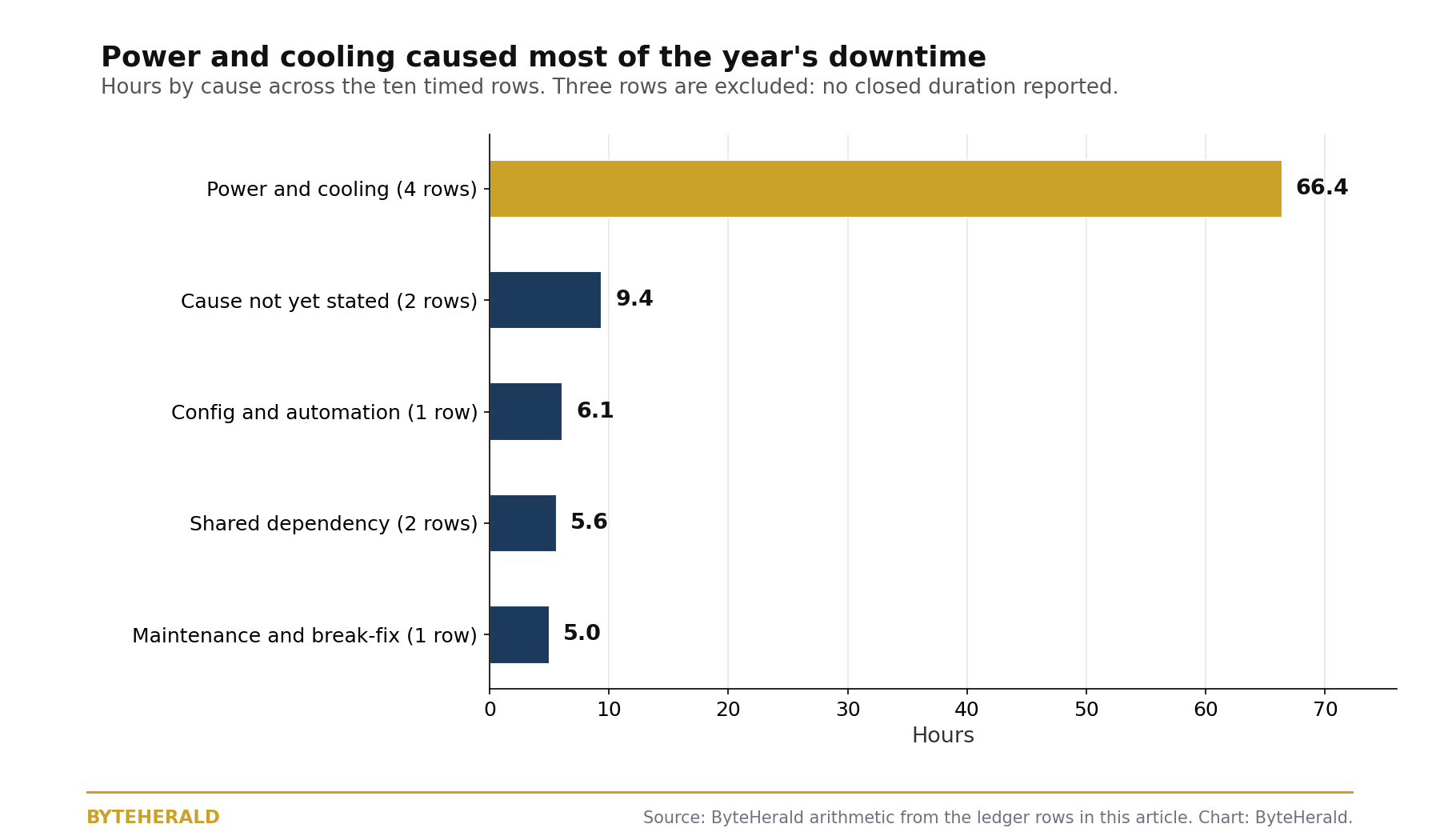
The rest of the timed hours split four ways. Cause not yet stated accounts for 9.4 hours: OpenAI's November 3 file-upload errors, for which no incident review had been read at the time the tracker logged it, and the two Claude incidents of November 13, for which Anthropic has given no cause. Config and automation accounts for 6.1 hours, the February Cloudflare incident in which a cleanup task asked for prefixes pending deletion, passed an empty value, and received every prefix instead, deleting about 1,100 of them before an engineer stopped it. Shared dependency accounts for 5.6 hours: the September 3 failure that took four AI services down together, and Cloudflare's Durable Objects errors on November 12. Maintenance and break-fix accounts for 5.0 hours, the July Azure West US incident in which a repair on one optical device expanded to every optical device leaving a datacenter. The components are rounded to one decimal place, so they add to 92.4 hours before rounding.
The week that broke the pattern's back
November 12 and 13 packed three ledger rows into two days, and they were not independent. Microsoft 365 went down on November 12, knocking out Outlook, Teams, and Copilot for users in 74 countries, and stayed down into November 13, stretching into Asia-Pacific business hours. Claude went down twice on November 13, first an authentication failure from 09:58 to 11:58 UTC, then degraded performance from 13:09 UTC, resolved at 15:38 UTC. And the third problem was the link between them: Claude's Microsoft 365 connector, the piece that lets Claude read mail, calendars, SharePoint, and Teams chats, has been failing since 17:52 UTC on November 12, because of the Microsoft 365 incident itself. We published the full Microsoft 365 timeline and the full Claude timeline on the morning of November 13, and this ledger adds the year's context those timelines could not carry.
Cloudflare was degrading the same week, with Durable Objects errors in North America and Workers API availability issues on November 13. The year's worst week for outages was also the week in which the services most visibly depend on one another. That is the ledger's second pattern, and it is the one that should worry a buyer more than the hours do.
The shared-dependency lesson
September 3 is the shortest row in the ledger and the most instructive. Claude, ChatGPT, Codex, and Grok failed within the same half hour, and the cause was not any one AI company. It was a problem at Cloudflare, the infrastructure in front of many websites and apps. Switching providers did not help, because the providers shared the same dependency. The lesson the morning's Claude post drew from November 13 is the same lesson, stated the other way: keep a second provider available for time-sensitive work, because the fallback can fail on the same day as the primary.
That is the test this ledger is really running. Every outage has a cause, and most causes are boring: power, cooling, a config push, a repair that went wide. The question that decides how much an outage costs you is not what broke. It is what else breaks with it. A buyer who runs two AI providers behind one Cloudflare account, or two cloud regions behind one power feed, has one provider, not two. The ledger's rows keep proving it, and the proof keeps arriving in the same week as the promise that this time the redundancy is real.
Three checks before you depend on one provider
First, read the status page, not the marketing page. A provider's status history shows how often it fails, how long it takes to recover, and whether it publishes a postmortem. Anthropic's status page, for example, showed 15 Claude incidents in the last 30 days, about 37 hours of disruption, before November 13 added two more. That number is more useful than any uptime percentage, because it counts what actually happened.
Second, ask what your fallback shares with your primary. If both go through the same content delivery network, the same identity provider, or the same region, they will fail together. September 3 proved it for four AI services at once. November 12 proved it for Claude's Microsoft 365 connector, which failed because the service it connects to failed.
Third, ask what the provider has not said yet. Four rows in this ledger carry no stated cause, and the Google Cloud London postmortem was still unpublished when ThinkReview checked on October 21, 2026. An unpublished cause is not a resolved cause. It is a risk you are carrying without a price on it.
What is missing from this ledger
This ledger covers the 13 biggest outages of 2026 by blast radius, not all 39 major incidents the tracker counts. Sentry, GitHub, Render, DigitalOcean, Discord, Netlify, Notion, Figma, DENIC, and npm all appear in that 39, and their incidents matter to the developers who depend on them. We did not include them because this ledger is about the cloud and AI services the AI economy runs on, and because each row needs a duration and a cause from a primary source, which the smaller incidents often lack.
One date trap deserves a correction in plain sight. The famous October 20 AWS outage, the DynamoDB DNS failure that hit 140 services and generated more than 11 million Downdetector reports, happened on October 20, 2025, not 2026. It is not in this ledger. The October 20, 2026, event is the Google Cloud London power cut, one year to the day later. Search results mix the two, and any ledger that does not say so will be read as claiming both.
Our method is public: we count only what operators and trackers published, we exclude rows without a closed duration from the total, and we label our arithmetic as ours. The full method lives on our methodology page, and any correction to this ledger will be logged publicly there.
By ByteHerald Staff. The Axis Intelligence Cloud Outage Tracker logs 39 major cloud and internet-infrastructure outages in 2026, with the latest dated November 11, 2026, and counts Sentry with 9, GitHub with 6, Microsoft Azure with 5, and Cloudflare with 3. ThinkReview reported on October 21, 2026, that Cloudflare's February 20, 2026, automation withdrew about 1,100 of 4,306 BYOIP prefixes, that the incident's total duration was 6 hours 7 minutes, that Azure West US failed from 14:44 to 19:41 UTC on July 23, 2026, after a break-fix expanded to every optical device leaving a datacenter, that Azure West US 2 ran 22 hours 6 minutes after lightning locked cooling out, that Google Cloud's europe-west4-a hall reached 44 degrees C during a 14 hour 55 minute interruption on July 15, 2026, and that AWS us-east-1 took 21 hours 30 minutes to majority recovery after a thermal event on May 7 to 8, 2026. Quietly Code reported on October 15, 2026, that Claude suffered a global login outage starting at 11:49 UTC on March 2, 2026, that Claude failed again on August 24, 2026, with 55 percent of user reports about Claude Code, and that Claude, ChatGPT, Codex, and Grok failed together for about 30 minutes on September 3, 2026, because of a shared Cloudflare fault. Fraser Annis wrote on Substack on October 21, 2026, that Google Cloud's London region suffered a power event from 06:08 UTC on October 20, 2026, mitigated by 11:36 UTC and resolved for most customers by about 14:03 UTC, affecting Lloyds, Halifax, HSBC, Revolut, and Royal Mail. Anthropic reported on its status page on November 13, 2026, that an authentication failure affecting claude.ai, Claude Code, and the developer console ran from 09:58 to 11:58 UTC and that degraded performance began at 13:09 UTC, with recovery reported at 14:36 UTC and the incident marked resolved at 15:38 UTC. StatusPal reported on November 13, 2026, that it counts 15 Claude incidents in the last 30 days, about 37 hours of disruption in total. Microsoft reported on November 13, 2026, that its Microsoft 365 outage began on November 12, 2026, with servers unexpectedly unavailable, and Downdetector logged about 140,000 Outlook problem reports at peak across 74 countries.
Comments
Post a Comment