A British chip startup that has never shipped a product raised 720 million dollars on November 11, 2026, at a valuation of about 7 billion dollars. Fractile, founded in London in 2022, designs chips for running AI models, and its new Series C round was led by Thrive Capital, Founders Fund, Lightspeed Venture Partners, and Redpoint, with Britain's Sovereign AI Fund joining as a backer.
What 720 million dollars buys
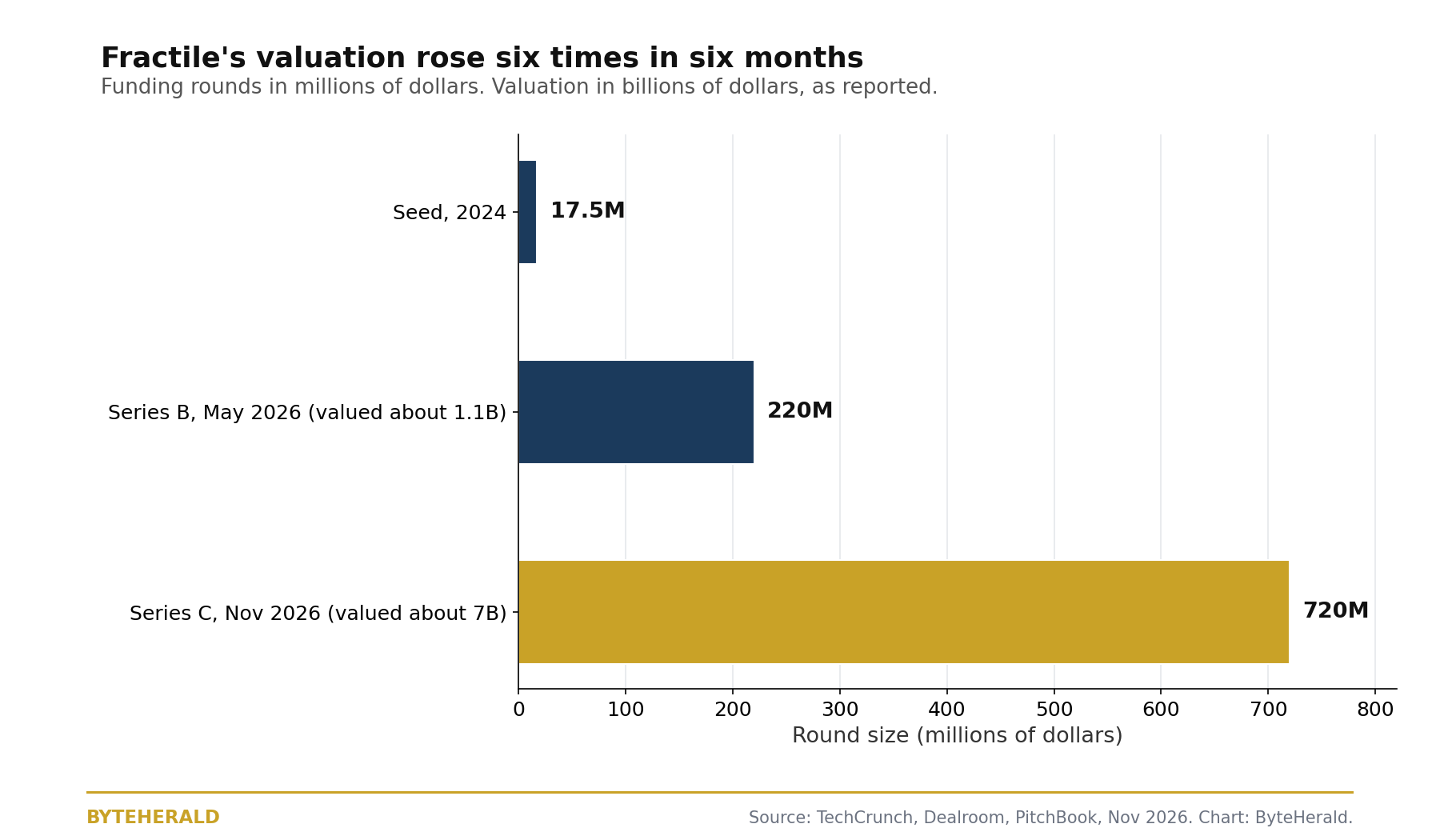
The round is a Series C of 720 million dollars, announced November 11, 2026, according to TechCrunch. The British government put the valuation at over 5 billion pounds, and the Financial Times and a Reuters source put the dollar figure at about 7 billion, TechCrunch reported. That is more than six times the roughly 1.1 billion dollar valuation of Fractile's Series B, a 220 million dollar round that closed in May 2026, according to Crypto Briefing. PitchBook puts the company's total raised at about 1.09 billion dollars. Dealroom records earlier rounds of about 17.5 million dollars in 2024 and 23 million dollars in early 2026, before the 220 million dollar Series B.
The chip that does not exist yet
Fractile's bet is about memory. Running large models is limited less by raw compute than by moving data to the chip, and Fractile's answer is to stack DRAM, the most common type of memory, on top of each chip, after dropping an earlier design based on SRAM in-memory compute, TechCrunch reported. The company pairs the hardware with its own machine learning compiler and describes itself as a frontier AI company rather than a chip vendor. Chief executive Walter Goodwin wrote that the new funding will let the company ship its first chips and systems next year, in 2027. The company has about 150 staff across London, Bristol, San Francisco, and Taipei, and as of October 30, 2026, it had no shipped silicon and no independent benchmark, according to Macroplane's comparison of inference-chip startups. Bloomberg reported an initial deal for Anthropic to buy about 250 million dollars of Fractile chips for 2027 delivery, though neither company commented on it. The memory bottleneck Fractile is betting against is the same one we mapped in our Memory Wall pillar, which tracked how high-bandwidth memory stacks decide what AI hardware can do.
The Graphcore warning
The cautionary tale is British, too. Graphcore, the last British AI chip startup to command this kind of money, raised about 700 million dollars, peaked near a 3 billion dollar valuation in 2020, and was sold to SoftBank in July 2024 for a price it never disclosed. The pattern is the risk in Fractile's round: valuations in this market are set by what investors believe the next chip will do, not by what the current one has done. Three things would have to be true for the 7 billion dollar price to hold. First, the chips ship in 2027 as Goodwin promises. Second, independent benchmarks confirm the speed claims, which so far exist only in the company's own materials. Third, customers beyond one reported Anthropic deal actually buy them.
Why investors paid anyway
The money is not irrational. Inference, the work of running trained models in live products, is now the largest and fastest-growing slice of AI compute, and purpose-built inference chips are the bet that general-purpose GPUs leave money on the table. Fractile is not alone in that bet: Etched raised 700 million dollars in August 2026 at a reported 21 billion dollar valuation, Tenstorrent closed a 1.5 billion dollar round in October at a 6.2 billion dollar valuation, and Positron raised 875 million dollars in September at a 5 billion dollar valuation. The question is not whether inference chips are a real market. It is whether a company with no shipped product, no public benchmark, and a first delivery date a year away is worth 7 billion dollars today, when the last British company to make that argument ended up sold for an undisclosed sum. The control Fractile is trying to break is real, and we mapped it in our pillar on who controls the open AI stack, from Hugging Face to Nvidia. Breaking it takes silicon, not just a round.
By ByteHerald Staff. TechCrunch reported on November 11, 2026, that Fractile raised a 720 million dollar Series C led by Thrive Capital, Founders Fund, Lightspeed Venture Partners, and Redpoint, backed by Britain's Sovereign AI Fund, with the British government putting the valuation at over 5 billion pounds and the Financial Times and a Reuters source putting the dollar figure at about 7 billion, and that chief executive Walter Goodwin said the funding will let the company ship its first chips and systems next year. Crypto Briefing reported that Fractile's Series B in May 2026 was 220 million dollars at approximately a 1.1 billion dollar valuation, and that the company has not shipped a production chip yet. Macroplane reported on October 30, 2026, that Fractile had dropped its SRAM in-memory-compute design, had no shipped silicon and no independent benchmark, and that Bloomberg had reported an initial deal for Anthropic to buy about 250 million dollars of Fractile chips for 2027 delivery with neither company commenting. Dealroom recorded Fractile's earlier funding as a 17.5 million dollar seed round in 2024 and a 23 million dollar early venture round in January 2026, and PitchBook puts the company's total raised at 1.09 billion dollars.
Comments
Post a Comment