Between November 9 and December 1, 2026, the cheapest frontier AI ticket changes hands twice. Anthropic cut Claude Fable 5.2 to $8 per million input tokens on November 9, Google opened Gemini 4 Carbon to paying developers at $2 on November 10, and both Google models double to $4 on December 1, landing exactly on Claude Opus 5.5's price. A buyer who locks a workload to one model without reading the expiry dates pays double on December 1 for the same tokens. This is the dated calendar that decides what AI costs, and every date on it is already published on a vendor pricing page.
The flip calendar
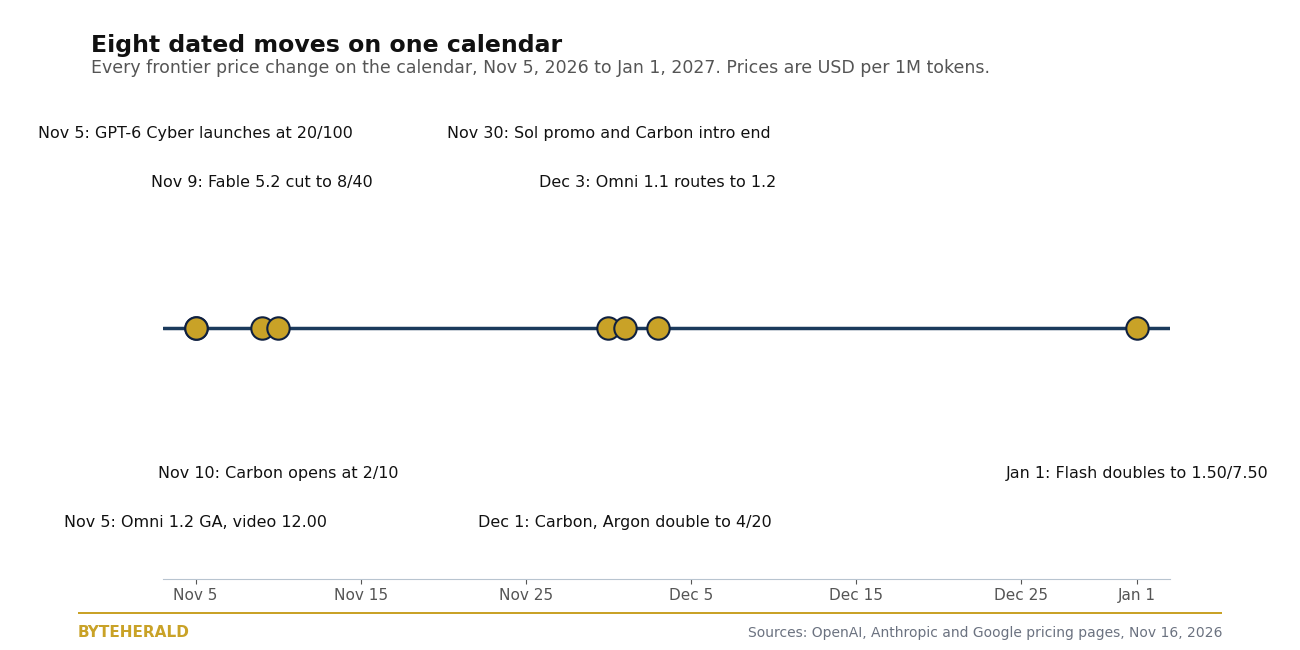
Eight dated moves sit on the calendar now, and they run from November 5 to January 1. Two are cuts, two are openings, two are step-ups, one is an expiry, and one is a routing change. The October chapter ended with the same warning: the cuts had already happened and the next moves were up. November proves it, and complicates it, because the month had cuts and rises in the same weeks.
| Date | Move | Price, per 1M tokens | What it means |
| Nov 5 | OpenAI launches GPT-6 Cyber | $20 in, $100 out | Cyber-specialized Astra variant, twice Astra's price, Daybreak Red approval only |
| Nov 5 | Google makes Gemini Omni 1.2 Flash generally available | Video out $12.00, from $17.50 | 31 percent cut; 15-second clips, up from 10; about $0.07 a second at 720p |
| Nov 9 | Anthropic releases Claude Fable 5.2 | $8 in, $40 out, from $10 and $50 | 20 percent cut; still twice Opus 5.5 at $4 and $20 |
| Nov 10 | Google opens Gemini 4 Carbon to paying API developers | $2 in, $10 out, through Nov 30 | A quarter of Fable 5.2's input price; same rate for Argon |
| Nov 30 | Two introductory windows end | GPT-5.6 Sol promo $4 and $20 ends; Carbon $2 and $10 ends | OpenAI names no successor price for Sol; Carbon's next price is already posted |
| Dec 1 | Gemini 4 Carbon and Argon double | $4 in, $20 out; cache $0.10 to $0.20 | Exact parity with Claude Opus 5.5 |
| Dec 3 | Omni 1.1 Flash routes to 1.2 | Billed at 1.2 rates | Requests to the old model ID are served by the new model, no code change |
| Jan 1, 2027 | Gemini 3.6 and 3.8 Flash double | $0.75 and $3.75 to $1.50 and $7.50 | Cache $0.075 to $0.15; cache storage $0.50 to $1.00 per 1M per hour |
The frontier table, November 2026
Standard tier, list prices, per 1 million tokens. Thinking tokens on Gemini bill at the output rate. Anthropic lists no dated change, so its side of the calendar is stable unless it moves.
| Model | Input | Output | Cached input | Effective Dec 1 |
| Gemini 4 Carbon, through Nov 30 | $2 | $10 | $0.10 | $4 and $20 |
| Gemini 4 Argon, through Nov 30 | $2 | $10 | $0.10 | $4 and $20 |
| Claude Opus 5.5 | $4 | $20 | $0.20 | Unchanged |
| Claude Fable 5.2 | $8 | $40 | $0.20 | Unchanged |
| Claude Fable 5.1 | $10 | $50 | $0.25 | Superseded by 5.2 |
| GPT-6 Astra | $10 | $50 | $1.00 | Unchanged |
Two models sit just outside the table and matter to the same buyer. GPT-6.1 Sol, OpenAI's balanced default, costs $2 in and $10 out with cached input at $0.10, the same as Carbon's introductory rate, and carries no dated change. GPT-5.6 Sol, the older model it replaced, sits on a promotional $4 and $20 that OpenAI says is available until November 30, 2026, with no successor price published. And Carbon is not free at any tier: Google lists every Carbon line as not available on the free tier, and consumer access in the Gemini app needs a Google AI Ultra subscription. The question people ask most about Gemini 4, whether it is cheaper than ChatGPT, has a per-token answer and a per-task answer. Per token, Carbon at $2 and $10 through November 30 undercuts GPT-6 Astra at $10 and $50 fivefold on input and output, and matches GPT-6.1 Sol exactly. Per finished task, the comparison turns on how many tokens each model needs, how much thinking it bills, and how often it retries, none of which a price list shows.
What a fixed workload costs
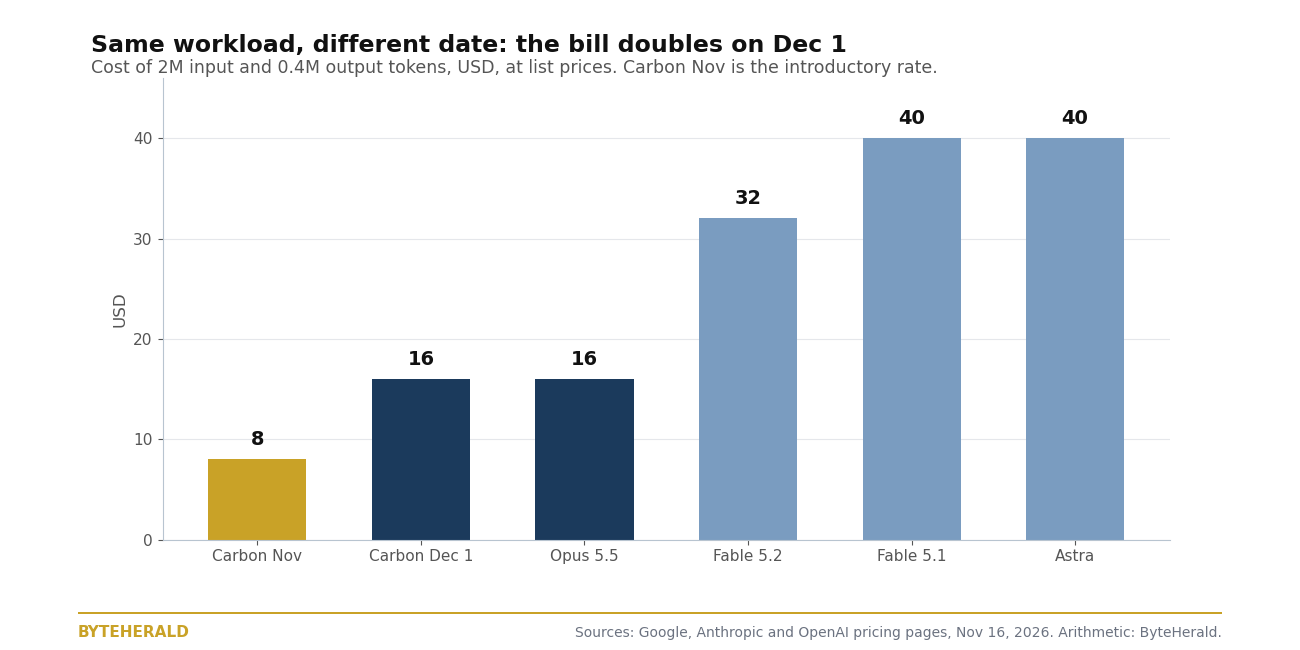
The calendar is abstract until it is priced against a workload. Take a fixed job of 2 million input tokens and 400,000 output tokens, and run the same job on each date. The arithmetic is ByteHerald's, from the list prices above, and every line recomputes the same way: input tokens times the input rate, plus output tokens times the output rate.
| Model and date | 2M in, 0.4M out | 10M in, 2M out |
| Gemini 4 Carbon, through Nov 30 | $8 | $40 |
| Gemini 4 Carbon, from Dec 1 | $16 | $80 |
| Claude Opus 5.5 | $16 | $80 |
| Claude Fable 5.2 | $32 | $160 |
| Claude Fable 5.1 | $40 | $200 |
| GPT-6 Astra | $40 | $200 |
The small job makes the point. Carbon at its introductory rate does the work for $8, half of Opus 5.5's $16 and a fifth of Astra's $40. On December 1 the same job on the same model costs $16, exactly Opus 5.5's price, and the saving is gone. The large job scales the same way: $40 in November, $80 in December. Nothing about the model changes on December 1. Only the price does, and it was printed on the pricing page before the introductory rate began.
Why the calendar matters
The price war did not end with the October cuts. It went calendar-driven, and the calendar is the story now. The October chapter found that the cuts had already happened and the next moves were up, with Argon doubling on December 1 and Flash doubling on January 1 flagged as the rises to watch. November added a second round of evidence, and it cut both ways: a new cut from Anthropic on November 9, a new entrant at a quarter of the frontier price on November 10, and the same December 1 step-up, now priced to the dollar. The honest caveat from October still holds: these are list prices, and batch processing, cache rates and context-size thresholds move real bills away from the table. Batch halves the standard rate on all three vendors, cached input runs from $0.075 to $1.00 depending on the model, and prompts over 272,000 tokens on OpenAI's flagships bill at double the input rate and 1.5 times the output rate. A workload that fits the table's assumptions pays the table's prices. One that does not, does not.
The three vendors are not moving together. Anthropic cut its top model by 20 percent and posted no dated change, so its side of the calendar is the stable one. Google opened its cheapest frontier model at half of Anthropic's mid-tier price and posted the doubling in the same announcement. OpenAI left the one open question on the calendar: GPT-5.6 Sol's promotional price ends November 30 and the page does not say what replaces it. Carbon's launch audit in October covered the model when it was gated and unusable; the November change is that it opened to paying developers with a price and an expiry on that price. The revenue gap we tracked in November showed the same pricing pressure from the Chinese open models; the Big Three frontier is now running the same play with dated rates instead of open ones.
What to check before you commit
First, is the rate an introduction with a date, or a standing price? Carbon's $2 is the first, Opus 5.5's $4 is the second, and the difference is $8 against $16 on the small workload above. Second, does your workload match the assumptions the table uses? A job that leans on cached input pays Carbon's $0.10 against Astra's $1.00, a tenfold gap the headline rates hide, and a job over 272,000 tokens on OpenAI pays the long-context multiplier the table does not show. Third, what does the model cost the day after the date? December 1 turns the cheapest frontier ticket into a tie with Opus 5.5, and January 1 doubles the Flash tier that most high-volume work actually runs on. The calendar rewards the buyer who checks the date before the workload, not after the invoice.
By ByteHerald Staff. Anthropic's pricing page, as read by independent pricing trackers on November 9 to 12, 2026, lists Claude Fable 5.2 at $8 per million input tokens and $40 per million output tokens, down from $10 and $50 on Fable 5.1, with Claude Opus 5.5 at $4 and $20 and cached input at $0.20 for both. Google's Gemini API pricing page, as read by independent pricing trackers on November 11 to 12, 2026, lists Gemini 4 Carbon and Gemini 4 Argon at $2 per million input tokens and $10 per million output tokens through November 30, 2026, then $4 and $20 from December 1, with cached input at $0.10 rising to $0.20, and lists Gemini 3.6 and 3.8 Flash at $0.75 and $3.75 through December 31, 2026, then $1.50 and $7.50 from January 1, 2027. OpenAI's API pricing page, as read by independent pricing trackers on November 5 to 7, 2026, lists GPT-6 Astra at $10 per million input tokens and $50 per million output tokens, GPT-6.1 Sol at $2 and $10, and GPT-5.6 Sol at a promotional $4 and $20 available until November 30, 2026, with no successor price published. Google's release notes of November 5, 2026, made Gemini Omni 1.2 Flash generally available with video output at $12.00 per million tokens, down from $17.50, and route requests to the 1.1 model ID to 1.2 rates from December 3, 2026. OpenAI's launch post of November 5, 2026, introduced GPT-6 Cyber at $20 per million input tokens and $100 per million output tokens for approved Daybreak Red customers, reporting 48.5 percent on ExploitGym and 81 previously unknown high-severity Firefox vulnerabilities found.
Comments
Post a Comment