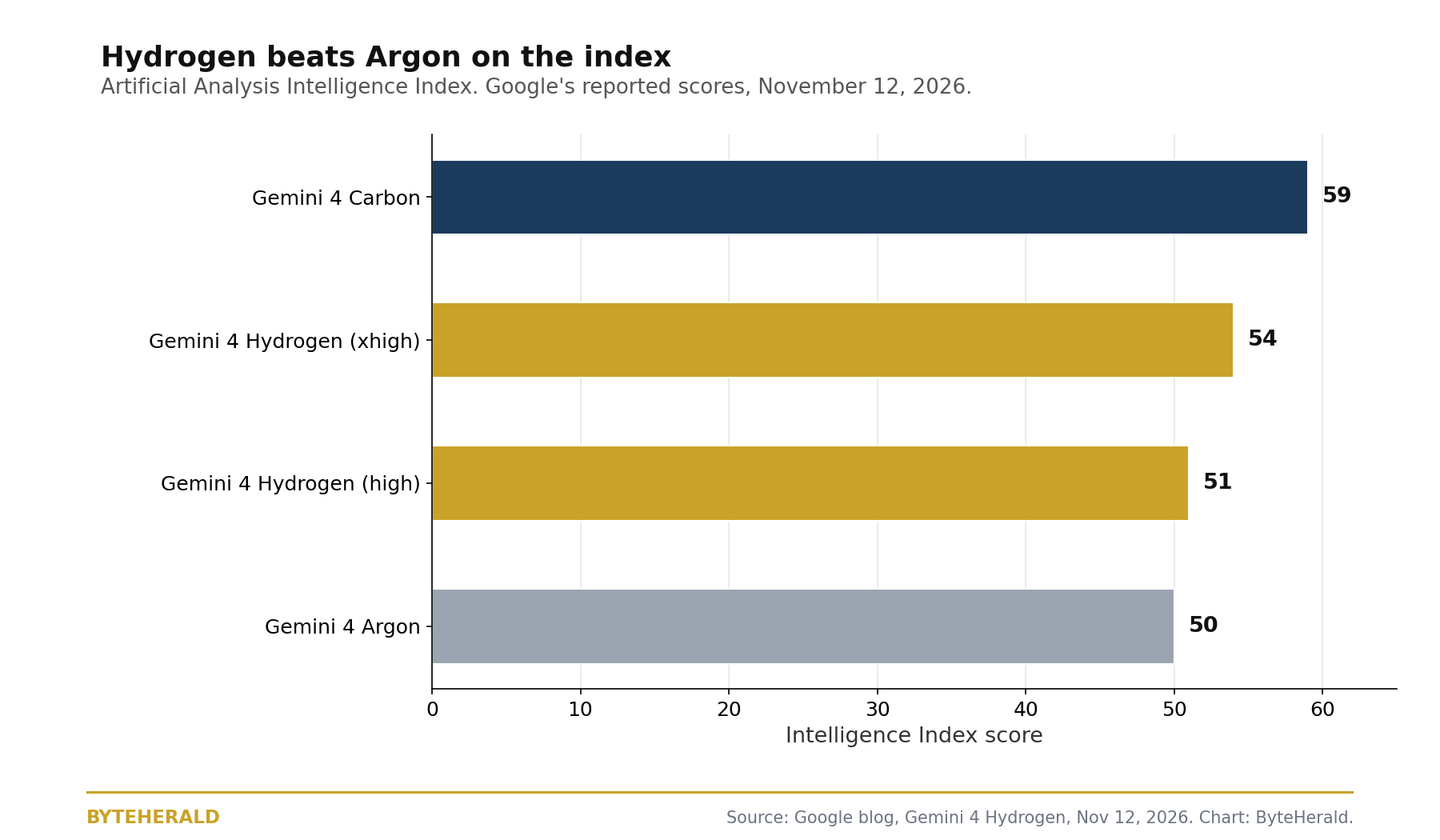
Google introduced Gemini 4 Hydrogen on November 12, 2026, and it is the fast, everyday model in the Gemini 4 family: built for coding and agentic workflows, priced at $1.50 per million input tokens and $7.50 per million output tokens, flat across its full 1 million-token context window, and available today on every Google surface, including the free tiers. The number that matters is the comparison Google published alongside it. At its default high thinking level Hydrogen scores 51 on the Artificial Analysis Intelligence Index, against 50 for Gemini 4 Argon, and reaches 54 at its highest xhigh setting, while costing less than Argon on both input and output. The mid-tier model now outscores the flagship-tier model on the headline index, and that inversion is the story of this launch.
The family, repriced
Hydrogen sits between the two frontier models and the old Flash tier, and the price table is what makes the launch a pricing event as much as a model event. Gemini 4 Carbon, the deep-reasoning flagship, costs $2 per million input tokens and $10 per million output tokens until November 30, then doubles to $4 and $20 on December 1. Gemini 4 Argon costs $2 and $10. Hydrogen costs $1.50 and $7.50, with no change announced. On the Intelligence Index, Carbon scores 59, Hydrogen scores 51 at high and 54 at xhigh, and Argon scores 50. Put those two columns together and the ladder reads differently than the names suggest: the model Google calls the everyday execution engine now beats one of the two frontier models on the headline benchmark while charging 25 percent less for input and output.
| Model | Intelligence Index | Input, per 1M tokens | Output, per 1M tokens | Role Google gives it |
| Gemini 4 Carbon | 59 | $2, then $4 from Dec 1 | $10, then $20 from Dec 1 | Deep, long-horizon reasoning |
| Gemini 4 Hydrogen (xhigh) | 54 | $1.50 | $7.50 | Everyday execution, highest thinking |
| Gemini 4 Hydrogen (high) | 51 | $1.50 | $7.50 | Everyday execution, default thinking |
| Gemini 4 Argon | 50 | $2 | $10 | Deep, long-horizon reasoning |
The table needs two honest notes. First, the Index is a single composite, and the one-point gap between Hydrogen at high and Argon is narrow enough that the next index update could flip it, which is why the xhigh figure matters: at its highest thinking setting Hydrogen opens a four-point gap, and that is the number to watch. Second, the Carbon price doubling on December 1, which we tracked when Gemini 4 Carbon became usable at a price that doubles on December 1, makes Hydrogen the cheapest way into the Gemini 4 family by a widening margin after the turn of the month. The index itself changed with version 5, which reweighted its benchmarks and made 60 percent of its tests private, as our audit of Intelligence Index v5 explains, so the scores are comparable across the family today but not against older index versions.
What Hydrogen is for
Google's pitch is not that Hydrogen replaces Carbon or Argon, but that it pairs with them. The company is introducing Orchestrator in Google Antigravity, which dynamically switches between models inside one session: Carbon plans and coordinates, Hydrogen powers the worker and verifier agents that build and test changes in parallel across isolated workspaces. On Terminal-Bench 4.0, Google says Orchestrator reached near-Carbon task success rates while consuming 24 percent less quota and completing 19 percent faster. The phrase "near-Carbon" leaves the exact quality gap unspecified, so the tradeoff for a particular application cannot be read off the announcement, but the direction is clear: Google wants teams to stop paying frontier prices for routine steps.
Against its predecessor the improvement is large and specific. Hydrogen is a major standalone upgrade for teams migrating from Gemini 3.8 Flash, finishing tasks 2.5 times faster at its high default setting while more than tripling Terminal-Bench 4.1 scores, 57 percent against 18.2 percent, and cutting fabricated claims by more than five times. In early testing with partners across complex graphs, SQL, and data-heavy enterprise workflows, Hydrogen ran 2 to 2.8 times faster while reducing token usage by 12 to 23 percent, compared with 3.8 Flash. It has four thinking levels, low, medium, high as the default, and a new xhigh tier, so a team pays for the reasoning depth a task requires instead of paying the frontier rate for everything. The name itself is new but the model is not a surprise: Hydrogen circulated in leaks since late October, reported by testers in blind arena matchups, and Google has now confirmed it as the Flash tier's successor under the element naming, with the Flash branding retired.
The benchmark check
Google's benchmark list for Hydrogen is long, and all of it is vendor-reported except the Intelligence Index, so it should be read as Google's case for the model, not an independent verdict. On the live Agent Arena board Hydrogen ranks fifth, which puts it in the top tier of agentic models on real user sessions, a board we read in full when we explained how Agent Arena grades agents on real work. For deep domain reasoning it leads its class on HLE-Diamond at 58.8 percent, ranks first overall on the Vals Tax Agent Bench at 52.3 percent, ties for first on the Vals Legal Research Bench at 55.8 percent, and leads its class on AutomationBench-AA. On end-to-end professional workflows it scores 53.4 percent on the Multimodal Knowledge Agent benchmark and 71.6 percent on Agents' Last Exam v1.1. On iterative repository coding it outperforms similar-tier models on SWE-sweep, where it has to discover and repair bugs without breaking existing code, and it natively batches file-read and search calls in parallel instead of inspecting files one by one.
The safety numbers are also Google's own internal evaluations, and they are the part of the announcement aimed at teams that will let the model act on their behalf. Hydrogen reduces overreach in agentic tasks by up to 81 percent and under-service by up to 79 percent, cuts misaligned actions and task shortcutting across tool-use and coding evaluations by 12 times, is up to 2 times less likely to bypass permission boundaries when faced with impossible or blocked tasks, and achieves a 96.7 percent honesty rate on Google's internal agent honesty evaluation. It preserves 99.9 percent chain-of-thought legibility with zero deceptive reasoning edits across more than 200,000 audited turns, is more than 2.3 times more resilient against indirect prompt injection on the Gray Swan benchmark, and keeps false refusals on HealthBench Pro under 0.4 percent. These are internal measurements, not third-party audits, and the honest way to use them is as a claim to test against your own workloads, not as proof.
Where you can use it today
Hydrogen is rolling out globally starting today across the developer, enterprise, and consumer surfaces: the Gemini API in AI Studio and Android Studio, Gemini for business via the API or model dropdown, Google Antigravity for paid Google AI Pro and Ultra subscribers, Gemini in Google Sheets for eligible business subscriptions, and the Gemini app and Google Search for everyone. Free users in the Gemini app get Hydrogen through automatic model selection when Google considers it suitable for the prompt, and Hydrogen is the default model for AI Mode and is used for the hardest questions in AI Overviews. That last point is the widest distribution of the launch: the model that beats Argon on the index is now the one answering the hardest search questions for all users, not a paid tier. In Search it is meant to understand multi-part queries and typos, give more visual responses, and fan out to a broader range of links than before.
When to use the fast model
The practical question Hydrogen answers is when to pay for the frontier and when to pay for speed. The pattern Google is pushing, frontier plans and fast model executes, is the right default for multi-step work: use Carbon or Argon for the architectural judgment, the subtle bug, and the decision that is expensive to get wrong, and use Hydrogen for writing the code, running the tests, verifying the changes, and drafting the documents. Use the thinking levels the same way: low for the routine formatting and summarising, high for the everyday coding and research, xhigh when the task is close to the frontier and the extra reasoning is cheaper than a wrong answer. And test the calibration claim on your own data before trusting it in production, because a model that tells you how sure it is only helps if the confidence score is honest, and Google's own safety numbers are the claim, not the test. The price is the forcing function: at $1.50 and $7.50 with no announced increase, against Carbon's doubling on December 1, the cost of staying on the frontier for routine work rises every week, and Hydrogen is Google's answer to the teams that noticed.
By ByteHerald Staff. Google announced Gemini 4 Hydrogen on November 12, 2026, in a post introducing the model for agentic workflows, stating that it scores 51 on the Artificial Analysis Intelligence Index at its default high thinking level against 50 for Gemini 4 Argon, reaching 54 at its highest xhigh setting, and that it is priced at $1.50 per million input tokens and $7.50 per million output tokens flat across its entire 1 million-token context window, with four thinking levels and availability across AI Studio, the Gemini API, Gemini for business, the Gemini app, Google Search, and Google Antigravity for paid subscribers. Google reported on November 12, 2026, that Orchestrator in Antigravity reached near-Carbon task success rates on Terminal-Bench 4.0 while consuming 24 percent less quota and completing 19 percent faster, and that Hydrogen finishes tasks 2.5 times faster than Gemini 3.8 Flash at its high default setting while more than tripling Terminal-Bench 4.1 scores to 57 percent from 18.2 percent. Google reported on November 12, 2026, that Hydrogen ranks fifth on Agent Arena, leads its class on HLE-Diamond at 58.8 percent, ranks first on the Vals Tax Agent Bench at 52.3 percent, and ties for first on the Vals Legal Research Bench at 55.8 percent. Google reported on November 12, 2026, that Hydrogen reduces overreach in agentic tasks by up to 81 percent and under-service by up to 79 percent, and achieves a 96.7 percent honesty rate on its internal agent honesty evaluation.
Comments
Post a Comment