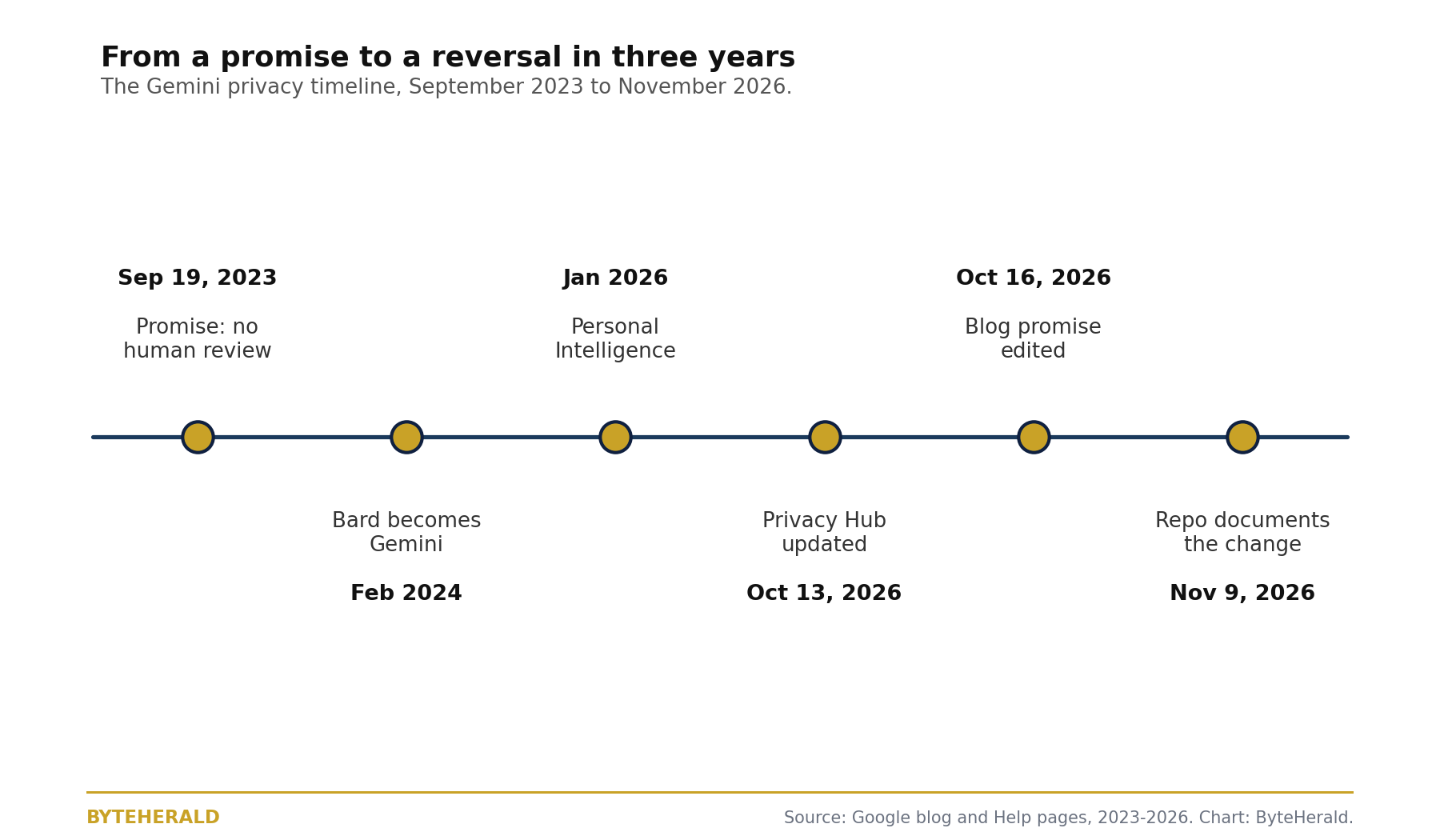
Google's promise was plain. When it launched Workspace extensions for Bard in 2023, it said content from Gmail, Docs, and Drive "is not seen by human reviewers." On October 16, 2026, Google edited that promise. Connected Workspace data can now be reviewed by human reviewers, and in some cases the reviewer sees the email or the file itself.
The change is not in a press release. It is in two of Google's own pages: an update note added to the 2023 blog post, and a help page about personalization with Connected Apps. Read together, they draw a narrower line than the one Google drew in 2023, and the new line is the one that matters to anyone who connected Gmail or Drive to Gemini.
The before and after
| Question | September 2023 | October 2026 |
| Do human reviewers see it? | Content from Gmail, Docs, and Drive "is not seen by human reviewers" | "It can also be subject to human review in limited circumstances" (blog update, Oct 16, 2026). "A subset of Connected Apps data processed by Gemini is reviewed by human reviewers" (Help Answer 16836988) |
| Is it used to train models? | Not used "to train the Bard model" | "That same subset of data can be used to train generative AI models," depending on settings (blog update). Gemini "does not train generative AI models directly on your Gmail inbox, Drive," but trains on "summaries, excerpts, generated media, and inferences" drawn from them (Help page) |
| What can a reviewer see? | Nothing (the promise) | "Interactions, summaries, excerpts and inferences from your relevant emails and files. In some cases... the summary may just be the email or file." |
The distinction Google draws now is between the source and the summary. Gemini does not train directly on your inbox or your Drive, the help page says. It trains on summaries, excerpts, generated media, and inferences drawn from them. Where the email or file is brief, or particularly relevant to the prompt, the summary "may just be the email or file." That is the sentence that turns a privacy policy into a practical warning, and Google states the warning plainly: "Please don't connect your apps to Gemini Apps if they contain confidential information that you wouldn't want a reviewer to see." The 2023 text also said the content would not be used to show you ads. The October update does not repeat that sentence.
What reviewers can actually see
The help page lists the subset that human reviewers see, and the list is wider than a chat transcript. It includes interactions, summaries, excerpts, and inferences from relevant emails and files; summaries, inferences, and generated media based on a connected Google Photos library, though media itself is not viewed except in cases of abuse and harm or when a user submits feedback; interactions, summaries, excerpts, and inferences from Google Wallet and payment services; and the prompts, the responses Gemini gave, and information about how the model generated them. Google says it takes steps before review to disconnect the interaction from the Google Account and to reduce personal information in the data, except where it needs to address abuse or harm, or where the user submitted feedback. The documentation project that surfaced this change argues, citing Google's own cloud documentation, that Google's automatic scrubbers cannot sufficiently deidentify narrative data: account numbers, confirmation numbers, transaction dates, and combinations of names, cities, and events can identify a person even after names are stripped.
Retention is the part that survives deletion. According to AI Weekly's report on Google's Gemini Apps Privacy Hub, chats reviewed by human reviewers are not deleted when a user deletes their activity, and are instead retained for up to three years. Spellbook's coverage of the hub puts the default at 18 months of chat retention with a sample sent to human reviewers, while temporary chats are kept for 72 hours. The control that matters is therefore the one applied before a prompt is sent, not the delete button pressed after it.
The part Google did not announce
The change surfaced on November 9, 2026, through a documentation project published on GitHub by the user thisisme6598, titled "Documentation of Gemini File Leaking Behavior." The author tested consumer Gemini with Connected Apps enabled and reports that background Workspace lookups fire autonomously, without an explicit tag such as at-Drive or at-Gmail, and that the result is probabilistic: the same kind of query can return no retrieval, a metadata summary, a two-to-four sentence exact quotation including account details, or the complete unredacted text of the document or email. In the author's example, asking whether he was paying too much for internet service returned, on different trials, a generic answer, a summary naming a 122 dollar bill dated September 4, a block containing the full name, account number, confirmation number, and payment date, and once the entire email including its headers. These are one person's reported tests, not a published study, and no independent lab has reproduced the four outcomes at scale. The project is the reason the story surfaced. Google's own pages are the reason it holds up.
How the pieces fit
Three settings decide what Gemini can reach, and they are not the same setting. Connected Apps decides which apps Gemini may pull from: Workspace services including Gmail, Calendar, Drive, Docs, Sheets, and Meet, plus Search, Maps, Photos, YouTube, Contacts, and Wallet. Keep Activity decides whether Gemini Apps activity is used to improve Google services, including training generative AI models. Memory decides whether past chats personalize future ones. Disconnecting an app does not delete what Gemini already collected, and deleting Gemini activity does not delete data in the connected apps. The expansion behind the change is Personal Intelligence, launched in January 2026, which widened Gemini's access across Gmail, Drive, Photos, Calendar, and Maps. A managed Workspace account is a different case from a personal one: administrators control the settings, and Vault retention and audit logs govern the same conversations, so the question there is what the employer can see, not only what Google's reviewers can. Governments are drawing the same line from the other side: Sweden's Government Offices blocked ChatGPT and Claude on staff computers in October, keeping only Copilot after a security review, because services without a formal contract carry consequences for information security. The consumer version of that decision is what you connect.
What to do before your next prompt
First, open Connected Apps in Gemini settings and disconnect Gmail, Drive, Docs, and Photos on any account that holds confidential material, because the connection is what makes the data reviewable. Second, check Keep Activity, since training use of connected data applies when it is on. Third, for work, use a managed Workspace account rather than a personal one, where administrators control the settings and retention is governed by policy instead of defaults. Fourth, remember that prompts themselves are reviewed: do not paste confidential material into a prompt to ask about it, because the prompt, the response, and the information about how the response was generated are all in the reviewed subset. Enterprises are already rethinking AI tools over data and governance questions, and the reckoning we mapped in October is the same question asked at company scale. The personal version has a simpler answer, and Google wrote it in its own help page: if you would not want a reviewer to see it, do not connect the app that holds it.
By ByteHerald Staff. Google's blog post of September 19, 2023, said content from Gmail, Docs and Drive connected to Bard "is not seen by human reviewers," and an update added on October 16, 2026, says that data from Workspace Apps can be used to train generative AI models and "can also be subject to human review in limited circumstances." Google's Gemini Apps Help page, Answer 16836988, says a subset of Connected Apps data is reviewed by human reviewers including trained service providers, that the summary "may just be the email or file," and warns users not to connect apps containing confidential information they would not want a reviewer to see. A GitHub project by the user thisisme6598, created on November 9, 2026, documents four reported outcomes when Gemini pulls connected files and emails in background conversation, from no retrieval to full-file ingestion, and notes the behavior is probabilistic. AI Weekly reported on November 9, 2026, that Google's Gemini Apps Privacy Hub, updated October 13, 2026, states that chats reviewed by human reviewers are retained for up to three years even after a user deletes their activity.
Comments
Post a Comment