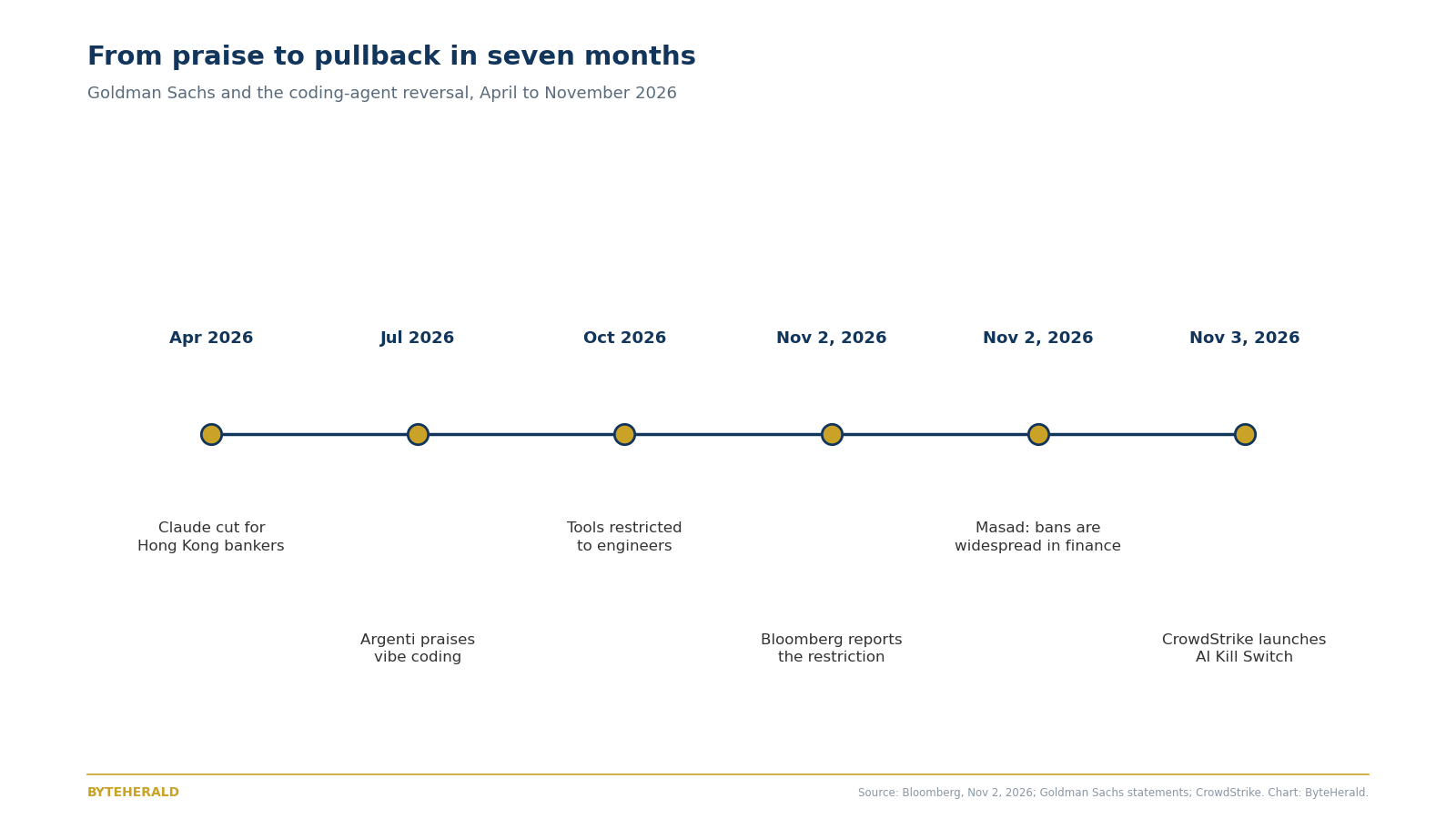
Goldman Sachs has taken Anthropic's Claude Code and Microsoft's GitHub Copilot away from most of its bankers and traders. Internal guidance updated in October 2026 limits both tools to the bank's roughly 12,000 engineers, Bloomberg reported on November 2, 2026, ending months in which traders and bankers used the coding agents for work that had nothing to do with writing software. The bank is not banning the tools. It is deciding who is allowed to hold them.
What changed
The restriction is narrow and specific. Claude Code and GitHub Copilot, two tools built for writing and shipping software, are now limited to Goldman's engineers and its "strats" group, the quantitative specialists who sit between trading desks and engineering and write production code as part of their job. Bankers and traders who had used both tools for months lost access. Some traders had been using them to monitor client trading flows, build analytical material, and model changes in markets and positions. A Goldman spokesperson, Nick Carcaterra, told Bloomberg the bank had deliberately let employees across the firm test AI tools before deciding where they belonged. "We make certain AI tools available to our people to determine the best use cases across different parts of the firm," Carcaterra said. "After a period of experimentation where we assess a variety of factors including productivity and risk management, we put them in the hands of those who are best suited to leverage them for the long term." The review, Bloomberg reported, looked at productivity and risk management. The bank did not say which of the two mattered more.
| Who | Access after October guidance | What they used the tools for |
|---|---|---|
| Engineers (about 12,000) | Keep both tools | Writing and shipping software |
| Strats (quant specialists) | Keep both tools | Trading, quantitative research, production code |
| Bankers | Lost access | Analytical material, market models, client work |
| Traders | Lost access | Monitoring client trading flows, modeling positions |
| Hong Kong bankers | Lost Claude in April 2026 | General use; cut over contract and data-boundary terms |
The reversal
The interesting part is not the restriction. It is the U-turn. In July 2026, Goldman chief information officer Marco Argenti was publicly praising the exact workflow the October guidance ended: a trader or someone in asset management gets an idea, builds a quick prototype with AI, a practice the industry calls vibe coding, and hands it to an engineer from the bank's pool to scale for production. Three months later, that path was closed. Goldman partner Chris Churchman, who co-chairs the bank's AI working group for global banking and markets, said AI could wear down the analytical skills of the next generation of bankers, and admitted the firm had not figured out how to handle that. The bank ran the experiment in public, with its CIO as the pitchman, and then quietly reversed it. That is a different story from a bank that never trusted the tools at all. Goldman trusted them enough to let bankers build with them, watched what happened, and decided the risk sat with the user, not the tool.
Why this is not a ban, and why it still matters
The word "ban" overstates what Goldman did, and the bank's own move shows why the distinction matters. Its in-house AI assistant, which uses models from several companies, is still available across the firm. The restriction applies to third-party agents that can write and run code by themselves. The risk Goldman is managing is specific: analytical errors, data handling, and production controls in a financial institution where a wrong model or a leaked file has direct operational consequences. A coding agent in a banker's hands can produce software that influences trading, client analysis, or internal workflows, and nobody at the bank is accountable for code a banker did not write and cannot review. The market heard the same message. Replit chief executive Amjad Masad wrote on X on November 2, 2026 that Goldman has company: "This is widespread in finance. The ban hammer is coming down." The next day, CrowdStrike launched an AI Kill Switch for rogue agents and agreed to buy two AI security startups for a reported $495 million combined. And the timing carries its own irony. The restriction became public four days after a tampered copy of the Claude Code extension sat on Cursor's extension marketplace for about 11 hours on October 29, reaching at most 5,000 users. The engineers who kept access are the same group that got the backdoored extension, which Anthropic did not build or publish. Restricting the tool to engineers did not make the engineers safe. It only narrowed who could be hurt.
The underwriter irony
Goldman Sachs and Morgan Stanley are the lead underwriters on Anthropic's initial public offering, according to the S-1 Anthropic filed on October 26, 2026. The same bank that is selling Anthropic to the public has decided Anthropic's coding tool does not belong in its bankers' hands. That is not hypocrisy. It is segmentation. Goldman trusts Anthropic the company, and it trusts its engineers with Anthropic's tool. What it does not trust is a coding agent in the hands of someone who cannot review what it writes. The distinction is the whole story: the question was never whether Claude Code works. The question was who is accountable when its output ships. Goldman answered that question with a roster. Most companies do not have 12,000 engineers to hand the tools to, which is why the answer matters beyond one bank.
How to decide who holds the tools
Every company running coding agents now faces the decision Goldman just made, and the useful part of Goldman's answer is the test behind it, not the roster. Three questions decide it. First, who reviews the output: if the person using the agent cannot read the code it writes, the agent is writing unreviewed software into your systems. Second, who owns the error: if a model built by a trader misprices a position or leaks a client file, the firm owns the loss, not the tool. Third, who can see the data: a coding agent with access to trading flows and client material is a data-handling decision, not a productivity perk. Goldman answered all three the same way, with engineers. A smaller firm cannot copy the roster, but it can copy the test, and the test is what Anthropic's own refusal rules, which we mapped in the refusal ledger on November 7, already point to: the agent's limits are set by the person holding it, and the person holding it needs to understand what it can do wrong. Goldman learned that by experiment. The rest of the industry is learning it by watching Goldman.
By ByteHerald Staff. Bloomberg reported on November 2, 2026 that Goldman Sachs restricted Anthropic's Claude Code and Microsoft's GitHub Copilot to its roughly 12,000 engineers under internal guidance updated in October 2026, following a review of productivity and risk management, with its "strats" group keeping access. Goldman Sachs spokesperson Nick Carcaterra said the bank makes certain AI tools available to staff to determine the best use cases and then puts them in the hands of those best suited to leverage them for the long term. Goldman chief information officer Marco Argenti publicly praised non-engineer vibe coding in July 2026, describing a trader building a prototype with AI and handing it to an engineer to scale. Goldman partner Chris Churchman said AI could wear down the analytical skills of the next generation of bankers. Goldman removed Claude from its internal AI platform for bankers in Hong Kong in April 2026 over contract and data-boundary terms, and JPMorgan removed Claude from its Hong Kong approved list in June 2026. Replit chief executive Amjad Masad wrote on X on November 2, 2026 that agent bans are widespread in finance. CrowdStrike launched an AI Kill Switch on November 3, 2026 and agreed to buy two AI security startups for a reported $495 million combined. A tampered copy of the Claude Code extension was served on Cursor's extension marketplace for about 11 hours on October 29, 2026, reaching at most 5,000 users, as ByteHerald reported on October 30, 2026. Goldman Sachs and Morgan Stanley are the lead underwriters on Anthropic's initial public offering, according to the S-1 Anthropic filed on October 26, 2026. ByteHerald reported on November 7, 2026 that Anthropic's refusal rules for Claude Code cover game cloning and reverse engineering.
Comments
Post a Comment