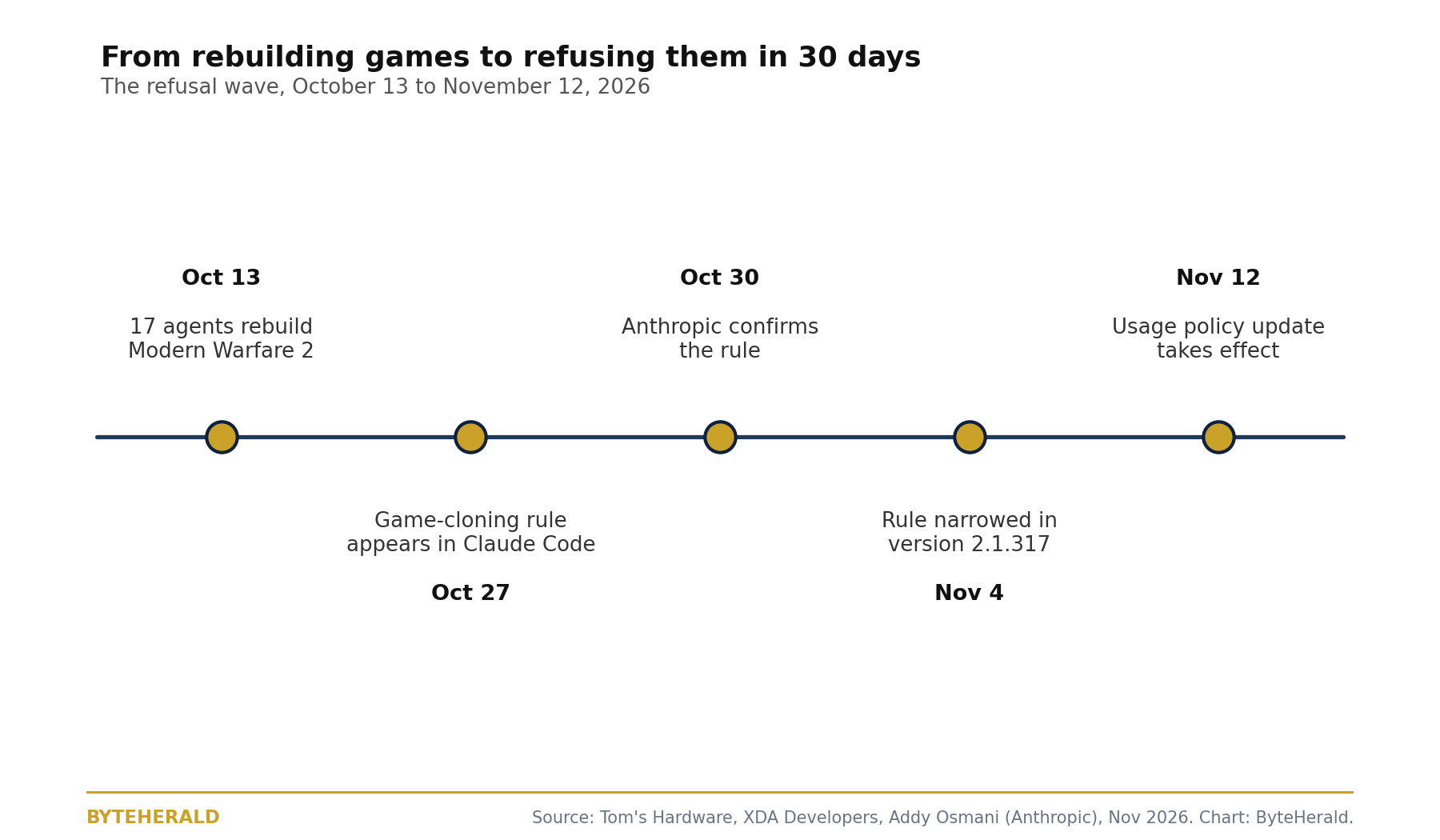
On October 13, 2026, 17 AI agents rebuilt the source code of Modern Warfare 2. Two weeks later, Claude Code refused to rebuild a game at all. In between, Anthropic added two sentences to a prompt, users reported refusals on work they owned, and version 2.1.317 narrowed the rule again. This is the first dated ledger of the refusal wave: what changed, when, who decided, and what it caught by mistake.
The ledger
| Date | Agent or model | What was refused | How | Status |
| Oct 13, 2026 | 17 AI agents (decompilation wave) | Nothing: the agents rebuilt Modern Warfare 2's source code | No refusal in place | Completed; the "before" |
| Oct 27, 2026 | Claude Code (server flag tengu_heron_brook) | Recreating a specific existing game | Two sentences added to the prompt | In force |
| Oct 30, 2026 | Anthropic (Addy Osmani, staff post) | Confirms the rule on Opus 5.5 | Public post; spokesperson points reporters to it | Confirmed |
| Oct 30, 2026 | Claude Code on Opus 5.5 | Board-wargame modules for games the customer owns (issue #106167) | Prompt overreach | Reported; not confirmed resolved |
| Oct 31 to Nov 2, 2026 | Opus 5.5 | Reverse-engineering tasks: crash dumps, anti-cheat code, own software | User-reported refusals | Anthropic denies a ban; Opus 4.8 works |
| Nov 3, 2026 | Claude Code 2.1.317 | Version ships with the narrowed rule | Release (trackers report Nov 2 or Nov 3) | Released |
| Nov 4, 2026 | Anthropic (Osmani, staff post) | Announces the narrowed rule | Name a game to describe mechanics; original game in that genre | In force |
| Nov 4, 2026 | Claude Code on Opus 5.5 | SuperTuxKart derivative, GPL v3 with Creative Commons assets (issue #107224) | Prompt overreach on open-licensed work | Reported |
| Nov 12, 2026 | Anthropic usage policy | Intellectual-property infringement (no games mention) | Policy update takes effect | In force |
What the rule actually says
The rule is two sentences, pushed from Anthropic's servers under a flag called tengu_heron_brook, and XDA Developers found the same text in the installed binary of Claude Code version 2.1.314, released October 30. It reads: "Do build original games, games in a genre, and games from the user's own designs and assets. Don't build a recreation of a specific existing game, even if it is renamed or called original." There is no setting to turn it off. On October 30, Addy Osmani, a member of Anthropic's technical staff, confirmed the change in public: the two sentences were added to Claude Code's prompt on Opus 5.5 "to steer it away from recreating someone else's specific game because using Claude to infringe IP is against our usage policy." Original games, genre games, and games built from the user's own designs and assets were, in his words, meant to keep working, and he asked developers who get wrongly refused to send him their cases. A company spokesperson pointed Game Developer at the same post. Anthropic did not publish an announcement, and the public changelog does not mention the rule.
The false positives
A two-sentence prompt cannot reliably tell inspiration from copying, and the false positives arrived within days. A developer at Conflict Simulations LLC filed GitHub issue #106167 on October 30, saying Claude began refusing to build digital board-wargame modules for customers who own the games and use the modules privately. Issue #107224, filed November 4, describes a test in which Claude refused a derivative of SuperTuxKart, a game released under the GPL v3 license with Creative Commons assets, which is precisely the kind of work the rule was not written to stop. Users also reported refusals for generic jobs such as analyzing a crash dump or using a reverse-engineering tool, and one developer testing his own software found that switching to Opus 4.8 let the work continue. A Reddit user said their account was suspended over Opus 5.5 and a reverse-engineering tool, and later reinstated. Osmani's November 4 update is the fix: in version 2.1.317, a user can name a game to describe the mechanics they want, and Claude should build an original game in that genre; asking for a copy of the original gets an offer to build something similar instead. Whether the board-wargame refusals are resolved is not confirmed, and Osmani does not say.
The reverse-engineering question
The messiest claim in this story is that Claude now refuses reverse engineering entirely, and it is the one Anthropic has explicitly denied. The reported refusals are real, as user reports: crash-dump analysis, anti-cheat code, a developer's own software. But the company's statement does not say reverse engineering is banned, and independent tests point the other way. XDA Developers asked Opus 5.5 about a Pokemon Diamond decompilation project and the model agreed to help, explicitly distinguishing reverse engineering from recreating the game. Former Tom's Hardware writer Jarred Walton told the site his checks worked until October 31 and that switching to Opus 4.8 let him continue. Opus 5.5's own announcement says the model ships with cybersecurity safeguards similar to those on Fable 5.1, that routine bug finding and fixing is allowed, and that most cybersecurity tasks are re-routed to Opus 4.8. For defensive security work, Anthropic's Cyber Verification Program offers reduced blocking to qualifying teams, including work like reverse-engineering malware. The honest reading is that the game rule and the reverse-engineering refusals are two different things that arrived in the same week, and Anthropic has tied them together only by denying the second. The ledger keeps them in separate rows for that reason.
Who decides what your agent refuses
The rule was never a policy. Anthropic's usage policy, in the update taking effect November 12, 2026, already tells every user not to infringe a third party's intellectual property, and it does not mention games. The game rule is a product instruction sitting in front of one coding agent, on one model, delivered by a server flag, with no changelog entry and no user setting. We compared four labs' usage policies in October, and the game rule appeared in none of them, because it is not written in any of them. That is the gap this ledger exists to record: the document users can read says one thing, and the prompt their agent actually runs says another, and the second one is the one that decides what gets built. The question to ask about any refusal, in any coding agent, is fivefold: can you turn it off, is it in the changelog, does it distinguish your work from a copy, is there an appeal path, and does another model version behave differently. On the game rule, the answers are no, no, not reliably, send a message to a staff member on X, and yes, Opus 4.8.
Why this matters beyond games
Games are the test case, not the stakes. The stakes are that a two-sentence prompt change is now a policy lever, and every lab that ships a coding agent has just watched it work. Opus 5.5 was good enough at reverse engineering to drive fast decompiles of old console games, which is why the rule landed on it first, and the same capability in the next model will get the same treatment, in games first and elsewhere next. A PlayStation 5 jailbreak surfaced in the same weeks, but there is no confirmation its developers used AI tools to build it. The October 13 decompilation wave showed what the agents can do; the October 27 rule showed who decides what they may do. And there is a mirror image to this ledger: websites spent October learning to block AI agents, and now the agents are learning to block themselves. The two refusals face opposite directions, and together they decide what AI agents are allowed to do, on whose say-so, and with what appeal. That is worth a ledger, because the next rule will arrive the same way this one did: silently, server-side, and two sentences long.
By ByteHerald Staff. Tom's Hardware reported in November 2026 that Anthropic added a two-sentence rule to Claude Code's prompt on Opus 5.5 blocking the recreation of specific existing games, and that users reported Opus 5.5 refusing reverse-engineering tasks including crash-dump analysis and anti-cheat work. Addy Osmani, a member of Anthropic's technical staff, confirmed the rule on October 30, 2026 in a public post, saying it was added to steer Claude away from recreating someone else's specific game because using Claude to infringe intellectual property is against Anthropic's usage policy, and announced on November 4, 2026 that version 2.1.317 narrows the rule so a named game can describe the genre wanted. XDA Developers found the rule text in the installed binary of Claude Code version 2.1.314, released October 30, 2026, and tested Opus 5.5 helping with a Pokemon Diamond decompilation, distinguishing reverse engineering from recreating the game. GitHub issues #106167, filed October 30, 2026, and #107224, filed November 4, 2026, report refusals of board-wargame modules for owned games and of a SuperTuxKart derivative under the GPL v3 license. Anthropic's usage policy update, effective November 12, 2026, prohibits infringing a third party's intellectual property and does not mention games. ByteHerald reported on October 13, 2026 that 17 AI agents rebuilt the source code of Modern Warfare 2.
Comments
Post a Comment