Google's Project Suncatcher prototype satellite, launched on October 1, 2026, has sent back its first AI-generated response from orbit: a haiku written by the Gemma 4 model running on a data center class TPU in space, downlinked as the satellite passed over Svalbard, Norway. Google announced the milestone on October 30, 2026, calling it the first-ever AI response from a data center class TPU in orbit. The honest reading is narrower than the headline: the test proves the full chain works, from prompt uplink to chip execution to answer downlink, and it proves nothing yet about running a data center in space.
What actually happened, in order
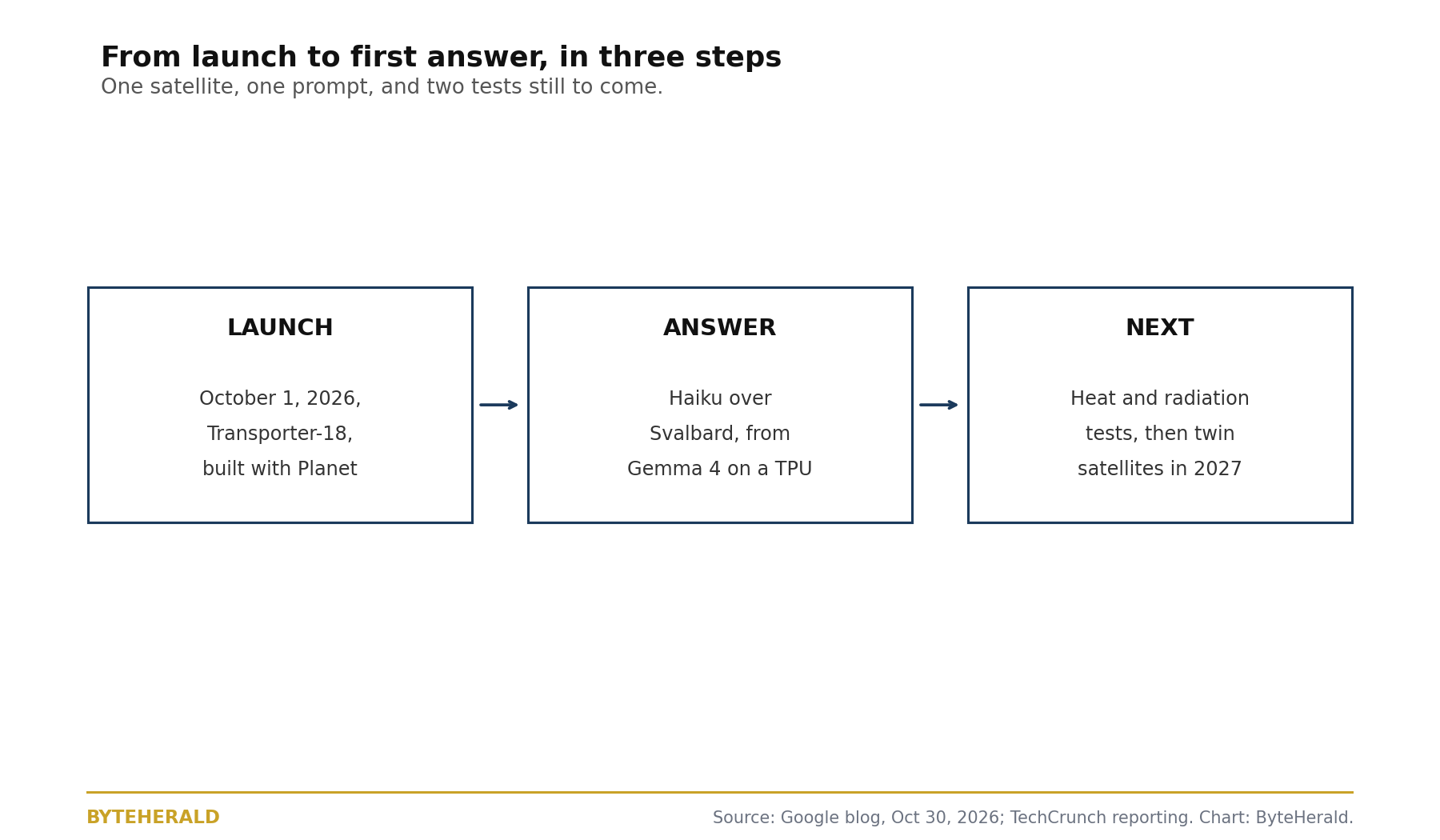
Google launched the prototype satellite on October 1, 2026, as the first step in what it calls a long-term research moonshot to explore powering AI compute in space. The satellite was built with Planet, the Earth-imaging company, and flew on SpaceX's Transporter-18 rideshare mission, according to reporting of the launch. Google then spent the following weeks on a commissioning checklist: powering up the host computer and the TPU trays, and running early machine learning tests. During a ground-station pass, the team uplinked its first prompt to the onboard Gemma 4 open model, asking it to generate a haiku about being in space. As the satellite passed over Svalbard, Norway, the downlinked poem confirmed success: "Blue marble below / Data streams in silent grace / Starlight feeds my core." Google then tested space-themed limericks and telemetry prompts reporting the technical status of the payload systems. Chief executive Sundar Pichai shared the same milestone on X on October 30, 2026, calling it a "hello world" milestone for Project Suncatcher.
| Item | Verified figure | Source status |
|---|---|---|
| Launch | October 1, 2026 | Google blog, October 30, 2026 |
| Model on board | Gemma 4, Google's open model | Google blog, October 30, 2026 |
| First answer | Haiku, downlinked over Svalbard, Norway | Google blog, October 30, 2026 |
| Chips | Four Trillium-generation TPUs | Reporting, attributed, not Google's post |
| Power | About 1 kilowatt of solar power | Reporting, attributed, not Google's post |
| Run length | One TPU at a time, about 15 to 20 minutes per burst | Reporting range: NPR about 15, TechCrunch about 20 |
| Next milestone | Twin interconnected satellites in 2027 | Google blog, October 30, 2026 |
The power and run-length rows deserve a note, because two respected outlets report different burst lengths and neither figure comes from Google's own post. NPR reported about 15 minutes at launch, and TechCrunch reported about 20 minutes for a single TPU at a time. ByteHerald reports the range rather than picking one, because the difference is a reporting difference, not a fact Google has settled. The same caution applies to the chip count and the kilowatt figure: they come from reporting around the launch, and they are labeled as such in the table above.
Why anyone would put a data center in orbit at all
The pitch, as Google frames it, is about sunlight and distance from the constraints on Earth. Satellites in the right orbit sit in near-constant sunlight, so their solar panels can generate power around the clock without a grid connection, a land negotiation, or a water supply. That is the long-term exploration: whether large-scale machine learning infrastructure could one day run where power is clean and constant, instead of where land, permits, and transmission lines are contested. The contrast with Earth-bound building is the point. OpenAI's new name for its buildings changes no site, as ByteHerald reported on November 1, 2026, when it covered OpenAI calling data centers compute campuses. Suncatcher changes the site itself, from a building on a grid to a satellite in orbit, and that is a real difference even though the workload so far is a poem.
That pitch should not be confused with a power argument that is already proven. A single satellite generating about 1 kilowatt is not a data center, and Google does not claim it is. The energy question that matters for orbit is not whether one chip can run, but whether thousands of chips can run together, cooled, powered, and repaired, without the ground infrastructure that makes Earth data centers work. ByteHerald's datacenter resource ledger showed how much power and water Earth campuses already consume, and orbit trades those problems for different ones, not for none.
The two tests that actually matter next
Google says the next tests will evaluate how its TPUs perform under thermal stress and radiation exposure in orbit, and those two words are the whole story of what remains unproven. In a vacuum, there is no air to carry heat away, so every watt a chip dissipates must leave through radiators, which is far slower than the cold plates and chillers of a terrestrial facility. A chip that runs for 15 to 20 minutes in a burst has not yet shown it can run continuously, or that it can shed heat at full load for hours. Radiation is the subtler threat: high-energy particles can flip bits and quietly corrupt data. Google has tested its TPUs in particle accelerators, and reporting of that work says the chips held up better than expected for running models, with more concern for training them, but an accelerator run is not the same as years of trapped particles and solar storms. Until the thermal and radiation tests report results, the haiku is a "hello world," not a benchmark.
The 2027 milestone is the test that would move the project from one satellite to a system. Google plans twin interconnected satellites, designed to demonstrate inter-satellite links, which are the key step toward satellites that genuinely share a workload rather than each running alone. A single satellite answering a prompt proves a chip can run in orbit. Two satellites passing work between them would prove a network can run in orbit, and that is the difference between a stunt and an architecture. Readers should watch for that link test, and for the thermal and radiation results, before judging whether Suncatcher is a path to orbital computing or a memorable demonstration.
What this is not
Suncatcher is not a product, not a service, and not something any reader can use. Google describes it as a research moonshot, and no pricing, availability, or customer offering has been reported. It is also not the first time computing has run in space: satellites have carried computers for decades. What is new, by Google's claim, is the class of chip: a data center class TPU, the same kind of silicon that powers its Earth data centers, running a modern open model and returning a complete answer. That claim is specific, and it is the one worth remembering. If the thermal and radiation tests fail, the project ends as a clever first. If they pass, and the twin satellites link in 2027, the conversation changes from whether AI can run in orbit to whether it should, and at what cost. For now, the poem is the proof of the chain, and the chain is all that has been proven.
By ByteHerald Staff. Google, October 30, 2026, announced the first AI response from a data center class TPU in orbit, with a Gemma 4 haiku uplinked during a ground-station pass and downlinked over Svalbard, Norway, after an October 1, 2026 prototype launch and a commissioning checklist including TPU tray power-up and early machine learning tests, and stated next tests on thermal stress and radiation exposure and a twin interconnected satellite milestone in 2027. TechCrunch, October 30, 2026, reported the prototype carries four Trillium-generation TPUs, generates about 1 kilowatt, and runs one TPU at a time for about 20 minutes, with a Google spokesperson saying the satellite is operating nominally. NPR, at launch, reported a burst length of about 15 minutes, which ByteHerald reports as a range with the TechCrunch figure rather than a settled Google figure. Sundar Pichai, October 30, 2026, shared the milestone on X as a "hello world" milestone for Project Suncatcher.
Comments
Post a Comment