OpenAI wants the buildings that power ChatGPT to be called compute campuses instead of data centers, a spokesperson confirmed to Business Insider on November 1, 2026. The new name is the headline, not the change: it alters no building, no permit, no power contract, and no water use, and it arrives as OpenAI prepares a policy push after the November 3 midterm elections.
What OpenAI actually said
The spokesperson's case for the name is about description, not engineering. "Compute campuses better describes the scale and role of the infrastructure we're building for AI," the spokesperson said, calling the facilities "long-term investments in computing, energy infrastructure and skilled work." That is a claim about how the buildings should be perceived: not as warehouses for servers, but as places where computing, energy, and jobs meet. OpenAI also said it wants host communities to help shape these projects and share in the opportunities they create, which is a promise about process, not a change to any existing site.
TechCrunch reported on November 1, 2026, that the rename sits inside a wider post-midterm plan described to Axios by OpenAI's chief global affairs officer, Chris Lehane. Lehane called the midterms "a bit of a movie trailer for what you're going to see in 2028," when he expects artificial intelligence to be the defining issue of the presidential election. The plan, as reported, includes proposals OpenAI calls "speed limits" for the most capable systems, efforts to present AI as empowering in daily life, and a push for the United States to lead on global standards.
Why the timing is not an accident
Data centers have become a local political issue, not just a technical one, and that is the context a reader needs before judging a new label. In Texas, a University of Houston Hobby School poll published on October 27, 2026, found that 79 percent of likely voters wanted limits on new data centers, a result ByteHerald reported the morning of November 1, 2026. When opposition is that measurable, a company has an incentive to change the word voters hear first. For the Texas result in full, including the poll's sample and margin, see 79% of Texas Voters Want Limits on New Data Centers.
TechCrunch also noted that the debate has already moved company behavior in one visible way: Amazon and Microsoft have said they will no longer use non-disclosure agreements in their negotiations with local governments. Lehane described the conversation around data centers as good and healthy, and said communities should hold companies responsible so projects deliver a real benefit. That is the standard OpenAI is inviting readers to apply, and it is a more useful test than the label itself.
What a data center actually is, and what a rename leaves alone
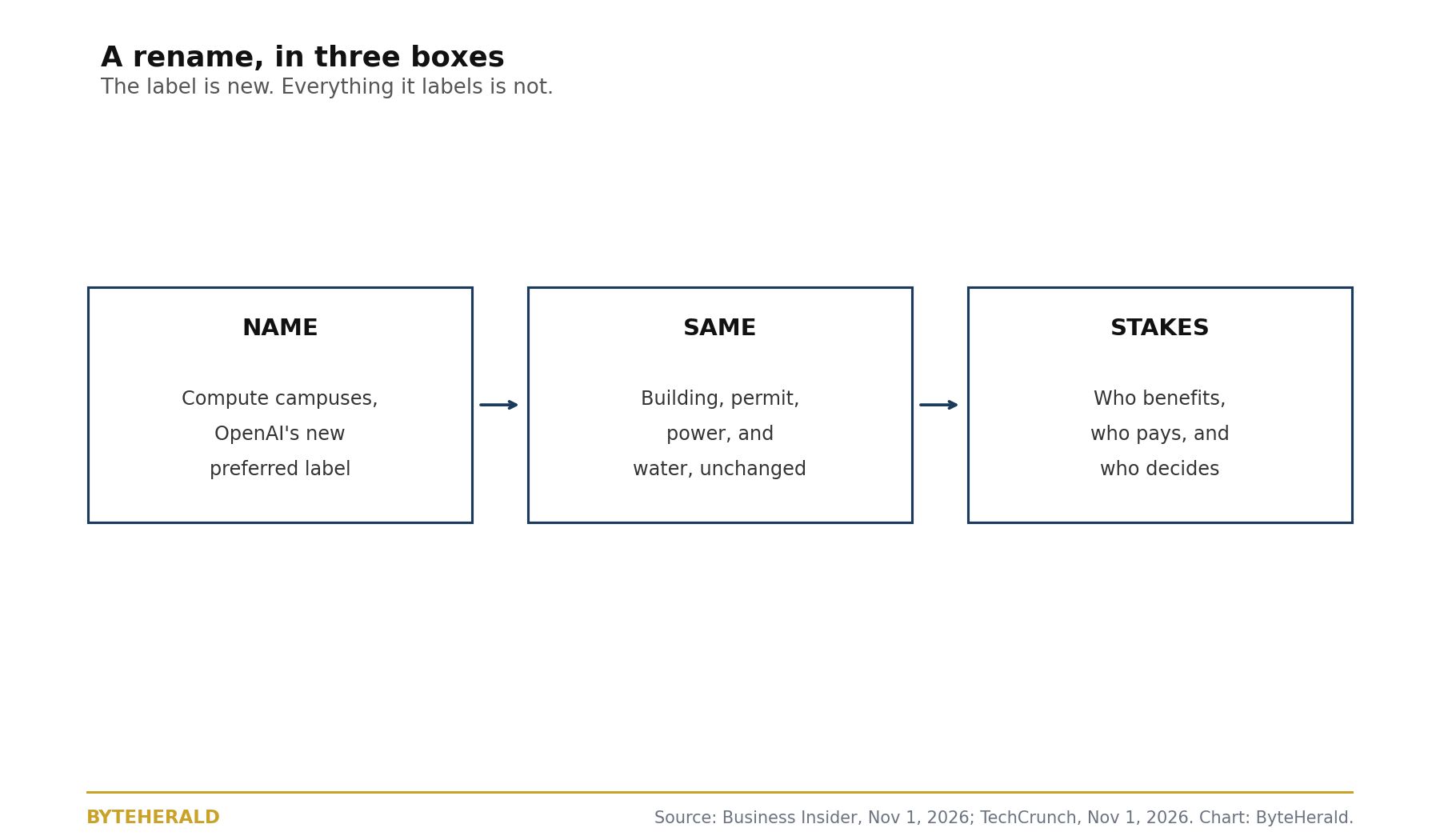
A data center, by any name, is a building full of computers, the power to run them, the cooling to keep them running, and the network links to everything else. Calling a group of such buildings a campus is not new: the industry already uses campus for multi-building sites. What OpenAI is doing is different. It is asking the public, and by extension local officials and journalists, to adopt its preferred word for the whole category, starting with its own projects.
The table below states the point plainly, because the distinction is the whole story. Nothing in the November 1 reporting describes a new building design, a new power deal, a new water commitment, or a new permit condition. Those are the things that change a project's effect on a town. A name changes the conversation about the project, which matters in politics, but it does not change the project.
| What changes | With the new name |
|---|---|
| The building and its servers | Unchanged |
| Permits and local approvals | Unchanged |
| Power drawn from the grid | Unchanged |
| Water used for cooling | Unchanged |
| Jobs promised or delivered | Unchanged, unless a separate agreement says otherwise |
For what those unchanged quantities look like in practice, ByteHerald's October 21, 2026, resource ledger is the useful companion read: it totals the power and water claims of the largest campuses, including the gigawatt-scale sites, so a reader can check any future "campus" announcement against real numbers rather than a new word. See AI's Power and Water Bill: The Datacenter Resource Ledger.
How to judge the rename, and what to watch next
The fair test is simple, and it comes from OpenAI's own framing. If a project announced as a compute campus arrives with a published community agreement, a stated power source, and a water disclosure, then the name is attached to something verifiable. If it arrives with only the name, then the name is doing all the work, and readers should say so. The same test applies to every lab, not just OpenAI: a label is not a benefit, and a campus is not a community agreement.
What comes next is more consequential than the label, and it is where attention should go. After the midterms, OpenAI is expected to press its policy proposals, including its "speed limits" idea and state-level standards, in a Congress that may be more inclined to regulate. Those proposals, if they become law or binding agreements, will change what companies must do. A rename will not. The honest summary of November 1, 2026, is therefore a narrow one: OpenAI found a better word for its buildings, and the debate about those buildings continues exactly where it was.
By ByteHerald Staff. Business Insider, November 1, 2026, reported OpenAI's spokesperson confirming the compute campuses name and the scale, role, and long-term investment framing. TechCrunch, November 1, 2026, reported Axios's account of Chris Lehane's post-midterm plan, the 2028 framing, the speed limits proposals, and the Amazon and Microsoft non-disclosure agreement change. University of Houston Hobby School, October 27, 2026, polled 2,000 likely voters in Texas and found 79 percent wanted limits on new data centers.
Comments
Post a Comment