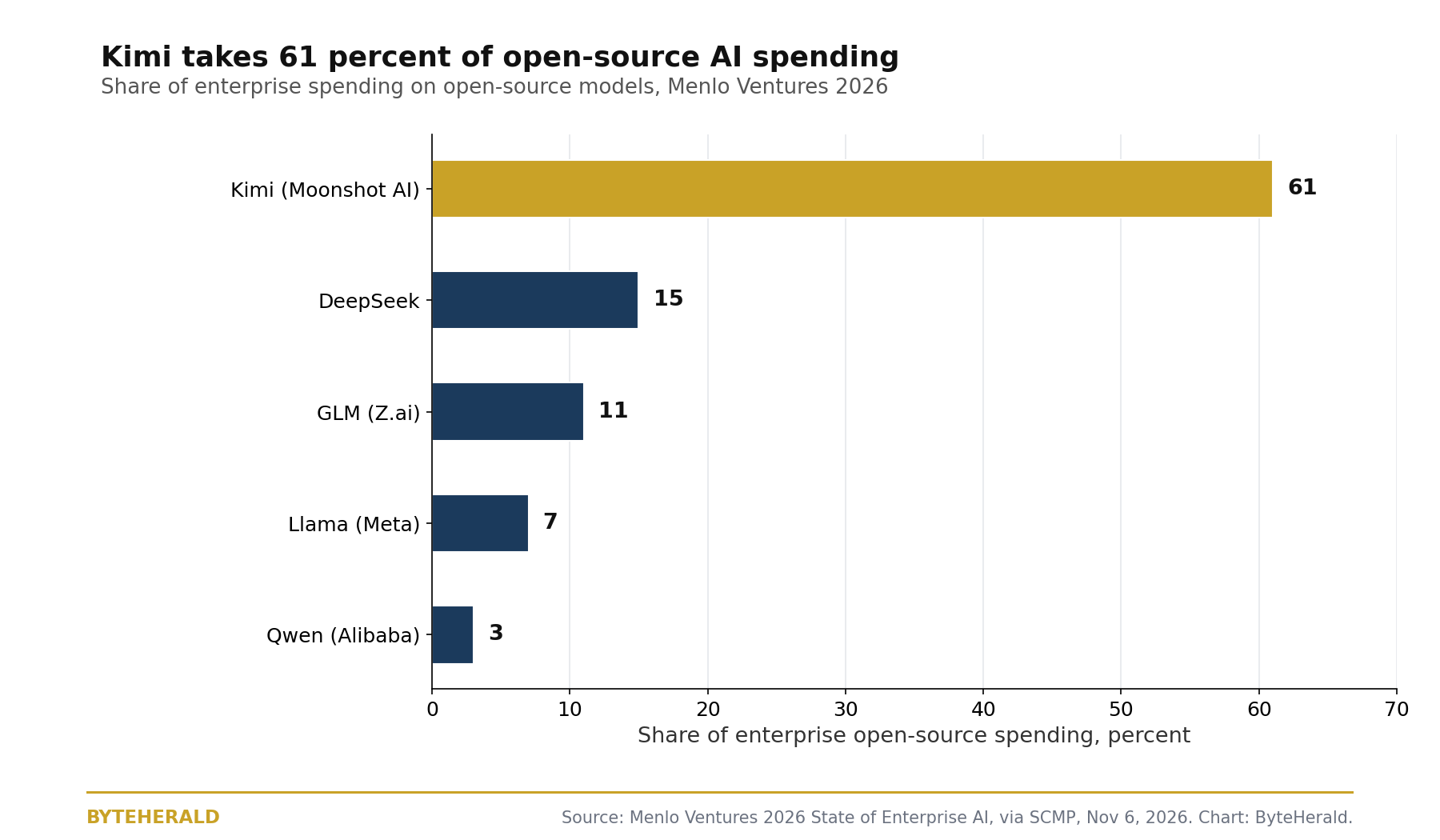
Almost nine out of every ten dollars American enterprises spend on open-source AI models now goes to a Chinese vendor. That is the central finding of Menlo Ventures' 2026 State of Enterprise AI report, released this week and reported by the South China Morning Post on November 6, 2026. Moonshot AI's Kimi family alone takes 61 percent of that spending, ahead of DeepSeek at 15 percent and Z.ai's GLM series at 11 percent, while Meta's Llama, the leading Western offering, holds 7 percent. The same report contains a paradox worth more attention than the headline: open-source models are just 4 percent of enterprise AI spending, but 19 percent of enterprise token usage. The open-source market is small, cheap, and overwhelmingly Chinese, and the three facts together explain more about where enterprise AI is going than any single share number.
The share table
Menlo's report, based on a survey of nearly 400 US enterprise decision-makers managing more than 4 billion dollars in total AI budgets in September, extrapolates global numbers from that survey alongside public filings and third-party reports. The open-source spending split it reports is stark. Chinese systems account for 89 percent of global enterprise spending on open-source models. The table below gives the shares the South China Morning Post published; the 3 percent remainder is ByteHerald arithmetic, the gap between the named shares and 100 percent, and covers models the coverage did not itemize.
| Model family | Share of enterprise open-source spending | Origin |
|---|---|---|
| Kimi (Moonshot AI) | 61% | China |
| DeepSeek | 15% | China |
| GLM (Z.ai) | 11% | China |
| Llama (Meta) | 7% | United States |
| Qwen (Alibaba) | 3% | China |
| Other models | 3% | Not itemized in the coverage verified |
The same report draws the line between open and closed clearly. Anthropic and OpenAI together command 86 percent of enterprise spending on AI models accessed through APIs, which is where most of the money sits. Open-source models, for all their usage, remain a rounding error in spending. That split is the context the Kimi number needs: Kimi dominates a small market, not the whole market. What it dominates is the part of the market where enterprises choose the model themselves, host it themselves, and pay per token rather than per seat.
The paradox: 4 percent of the money, 19 percent of the tokens
Open-source models take 4 percent of enterprise AI expenditure and 19 percent of enterprise token usage. The gap is a price story. Menlo reports, via secondary coverage of the report, that the average price of an open-model token fell by two thirds over the year, from 45 cents to 13 cents per million tokens. At those prices, a model can run a fifth of an enterprise's tokens and still cost a twenty-fifth of its budget. The usage data points the same way. On OpenRouter, the model aggregation platform, Chinese models' token usage exceeded that of US models for the 27th consecutive week in the week of October 26 to November 1, 2026. DeepSeek held 29.8 percent of text requests across all model authors that week, up 7 percentage points, according to the same secondary coverage. The spending stall we reported on November 6 is the other side of the same coin: token use keeps growing while token spending flattens, because competition and efficiency keep cutting the price per token. Enterprises are not spending less on AI because they use it less. They are spending less per token because the tokens got cheaper, and the cheapest tokens are open and Chinese.
What the survey actually measured
Menlo Ventures is a Silicon Valley venture capital firm, and its report is a survey plus extrapolation, not an audit of invoices. The global numbers come from a September survey of nearly 400 US enterprise decision-makers, plus public filings and third-party reports, and the 89 percent figure is an estimate built from that mix. That does not make it wrong, but it sets the confidence level: the direction is well supported by the OpenRouter usage data, which is measured rather than surveyed, while the exact shares carry survey error. The report also sizes the market around the shares. Coding tools and enterprise chatbots now make up 76 percent of the 77.3 billion dollar global enterprise AI application market, and Menlo puts US enterprise AI deployment spending at 176.8 billion dollars in 2026, up from 33 billion dollars a year earlier, a 5.4-fold increase, according to secondary coverage of the report. The application market and the deployment market are different numbers, and the report's claim is that both are growing fast while the open-source slice of the spending stays small and cheap. Kimi's lead inside that slice is built on the things enterprises say they buy open models for: long-context processing for internal documentation and legal archives, and the ability to host the model themselves rather than send data to a US API.
What it means for buyers
For an enterprise choosing models this month, the report's message is practical, not geopolitical. The cheapest capable tokens are open-weight Chinese models, and the most expensive tokens are closed US APIs, and the two serve different jobs. Open models win where the work is high-volume, long-context, and self-hosted: document processing, internal search, coding assistance, and anything where data cannot leave the building. Closed APIs win where the work needs the frontier: the hardest reasoning, the newest capabilities, and the vendor standing behind the answer. The risk in the open choice is not capability but permission. China's draft export rules, which we mapped in October, would control model weights and source code above a 2 trillion parameter threshold, and Kimi K3, reported at 2.8 trillion total parameters, sits above it. A license is not permission, and an open weight is not a guarantee it stays open. The buyers who benefit most from Kimi's 61 percent share are the ones who treat the model as a rented advantage, not a permanent fixture: use the cheap tokens while they are cheap, keep the workload portable, and keep a second model warm. The 89 percent figure will move when the next report lands. The price collapse behind it, from 45 cents to 13 cents per million tokens in a year, is the part that will not reverse.
By ByteHerald Staff. The South China Morning Post reported on November 6, 2026, that Menlo Ventures' 2026 State of Enterprise AI report found Chinese models account for 89 percent of global enterprise spending on open-source models, with Moonshot AI's Kimi at 61 percent, DeepSeek at 15 percent, Z.ai's GLM at 11 percent, Meta's Llama at 7 percent, and Alibaba's Qwen at 3 percent. Menlo's report, based on a September survey of nearly 400 US enterprise decision-makers managing more than 4 billion dollars in AI budgets, found Anthropic and OpenAI together hold 86 percent of enterprise spending on API-accessed models, and open-source models account for 4 percent of expenditure against 19 percent of token usage. OpenRouter data cited in the coverage shows Chinese models' token usage exceeding US models for the 27th consecutive week in the week of October 26 to November 1, 2026. Secondary coverage of the Menlo report puts the average open-model token price at 13 cents per million, down from 45 cents a year earlier, and US enterprise AI deployment spending at 176.8 billion dollars in 2026, up from 33 billion dollars a year earlier.
Comments
Post a Comment