Marvell agreed on November 2, 2026, to acquire Lumentum in an all-stock deal with an implied enterprise value of $115 billion, and Lumentum shareholders will receive 4.5 Marvell shares for each Lumentum share they own, not cash. That single sentence is the deal, and it is also the trap in every headline about it: the $115 billion is a snapshot taken at October 28 prices, and the value of those 4.5 shares will move with Marvell's stock every day until the deal closes, which the companies expect in the first half of 2028.
What the deal actually says
Marvell and Lumentum announced a definitive agreement, unanimously approved by both boards, under which Marvell will acquire Lumentum. The companies describe the combination as creating a category leader in AI connectivity, joining Marvell's electrical and optical interconnect, network switching, and custom chip work with Lumentum's lasers, optical transceivers, and optical circuit switching. Marvell chief executive Matt Murphy called it an opportunity that comes along once in a generation, and Lumentum chief executive Michael Hurlston will join Marvell's board along with two other Lumentum directors when the deal closes. Murphy stays as chairman and chief executive of the combined company.
| Term | Announced value | What it means |
|---|---|---|
| Structure | All-stock, definitive agreement | No cash price is offered; payment is Marvell shares |
| Exchange ratio | 4.500 Marvell shares per Lumentum share | Fixed: the share count does not change, the dollar value does |
| Implied enterprise value | About $115 billion | Includes debt; it is not the cash Marvell pays |
| Implied value per share | About $1,132 | Computed from October 28, 2026 closing prices |
| Premium | About 23.9 percent | Against unaffected October 28 closes, before deal speculation |
| Ownership after close | About 67 percent Marvell, 33 percent Lumentum | Fully diluted basis, as announced |
| Expected close | First half of calendar 2028 | Subject to both stockholder votes and regulatory approvals |
| Company claims | $550 billion addressable market; more than $1 billion annual run-rate cost synergies | Company estimates, not measured results |
The distinction between enterprise value and equity value matters here, and it is easy to miss in a headline. Reuters reported the deal's equity value at $102.54 billion, with the $115 billion figure as enterprise value, which includes debt. Neither number is cash changing hands on announcement day. What Lumentum shareholders actually receive, if the deal closes, is a fixed number of Marvell shares, and the dollar value of that package is set by Marvell's share price at closing, not by the announcement-day arithmetic.
The $115 billion number is a snapshot, not a price
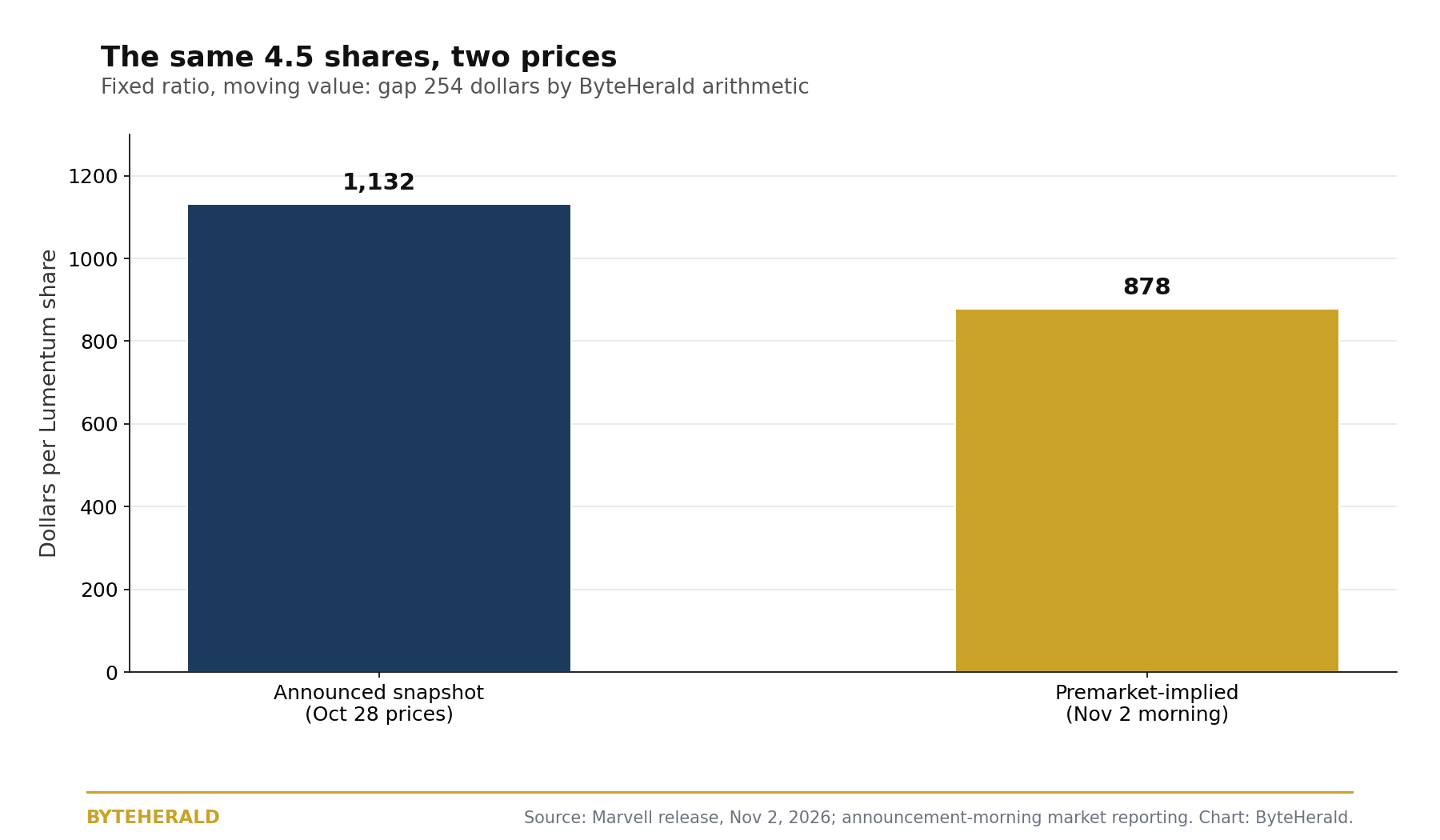
The announcement pegs $1,132 per Lumentum share to October 28, 2026, the last trading day before market speculation about a deal began. Market reporting on announcement morning put Marvell's October 28 close at $251.65, and 4.5 times $251.65 is $1,132.43, which matches the announced figure after rounding. That is the snapshot. The same morning's premarket reporting put Marvell at $195.15, which makes 4.5 shares worth $878.18, or $254.25 (22.5 percent) below the announcement snapshot by ByteHerald arithmetic. Premarket prices are not closing prices, and they are not the price anyone will receive at a 2028 closing, but they show the mechanism plainly: a fixed ratio transfers Marvell's share-price risk to Lumentum shareholders, for better or worse, for as long as the deal takes to close.
Readers who compare this deal with other big AI numbers should keep the universes separate. ByteHerald's five-company $828 billion capex ledger counts money companies plan to spend building capacity, not prices paid to acquire a company, and the two totals answer different questions. The Marvell deal is a bet on who owns the connection between AI chips, and the capex ledger is a count of how much building that capacity costs. Mixing them produces a bigger number and a worse understanding.
Why optics, and why now
The companies' own rationale is about a physical limit, not a marketing slogan. Their release says rapidly growing bandwidth requirements and the physical limitations of copper-based connectivity are accelerating the transition toward optical technologies, and that AI infrastructure is shifting from discrete, modular components toward highly integrated optical solutions. In plain terms, copper traces between chips lose signal and waste power as speeds rise, and light over fiber does not have the same limit. Lumentum brings the light side of that chain: high-performance lasers, optical transceivers, optical circuit switching, and compound semiconductor manufacturing, including indium phosphide. Marvell brings the electrical side: interconnect, switching, and custom chips. The deal joins the two sides of the same signal path under one roof.
That is also why the deal is not just a financial story. The power a data center spends moving data between chips is part of the same bill as the power it spends computing, and ByteHerald's datacenter resource ledger showed how large that total bill has become. A cheaper, lower-power way to move data does not cut the computing bill, but it cuts one of its fastest-growing parts, and at the scale of AI clusters, that part is no longer a rounding error.
What Lumentum reported the same day
Lumentum reported its fiscal first quarter 2027 results alongside the deal announcement, for the quarter ended September 26, 2026. Revenue was $1,262.6 million, against $533.8 million a year earlier, a rise of 136.5 percent that ByteHerald checked by division (1,262.6 divided by 533.8 is 2.365, or 136.5 percent growth). GAAP net income was $360.3 million, or $3.54 per diluted share, and non-GAAP net income was $461.1 million, or $4.57 per diluted share. For the second quarter, Lumentum guided revenue to $1.575 billion to $1.625 billion, a midpoint of $1.60 billion. Those results are the business Marvell is buying, at a moment when its growth is accelerating, and they are also the reason the premium looks the way it does: a company growing revenue by more than double year over year does not sell at its unaffected price.
What would have to go wrong
Three things can still change this deal before 2028, and readers should watch all three rather than treating the announcement as a completed acquisition. First, both sets of stockholders must approve it. Second, regulators must clear it, and a deal that joins two of the fastest-growing enablers of AI infrastructure will be read closely. Third, Marvell's share price will keep moving, and with a fixed ratio, every move changes what Lumentum shareholders ultimately receive. The companies also claim more than $1 billion in annual run-rate cost synergies and earnings accretion in the first year after close, and a $550 billion total addressable market. Those are company claims about the future, stated in the release as expectations, and they should be read as the companies' case for the deal, not as results. The honest summary of November 2, 2026, is narrower and more useful: Marvell has agreed to pay in stock for the company that makes the light its chips need, at a price that will not be final until 2028.
By ByteHerald Staff. Marvell Technology, November 2, 2026, announced a definitive all-stock agreement to acquire Lumentum, with a fixed ratio of 4.500 Marvell shares per Lumentum share, an implied enterprise value of about $115 billion, about $1,132 per share, about a 23.9 percent premium to October 28, 2026 unaffected closes, about 67 percent and 33 percent pro forma ownership, and an expected close in the first half of calendar 2028. Lumentum Holdings, November 2, 2026, reported fiscal first quarter 2027 results for the quarter ended September 26, 2026, with revenue of $1,262.6 million against $533.8 million a year earlier, GAAP net income of $360.3 million, non-GAAP net income of $461.1 million, and second quarter revenue guidance of $1.575 billion to $1.625 billion. Reuters, November 2, 2026, reported the deal's equity value at $102.54 billion against the $115 billion enterprise value, and announcement-morning market reporting put Marvell's October 28 close at $251.65 and its premarket price at $195.15, from which the $878.18 premarket-implied value for 4.5 shares is calculated.
Comments
Post a Comment