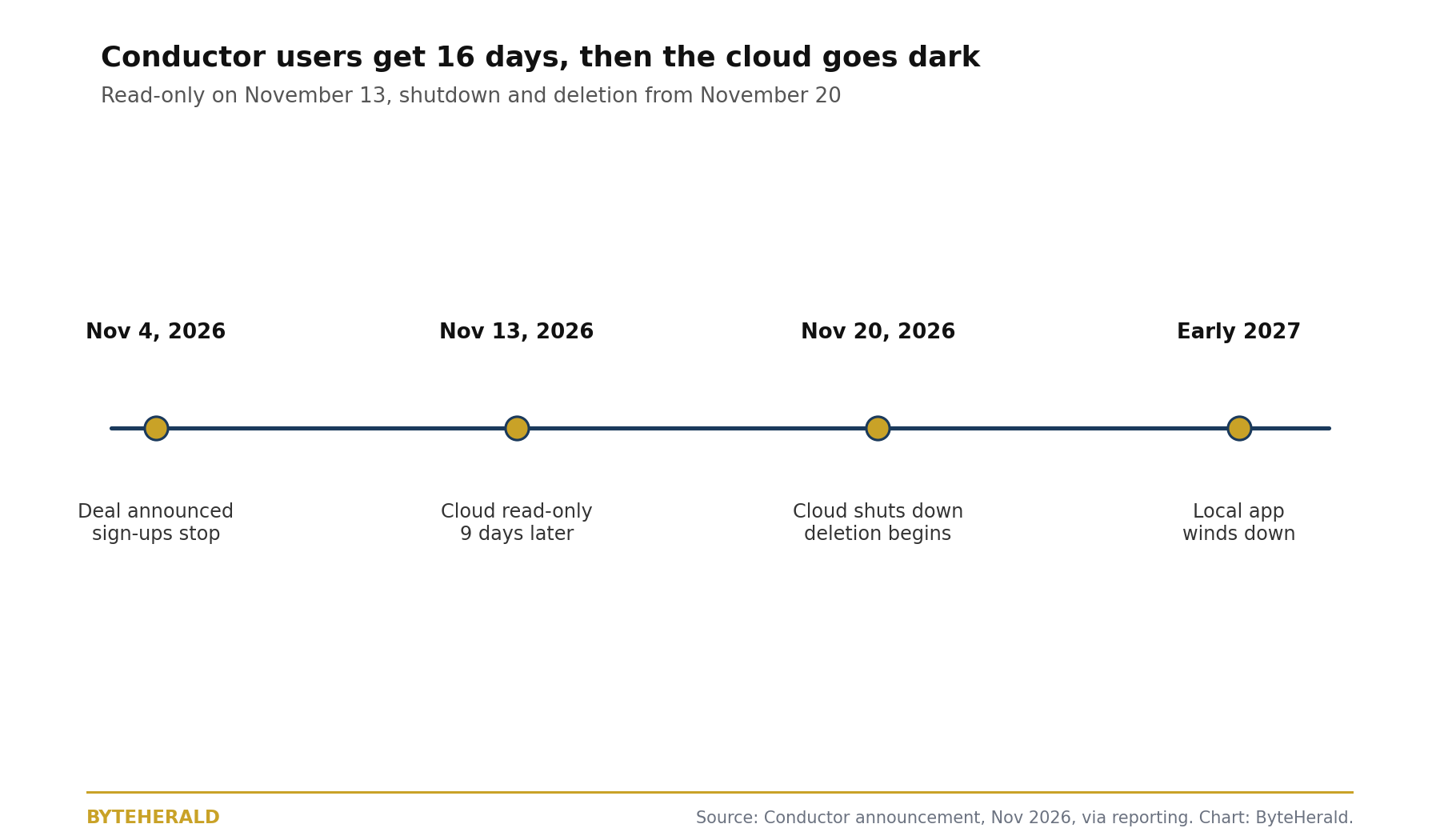
Meta acquired Conductor on November 4, 2026, and Conductor's cloud service will shut down on November 20, 2026, after going read-only on November 13. That gives cloud users 16 days from the announcement to move their work or export it, because Conductor says it will begin deleting cloud user data after the shutdown. The local app lasts longer, with support until early 2027, but it is a temporary destination, not a replacement for the cloud service.
What Meta bought, and what it did not say
Conductor, founded in 2024, builds software that runs several AI coding agents in parallel workspaces, so a developer can put different agents on different parts of a project at the same time instead of queuing them through one shared session. The agents themselves are not built by Conductor. According to TechCrunch, they come from major labs including Anthropic and OpenAI, and Conductor supplies the layer that organizes and runs them. Founder and chief executive Charlie Holtz announced the deal on November 4, 2026, writing that Conductor is joining Meta and that the company has big plans for the next interface, with something new for customers by early next year. Meta confirmed the acquisition to TechCrunch but would not comment further or provide additional details, and the financial terms were not disclosed.
What Meta did not say matters as much as what it did. Meta has not said whether Conductor continues as a product, how many of its employees join Meta, or how its technology will be used inside Meta. Axios reported that the team joins Meta Superintelligence Labs, and Holtz said on X that he looks forward to working with Alexandr Wang, Meta's chief AI officer, and Nat Friedman, head of product at Superintelligence Labs. Those are the only placement details on the record. A reader who assumes Conductor's product survives inside Meta is ahead of the facts: the only product future Conductor itself announced is a wind-down schedule, plus an unnamed new interface early next year.
The same day OpenAI bought storage, Meta bought orchestration
November 4, 2026, was a coding-tools deal day on both sides of the frontier. Hours before the Conductor news, OpenAI announced it will acquire Pierre Computer and fold its Code Storage service into Codex, buying the storage layer underneath agent coding. Meta's Conductor deal buys the layer above the models: the interface where a developer assigns, watches, and merges work from a team of agents. Neither deal buys a better model. Both buy the plumbing and the interface around models that already exist, which tells a reader where the labs think the next advantage sits: not in one more coding model, but in making many agents usable at once.
Meta's own coding push frames the purchase. The company launched Muse Code, its own coding agent, in August 2026, and says its Muse agents passed 10 million users. Conductor's orchestration fits that push directly, because a coding agent that works alone solves one task, while an orchestrator lets a team of agents work on a whole project in parallel. Whether Meta folds Conductor's interface into Muse Code, rebuilds it as something new, or simply hires the team and retires the product is undisclosed, and the wind-down schedule is the only evidence about the current product's future.
What Conductor users must do before November 20
The schedule Conductor published leaves no room for waiting. New sign-ups and app downloads stopped with the announcement, existing free users cannot upgrade, and current Pro users keep Pro features at no charge. On November 13, 2026, Conductor Cloud workspaces become read-only: users can still view old chats and export data, but they cannot send new messages. On November 20, 2026, the cloud service shuts down and Conductor begins deleting cloud user data. Active subscribers receive refunds, according to reporting on the announcement. To move a cloud workspace and its chats to a Mac, users right-click the workspace and choose Transfer to local; for a full copy of their data, they go to Settings, then Account, then Export data. Conductor says it has never sold or trained on user data and will delete all remaining user data at final shutdown.
The honest advice follows the dates. Cloud users should transfer or export this week, not in the read-only week, because read-only still allows export but removes the ability to finish work in the cloud. Local users have until early 2027, when the local Mac app stops receiving new models and critical bug fixes and begins winding down, so the local app buys months, not a permanent home. Anyone whose workflow depends on agents running after the app closes, which the cloud version allowed through hosted workspaces, needs a new home for that workflow now, because a local session ends when the app closes or the Mac shuts down.
Why orchestration, not another model, is the prize
For readers who do not write code daily, the durable idea is this. The first wave of AI coding tools gave each developer one assistant. The second wave gives each developer a team, and a team needs a manager: something that keeps agents from overwriting each other's work, tracks which agent did what, and merges the results. That manager is orchestration, and it is a different product from a model. A lab that owns the orchestrator owns the developer's daily workflow, even when the agents inside it come from rival labs. That is why a startup whose agents are borrowed can still be worth buying: the value sits in the interface and the workflow habits built around it, not in the models it rents.
That reading also explains the risk for buyers of any agent tool, not just Conductor. When a startup is acquired, the product users rely on can be wound down in weeks, as Conductor's cloud is, while the team moves inside the buyer. The defense is boring and effective: keep work in repositories and exports the user controls, not only inside a vendor's workspace. Readers comparing coding assistants can use our earlier scorecard of five AI coding assistants on the same ten tasks to judge the agents themselves, and should judge any orchestrator separately, on one question: if this company is acquired tomorrow, does my work survive the announcement.
Confirmed, promised, and not yet shown
| Claim | Status | Why it matters |
|---|---|---|
| Meta acquired Conductor | Confirmed Nov 4, 2026 | Meta confirmed it to TechCrunch; Axios reported it first |
| Cloud read-only Nov 13, 2026 | Announced by Conductor | Last week to export with full access ends here |
| Cloud shutdown Nov 20, 2026, deletion begins | Announced by Conductor | Data left in the cloud is deleted after this date |
| Local app supported until early 2027 | Announced by Conductor | Months of runway, not a permanent home |
| Team joins Meta Superintelligence Labs | Reported by Axios; Holtz named Wang and Friedman | Placement inside Meta, not a standalone future |
| Purchase price and deal structure | Not disclosed | Size of the bet cannot be judged |
| Conductor product survives inside Meta | Not announced | Only an unnamed new interface early next year is promised |
| Series A of 22 million dollars, March 2026 | Reported, not confirmed by Meta | Eight months from fundraise to acquisition, if the figure holds |
Update, November 6, 2026
Conductor's announcement lists a team of ten, led by founder and chief executive Charlie Holtz and chief technology officer Jackson de Campos, and its March 2026 Series A of $22 million came from Spark Capital and Matrix, according to reporting on the announcement. Neither figure changes the wind-down dates above: the cloud service still goes read-only November 13, 2026, and shuts down November 20, 2026.
By ByteHerald Staff. TechCrunch, November 4, 2026, reported that Meta acquired Conductor, an AI coding startup that deploys multiple agents into parallel workspaces, that Meta confirmed the deal but gave no further details, that Conductor was founded in 2024 and launched its core product last summer, and that its cloud service shuts down November 20, 2026, after which the company will begin deleting user cloud data. Conductor, November 4, 2026, announced it is joining Meta, set November 13, 2026, as the date its cloud workspaces become read-only and November 20, 2026, as the shutdown date, said new sign-ups and downloads stopped with the announcement, and promised something new for customers by early next year. Axios, November 4, 2026, first reported the acquisition and reported that the team joins Meta Superintelligence Labs. Meta, August 2026, launched Muse Code, its own coding agent, and reported that its Muse agents passed 10 million users.
Comments
Post a Comment