Microsoft has filed a patent application for an AI system that rewrites what a person says during a livestream, in near real time, and redraws their lips so the edit does not show. The application, US 2026/0341309 A1, was published by the US Patent and Trademark Office on October 29, 2026. It is a filing, not a product: no patent has been granted, the examiner rejected the claims as filed in July 2026, and Microsoft has not announced anything built on the idea.
How the system would work
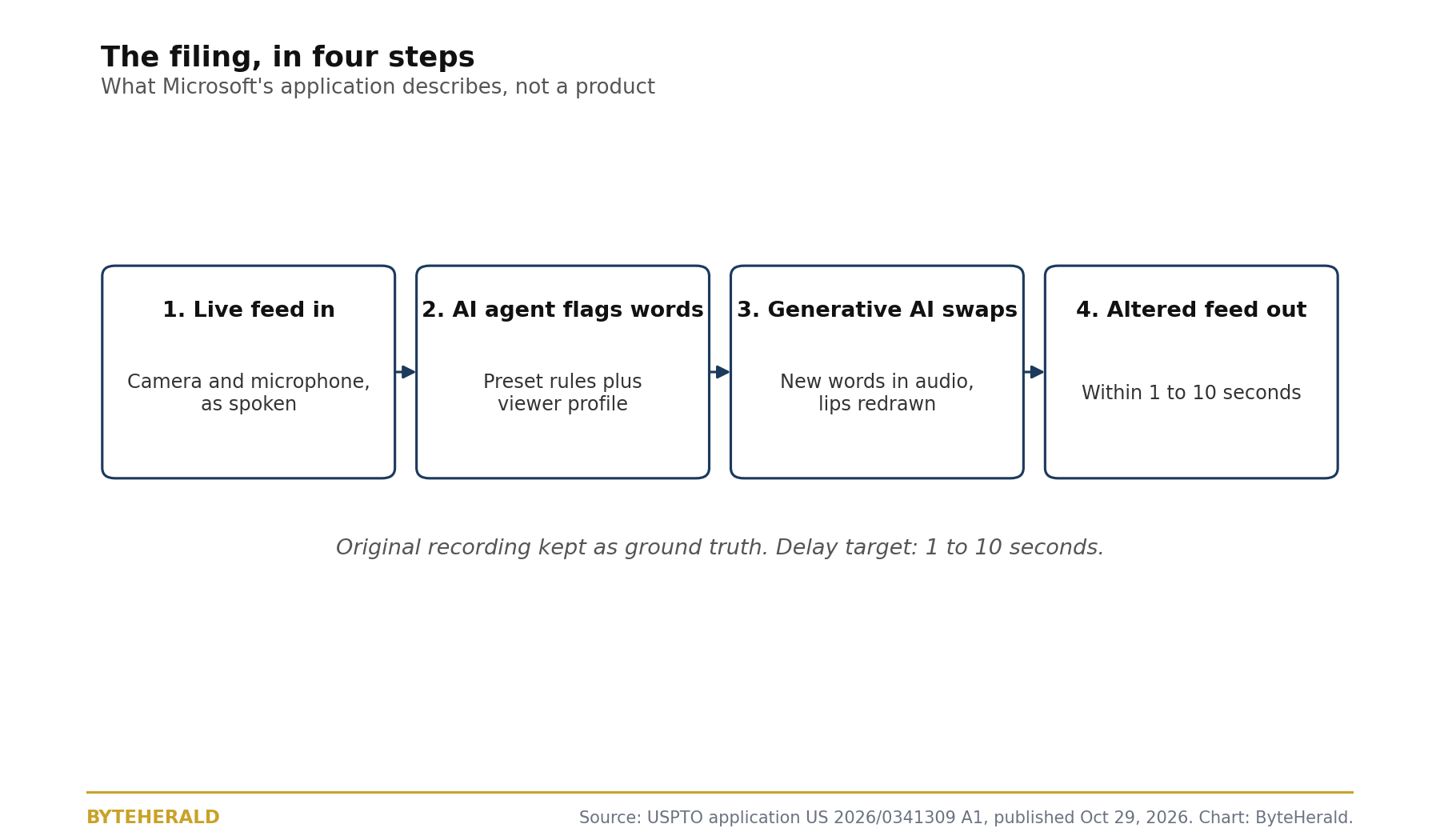
The application, titled "Near Real-Time Artificial Intelligence (AI) Enhancement of Video or Augmented Reality (AR) Presentations of Live Events," starts from a simple complaint: live speech is messy, and the tools to clean it up only work after the fact. Microsoft's version moves the edit into the live feed. An AI agent listens to the live audio and flags words to change, using a set of preset rules and a profile of the viewer. A generative AI system then does two jobs. It swaps the flagged words for new ones in both the audio and the video, redrawing the speaker's lips to match, and it smooths the transitions so the edit sounds and looks natural. The filing puts the delay at a few seconds, giving 1 to 10 seconds as an example. That figure is a target written into the application, not a measured result, and the filing includes no demonstration of a system redoing voice and lips at that speed.
The application carries 20 claims, three of them independent. Claim 1 covers any system that scans live video and audio of people speaking, picks words to change based on a user's profile, has generative AI replace them in both sound and picture, smooths the transitions, and displays the result within seconds. Translation gets its own independent claim, number 16. When a speaker uses a language that is not in the viewer's profile, the system swaps in translated words and redraws the video, lips included, so the viewer hears and sees the speaker talking in their own language. That claim is much narrower than the first one, since it only applies to languages missing from the profile and requires the redrawn lips.
What it would change
The filing's list of targets mixes very different things. At the harmless end are filler words such as "um," "uh," "like," and "you know," plus stutters, mispronunciations, and regional slang such as "y'all" and "gonna." At the other end is profanity and offensive language, removed or replaced before the viewer hears it. The live content named as examples runs from lectures and presentations to award ceremonies, game shows, cooking shows, concerts, opera, and live sports. The filing says the system could run on phones, tablets, cameras, and AR glasses.
The viewer's profile decides what counts as unwanted. According to the application, a profile can hold age, languages spoken, region of birth or residence, ethnicity, cultural background, religion, education level, college attended, and voice or video samples. That is the part of the filing that matters most, because it means the same speech would be edited differently for different viewers. A joke that is fine for one audience could be rewritten for another, and neither viewer would know the other saw something different. The filing describes storing the original video and audio as a "ground truth" record, but it does not require the viewer to be told that the stream was altered. The question the filing raises, and does not answer, is the same one our FlashProve pillar asks about AI output in general: how do you prove what was actually said, once the words can be swapped live. Watermarking and provenance, which our watermarking explainer covers in detail, are the existing tools for marking altered media, and this filing does not use them.
What the filing is not
The post that spread the story on X said Microsoft "filed a patent" for the capability. That wording is wrong in the way that matters. Microsoft filed an application on April 29, 2025, and it became public exactly 18 months later, which is when US applications are published no matter how examination is going. No patent has been granted. On July 29, 2026, the examiner rejected the claims as filed, a routine first step that applicants usually answer with amendments, and Microsoft can respond. The application was first spotted by patent tracker Patentlyze, and Microsoft did not immediately respond to a request for comment from Futurism. Microsoft has not announced a product built on the idea, and the filing describes a system, not a system that exists.
That distinction is the whole story. A patent application is a claim on an idea, written as broadly as the applicant can manage, and the broadest claim here covers any system that rewrites live speech to match a viewer profile. Whether the examiner allows it, whether Microsoft ever builds it, and whether the lip redraw works at the claimed speed are all open questions. What is not open is the direction: the tools to alter live video are getting cheaper, the filings are getting broader, and the gap between "this is a filing" and "this is shipping" is the only thing standing between a viewer and a speech they never heard.
By ByteHerald Staff. The US Patent and Trademark Office published application US 2026/0341309 A1, titled Near Real-Time Artificial Intelligence Enhancement of Video or Augmented Reality Presentations of Live Events, on October 29, 2026, after Microsoft filed it on April 29, 2025, and the application carries 20 claims, three of them independent, with translation covered by claim 16. Shane the Gamer's report, published November 2026, confirms the filing and publication dates, the 1 to 10 second delay example, and that no patent has been granted and Microsoft did not immediately respond to a request for comment. Dexerto's report, published November 8, 2026, confirms that the system would tailor changes to each viewer's profile, including age, location and languages, and that Microsoft has not announced any plans to use the technology. TBreak's report, published November 2026, confirms that the examiner rejected the claims as filed on July 29, 2026, and that the 1 to 10 second figure is an example in the filing rather than a measured result.
Comments
Post a Comment