Microsoft’s AI Frontiers research group is over. Its founder, John Langford, resigned on November 6, 2026, after the group was moved from Microsoft Research into Microsoft AI in early September, where he says the leadership’s scaling-only philosophy left no room for original research. In a post on his own blog, Machine Learning (Theory), Langford wrote that he situated his team members as best he could and left, and that every other founding leadership member of the group seems to have come to the same conclusion.
What AI Frontiers was
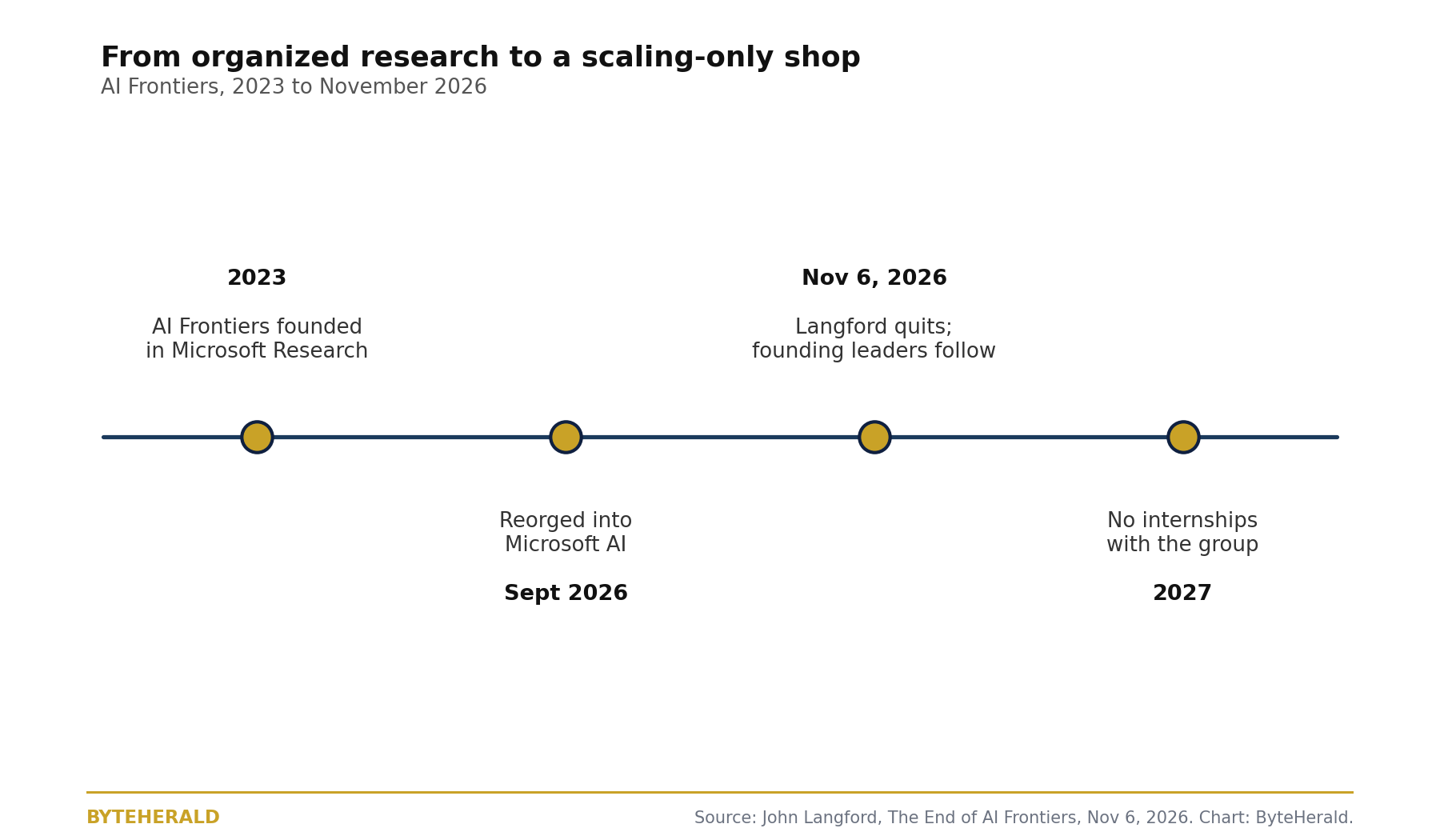
Langford created AI Frontiers inside Microsoft Research in 2023, after the release of ChatGPT made it clear to him that research needed to be more organized to succeed than was typical inside the lab. A single researcher with a clever idea, he wrote, would arrive late and unconvincing, because one person could not move fast enough and the baselines one person could assemble were not strong enough to show an idea was worth taking flight. The group had about 50 people, and much of its work was figuring out how to make agents work, including the AutoGen orchestration framework and the Fara computer-use agent. In New York, several members worked on new fundamental capabilities: the Next Latent objective, which enables extrapolation; Dion3, which creates an optimized and improved version of the Muon optimizer; and the Full Bandwidth Transformer, which makes models function substantially more powerfully through recursion. The group also built a shared monorepo for all of Microsoft Research, containing an edge-scale pretraining codebase Langford described in a keynote the previous month.
The September move
In early September 2026, AI Frontiers was reorganized out of Microsoft Research and into Microsoft AI. On the surface, Langford wrote, putting two AI organizations together could make sense, because it creates opportunities for better concentration of effort, and there were places where AI Frontiers was ahead of Microsoft AI and vice versa. In practice, he wrote, there were substantial issues, because the philosophy of the former Inflection leadership of Microsoft AI is incompatible with research. The core philosophy there, in his words, is scaling, and aggressively not research. In a scaling-only environment, the primary effort is getting, making, and refining data, which he calls quite a step away from what his group was working on. He added that there was plenty of evidence the new leadership just did not really want his group. He announced the post on X on November 6, 2026, calling the situation "a bit of a train wreck."
The math Langford cites
Langford concedes the business logic. Returns to scale are far more predictable than returns to research, and bigger models are better models as far as the quality of the predictions they make. His argument is that treating scaling as a substitute for research, rather than a complement, is a failure mode: it is common for people to give up on a tradeoff between competing ideals by adopting one in totality and dropping the other. Returns to research, he wrote, are real and significant. His evidence is an experiment from ByteDance, which suggests a variant of the Full Bandwidth Transformer might be comparable to a model of twice the size, implying significant savings in training and inference for the same capability. His question: how much is it worth to halve training and inference cost, given that the industry has investments approaching a trillion dollars? The table below is the ledger his post draws, in his own terms.
| Priority | What AI Frontiers did | What Microsoft AI prioritizes |
|---|---|---|
| Core question | New capabilities and architectures | Bigger models, better data |
| Work | Agents, extrapolation, new optimizers | Getting, making, refining data |
| Returns | Real and significant, less predictable | Far more predictable |
| Risk | Arriving late without organization | Scaling-only focus drops research entirely |
Why he did not go back to Microsoft Research
Langford says he considered returning to Microsoft Research, but could not get past two obstacles. The first is that he is not comfortable being at a company where the research he does has no path to real use: he could not get innovation into use, or even seriously considered, while he was in Microsoft AI, so the prospects for success from Microsoft Research seem quite small. The second is that he believes there is a breakdown of the basic deal in Microsoft Research, that doing good work leads to good things happening. As far as he can tell, his group did good work and was non-consensually reorganized away, and he would not be surprised to see that kind of thing continue until Microsoft Research leadership develops the will to organize effectively to meet the moment. His closing line is blunt: "So AI Frontiers is over. I’m sorry to say that there will not be internships with the folks there in the coming year."
The wider pattern
Langford’s exit is not the only senior departure Microsoft has absorbed this year. Eric Boyd, another senior AI leader, left for Anthropic as its head of infrastructure in April 2026. Microsoft also offered voluntary exit to as many as 60,000 employees on October 26, 2026, with staff deciding by early December and leaving on December 31. Microsoft says AI is not driving that offer, and the offer is a voluntary exit program, not a layoff: a smaller spring program saw about 2,600 of roughly 8,750 eligible employees take it, or about 30 percent. The distinction matters, because the story here is not headcount. It is a research group whose founder says the work had no path to use, and a company that keeps choosing scale over the research that might make scale cheaper. Microsoft is losing research leaders the way OpenAI lost them in 2024 and 2025, when 16 senior departures were tracked in our earlier ledger, and the pattern in both cases is the same: the people who build the capabilities leave when the organization stops making room for them. The AutoGen framework AI Frontiers built is part of the agent stack now being standardized across the industry, which is why the fight over who writes the rules for AI agents matters beyond any one company.
What to watch
Three questions decide whether this is a footnote or a warning. First, whether Microsoft AI publishes fundamental research at the rate AI Frontiers did, or whether its output narrows to scaling and data work. Second, where Langford and the other founding leaders land, and whether they rebuild an organized research effort elsewhere. Third, whether Microsoft Research regains a path from research to use, which Langford says is the condition for the lab becoming attractive to researchers again. None of those questions has an answer today. What is established is the ledger: a 50-person group, three years of work, one reorganization, and a founder who concluded that the research had no future inside the new structure.
By ByteHerald Staff. John Langford published "The End of AI Frontiers" on his blog, Machine Learning (Theory), on November 6, 2026, writing that AI Frontiers was created inside Microsoft Research in 2023, had about 50 people, was reorganized into Microsoft AI in early September 2026, and is over, with no internships in the coming year. NewsBytes reported on November 7, 2026 that Langford resigned after the move to Microsoft AI, calling the situation "a bit of a train wreck" in his announcement on X. Business Examiner reported on November 7, 2026 that Langford, a partner researcher manager at Microsoft Research New York, had left Microsoft and declared the group finished. A November 2026 analysis drawing on Fortune’s reporting said Microsoft offered voluntary exit to as many as 60,000 employees on October 26, 2026, that about 2,600 of roughly 8,750 eligible employees took a smaller spring offer, and that Microsoft said AI is not driving the buyouts.
Comments
Post a Comment