The Wall Street Journal reported on November 13, 2026, that Nvidia financed AI startups and smaller cloud providers so they could keep buying its graphics processors, and that the arrangement sat at the center of a confrontation between former chief executive Jensen Huang and the chief financial officer who now runs the company. The filing numbers behind the story are public, and they are large enough to check.

What the Journal reported
The investigation describes a tense meeting in August 2026 between Huang and Nvidia's longtime chief financial officer, Colette Kress, who is now interim chief executive after Huang's resignation. Kress pushed to rein in the company's circular financing commitments to smaller cloud providers and major AI firms, according to the Journal, and Huang belittled her for questioning the deals, calling her "a deer in the headlights." The Journal's account is based on documents and internal accounts, as reported by Wccftech, and Nvidia has not confirmed it.
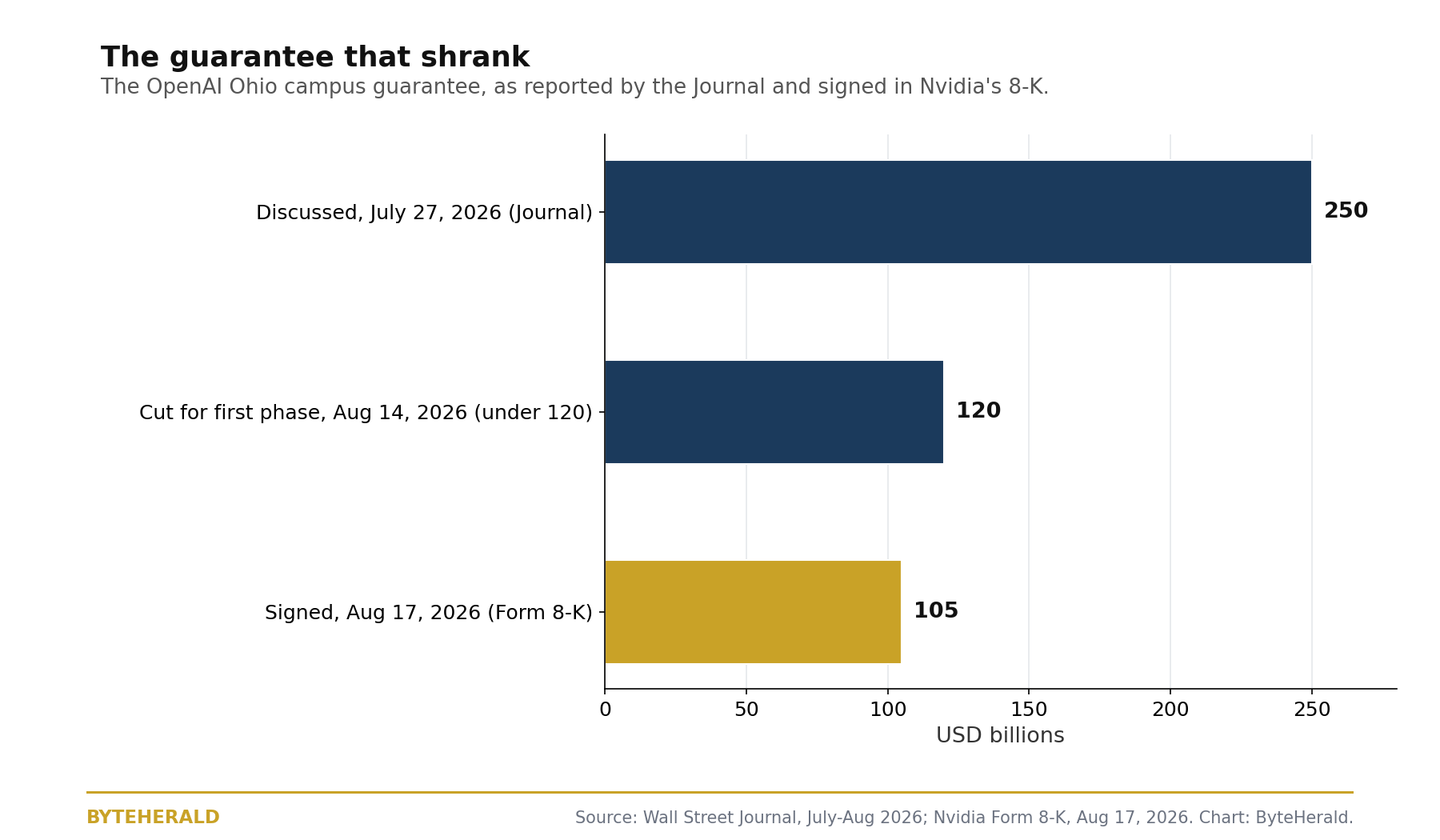
The largest single deal in the account is the OpenAI campus in Ohio. Initial discussions had floated underwriting roughly 8 gigawatts of OpenAI compute valued at up to 250 billion dollars. The Journal reported in late July that Nvidia was weighing a 250 billion dollar guarantee for the project, then reported on August 14 that the guarantee had been cut to under 120 billion dollars for the first phase. On August 17, Nvidia signed a guarantee capped at up to 105 billion dollars, according to its Form 8-K, providing credit support on a land, power, and shell buildout with SB Energy for a data center campus in Pike County, Ohio, leased to an OpenAI affiliate. The site will exclusively host Nvidia hardware, and the guarantee covers about 4.25 gigawatts of capacity over 20-year leases.
The reason Huang gave, according to the Journal, was that the largest cloud companies were moving away from Nvidia's off-the-shelf chips toward their own custom silicon. With that shift underway, the prepaid wafers and memory Nvidia had committed to buy from TSMC were, in Huang's words, "coming at him like an avalanche." Funding the buyers was the alternative to letting the surplus hit the open market and push prices down. Kress's objection, as reported, was that the small cloud providers Nvidia was investing in could not afford to buy its GPUs in the first place, which made them a financial dead end. The Journal also reports that Nvidia has since contacted TSMC to wind down its upcoming chip orders.
The filing numbers
The 530 billion dollar figure at the center of the story comes from Nvidia's own quarterly filing, as read by research firm SemiAnalysis. Nvidia's Form 10-Q for the quarter ended July 26, 2026, filed on August 26, discloses commitments and guarantees that add up to about 530 billion dollars, up from 184 billion dollars one quarter earlier. The filing itself prints no combined total. The figure is the sum of three tables in Note 10, and the items in it are obligations of different natures, not a single liability. More than half of it is orders to Nvidia's own suppliers.
| What Nvidia disclosed (quarter ended July 26, 2026) | Amount | What it is |
|---|---|---|
| Supply and capacity commitments | About 279 billion dollars | Purchase obligations, mostly memory for next-generation Vera Rubin systems; 96 percent due by fiscal 2029 |
| Maximum gross exposure under guarantees | 108.5 billion dollars | Mostly the 105 billion dollar Ohio lease guarantee, plus 3.5 billion dollars on land, power, and shell |
| AI cloud agreements | 36 billion dollars | Take-or-pay capacity commitments to neocloud providers that buy Nvidia chips |
| Cloud service contracts for research and development | 29 billion dollars | Capacity bought for Nvidia's own research work |
| Not-yet-commenced data center leases | 25 billion dollars | Leases intended mainly for Nvidia's own use |
Two other numbers from the same filing matter. Nvidia's accounts receivable stood at 63.1 billion dollars, and its days sales outstanding rose to 60 from 45 in one quarter, because of extended payment terms on large, multi-quarter agreements with certain investment-grade customers. And industry analyst Ed Zitron estimates that at least 200 billion dollars worth of Nvidia GPUs are sitting idle in warehouses, bought by cloud giants that lack either the electrical grid capacity or the end-user demand to switch them on. That is an estimate, not a filing figure, and it is the number that makes the circular financing story matter: if the chips are bought but never switched on, the demand behind the sales is thinner than the revenue suggests.
What this does and does not prove
Circular financing is not, on its own, evidence of wrongdoing, and no formal investigation has been publicly confirmed. A chipmaker investing in its customers and guaranteeing their leases is a real business practice, and Nvidia's defenders in the venture world have said the model worked: the startups got compute, Nvidia got sales. The Journal's reporting does not claim the revenue was fake. It was collected. The question it raises is whether the demand behind it was real, and whether the guarantees will turn into losses if the customers cannot pay.
The 530 billion dollar total also needs its caveat kept in view. About 279 billion dollars of it is supply and capacity commitments, which are orders to Nvidia's own suppliers, mostly memory. The customer-support subset, the part that directly props up buyers, is 164.5 billion dollars: the 36 billion dollars of AI cloud contracts, 20 billion dollars of data center leases for third parties, and the 108.5 billion dollars of guarantees. That is about 72 percent of Nvidia's shareholder equity of 229 billion dollars. Large, but not the same as a 530 billion dollar liability, and the guarantees are maximum gross exposure, a ceiling rather than a certain loss. They phase in as construction completes, the first phase is expected in fiscal 2029, and they decline as rent is paid. They also terminate on certain events, including OpenAI achieving a satisfactory credit rating.
What to watch is now in Kress's hands. She is the executive who pushed back on the guarantees, and she is the one presenting Nvidia's third-quarter results on Tuesday, November 17, the company's first earnings since Huang's departure. The filing that follows those results will update the commitments and guarantees, and it will show whether the interim chief is shrinking the book she warned about, or keeping it. Congress is already asking questions on a parallel track: Democrats opened an inquiry on November 12 into how the administration handled Nvidia's H200 sales to China, and Senate Banking chairman Tim Scott asked Huang and Commerce Secretary Howard Lutnick to testify December 3 and December 10, warning Huang of a subpoena if he did not appear voluntarily.
Will graphics cards get cheaper?
For PC builders, the short answer is probably not soon. TechSpot's November 2 analysis found that graphics card prices rose approximately 35 percent between August and October 2026, based on a 10-country sample. Notebookcheck reported on November 14 that a retreat from circular financing is unlikely to bring back affordable GeForce cards in 2027, because AI accelerators and gaming GPUs rely on different components and manufacturing processes: the data center chips use high-bandwidth memory and complex packaging, while GeForce cards use GDDR memory. Semiconductor analyst Ian Cutress told PCWorld that producing silicon wafers at a foundry such as TSMC typically takes around six months, so even a slowdown in data center demand does not quickly free up gaming supply.
The longer answer is that the shortage story itself has changed. For years, the defining fact of the AI boom was that you could not get Nvidia GPUs, and the waitlists, allocations, and premiums organized the whole industry around scarcity. The Journal's numbers say that scarcity was, at least in part, manufactured on the demand side: the chips were there, the buyers were funded, and the prices stayed high. Whether that was a prudent defense of a business or a fragility that is now unwinding is the question the November 17 earnings will start to answer, and it is the question Kress, who asked it first in August, now has to answer in public.
By ByteHerald Staff. The Wall Street Journal reported on November 13, 2026, that former Nvidia chief executive Jensen Huang and chief financial officer Colette Kress clashed in August 2026 over circular financing commitments, and that Huang called Kress "a deer in the headlights," as reported by Wccftech and TechPowerUp. The Journal reported in late July that Nvidia was weighing a 250 billion dollar guarantee for an OpenAI data center project, reported on August 14 that the guarantee had been cut to under 120 billion dollars for the first phase, and Nvidia signed a guarantee capped at up to 105 billion dollars on August 17, 2026, according to its Form 8-K. SemiAnalysis's reading of Note 10 of Nvidia's Form 10-Q for the quarter ended July 26, 2026, filed August 26, puts total commitments and guarantees at about 530 billion dollars, up from 184 billion dollars the prior quarter, with about 279 billion dollars of supply and capacity commitments and 108.5 billion dollars of maximum gross guarantee exposure. Nvidia reported accounts receivable at 63.1 billion dollars and days sales outstanding of 60, up from 45. Industry analyst Ed Zitron estimates at least 200 billion dollars of Nvidia GPUs are sitting idle in warehouses. TechSpot reported on November 2, 2026, that graphics card prices rose about 35 percent between August and October 2026. Nvidia reports third-quarter results on November 17, 2026.
Comments
Post a Comment