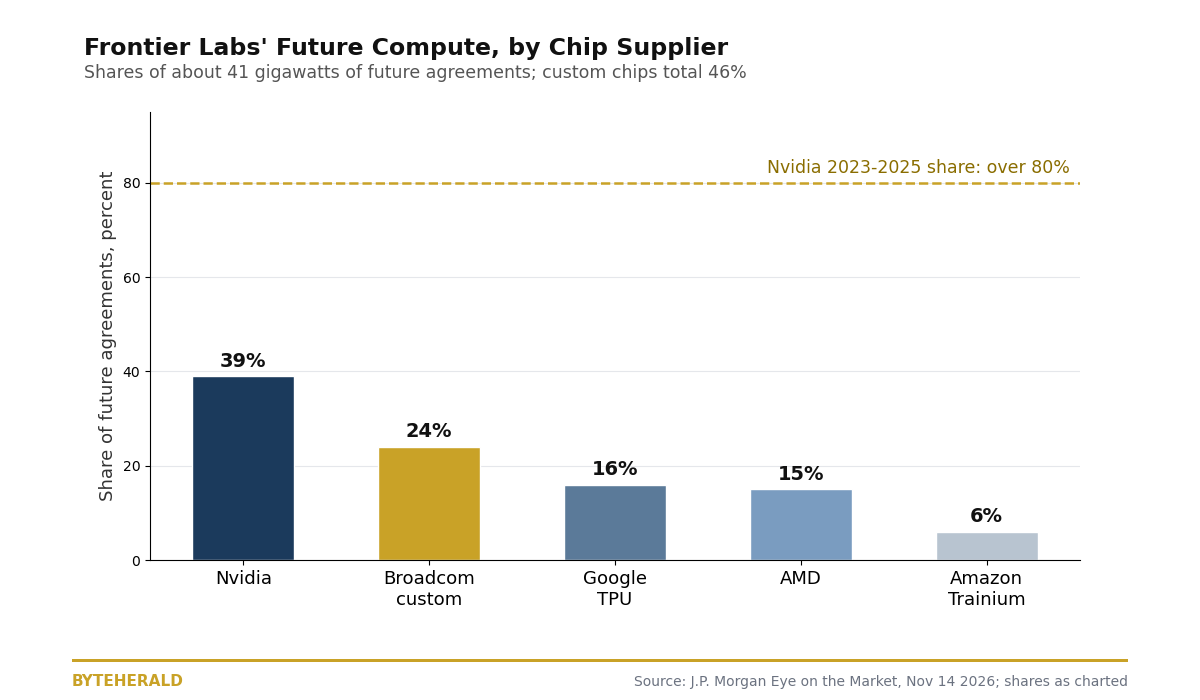
J.P. Morgan's Michael Cembalest puts Nvidia at 39 percent of future frontier-lab compute agreements, against a market share of more than 80 percent from 2023 to 2025. The figure comes from the Eye on the Market note dated November 14, 2026, two days after Jensen Huang resigned as chief executive of Nvidia. Custom chips from Broadcom, Google and Amazon hold 46 percent of those future agreements combined, by ByteHerald's arithmetic, more than Nvidia on its own. The note is Cembalest's own view. Its disclaimer says it "in no way constitutes J.P. Morgan Research."
The chart, in numbers
The note's chart, titled "Frontier Lab future compute agreements" and measured in gigawatts, shows a single bar of roughly 41 gigawatts. Nvidia's 39 percent is about 16 gigawatts of that total, by ByteHerald's arithmetic on a chart-read total that is approximate. Everything other than Nvidia comes to 61 percent, and graphics chips from Nvidia and AMD together come to 54 percent.
| Supplier | Share of future agreements | Gigawatts, approximate |
| Nvidia | 39% | about 16 |
| Broadcom custom chips | 24% | about 10 |
| Google TPUs | 16% | about 6.6 |
| AMD GPUs | 15% | about 6.2 |
| Amazon Trainium | 6% | about 2.5 |
The same note says Nvidia earned 83 percent of AI chip revenues from 2023 to 2025, with gross margins of 75 percent and operating margins of 66 percent. The comparison is the point: the company that took more than four-fifths of the revenue in the last three years holds less than two-fifths of the future agreements the labs have signed.
The announced deals behind the shift
The note's chart does not name the frontier labs or list the agreements behind the 39 percent, and it does not give the dates those agreements run to. The announced deals, however, show the same direction of travel. OpenAI signed up to 6 gigawatts of AMD chips in October 2025, Meta signed up to 6 gigawatts in February 2026, and Anthropic signed up to 2 gigawatts in July 2026, with AMD investing up to 5 billion dollars in Anthropic. OpenAI signed 10 gigawatts of custom chips with Broadcom in October 2025, and Anthropic signed about 3.5 gigawatts of Google and Broadcom TPU capacity in April 2026, starting in 2027. OpenAI's three announced chip deals add up to 26 gigawatts: 10 from Nvidia, 6 from AMD and 10 from Broadcom. The challenger ledger we published on November 11 lists the ten chip startups chasing Nvidia with 15.1 billion dollars raised between them; the Cembalest chart shows the chase is now coming from the labs' own suppliers too.
| Deal | Size | Announced | Terms worth noticing |
| OpenAI and AMD | Up to 6 GW | October 2025 | First 1 GW of MI450 chips, second half of 2026; warrant for up to 160 million AMD shares |
| Meta and AMD | Up to 6 GW | February 2026 | First 1 GW on MI450; same size of warrant |
| Anthropic and AMD | Up to 2 GW | July 2026 | First 1 GW, first half of 2027; AMD invests up to 5 billion dollars in Anthropic |
| OpenAI and Broadcom | 10 GW | October 2025 | Racks from second half of 2026 through 2029 |
| Anthropic, Google and Broadcom | About 3.5 GW | April 2026 | TPU capacity from 2027 |
The caveat belongs in the same paragraph as the numbers: this is planned capacity, with the first systems due only in the second half of 2026, so most of it is plan and not yet hardware. AMD's warrant for up to 160 million shares vests in tranches as OpenAI's purchases scale toward 6 gigawatts and AMD hits share-price targets. A gigawatt measures electrical power, not chips, and labs now size their chip deals in power because power is often the limit on what they can build.
Why switching got cheap
The note relates what it "heard from one of the frontier labs last week": a year ago it would have taken 6 to 12 months to onboard and start running models on AMD graphics chips. Now, using its latest AI model to do the engineering, the lab can onboard new models on AMD chips in just 3 days. The lab is not named, and the figure is one lab's account as the note relates it, not a measured industry figure. The note pairs it with an Epoch AI inference index that "shows AMD at the top" on modelled performance per chip, and says Nvidia's Rubin Ultra series "may change that when rolled out in 2027." The note sets this against Nvidia's case that "its superior tokens per watt and superior software ecosystem (CUDA) made switching uneconomic," and says AMD's MI455X results "may have eroded at least part of that advantage." Of the seven large users and purchasers of accelerators, the five hyperscalers and the two frontier labs, the note adds, "only SpaceX is not trying to build their own."
What the note does not establish
Three things in the note deserve the same care as the headline number. First, the 39 percent is a share of future agreements, not of installed capacity or revenue. It cannot be read as Nvidia's current market share, and it does not say when the agreements run to. Second, the note's other striking figures are commitments, not debt. Nvidia's off-balance-sheet long-term debt and lease liabilities rose from 214 billion dollars to 422 billion dollars between the quarters ended April 26 and July 26, 2026, by the note's reading of the filings, and to 530 billion dollars with land, power and shell guarantees. Nvidia's two latest 10-Q filings label those items commitments and guarantees, not debt, and the filings say some supply agreements "may be cancelable, rescheduled, or adjustable" before firm orders. Third, the market has already reacted: Baird cut its Nvidia target to 200 dollars from 500 on November 11, and Evercore ISI lowered its target to 186 dollars on November 12, from 413 on July 1. Cembalest still writes that Nvidia "looks interesting for long term holders at 32% below its all-time high and with a PEG ratio of just 0.2x." The Huang exit audit put the leadership change in the same frame: Nvidia reports third-quarter results on November 17, its first report under interim chief executive Colette Kress, and that report is the next hard number in this story.
By ByteHerald Staff. FourWeekMBA reported on November 15, 2026, in a full read of Michael Cembalest's Eye on the Market note dated November 14, 2026, that Nvidia holds 39 percent of future frontier-lab compute agreements against more than 80 percent market share from 2023 to 2025, that Broadcom custom chips hold 24 percent, Google TPUs 16 percent, AMD 15 percent and Amazon Trainium 6 percent, that the chart totals roughly 41 gigawatts, that one unnamed frontier lab cut AMD onboarding from 6 to 12 months to 3 days, and that the note's disclaimer says it in no way constitutes J.P. Morgan Research. Guide to Artificial Intelligence reported on November 2, 2026, that OpenAI and AMD signed up to 6 gigawatts in October 2025, Meta and AMD up to 6 gigawatts in February 2026, Anthropic and AMD up to 2 gigawatts in July 2026 with AMD investing up to 5 billion dollars in Anthropic, OpenAI and Broadcom 10 gigawatts in October 2025, and Anthropic, Google and Broadcom about 3.5 gigawatts from 2027. Safeguard reported in October 2026 that OpenAI's announced chip deals total 26 gigawatts, 10 from Nvidia, 6 from AMD and 10 from Broadcom, with deployments due from the second half of 2026 and full rollout running to 2029. Ajaxsmmaent reported on November 13, 2026, that Nvidia reports third-quarter results on November 17, its first report under interim chief executive Colette Kress.
Comments
Post a Comment