The Financial Times reported on November 17, 2026, that Nvidia's Singapore subsidiary booked $104 billion of revenue in 2025, up 72 percent from the year before, a figure close to half of the company's global sales. The same year, Nvidia stopped breaking out Singapore in its public results, after changing the way it assigns sales to countries. The disclosure, from company accounts the FT reviewed, lands in the middle of US investigations into whether chips sold through Singapore reached China.

The four numbers
Four figures from the FT's reporting describe the business that went dark. The headline number is $104 billion of external revenue booked through the Singapore subsidiary in calendar 2025, up 72 percent in twelve months. The subsidiary's total revenue in the twelve months to January 2026 was $117.8 billion, including $13.6 billion of sales to another Nvidia company. The subsidiary reported just $53 million of profit for the year, which suggests limited scope for Nvidia to benefit from Singapore's lower corporate tax rates.
| Figure | Value | What it is |
| External revenue booked through the Singapore subsidiary, 2025 | $104 billion | Up 72 percent year on year; nearly half of Nvidia's global sales |
| Subsidiary total revenue, 12 months to January 2026 | $117.8 billion | Includes $13.6 billion of sales to another Nvidia company |
| Sales to another Nvidia company | $13.6 billion | Intercompany revenue, inside the $117.8 billion total |
| Subsidiary profit, 12 months to January 2026 | $53 million | Suggests limited benefit from Singapore's lower tax rates |
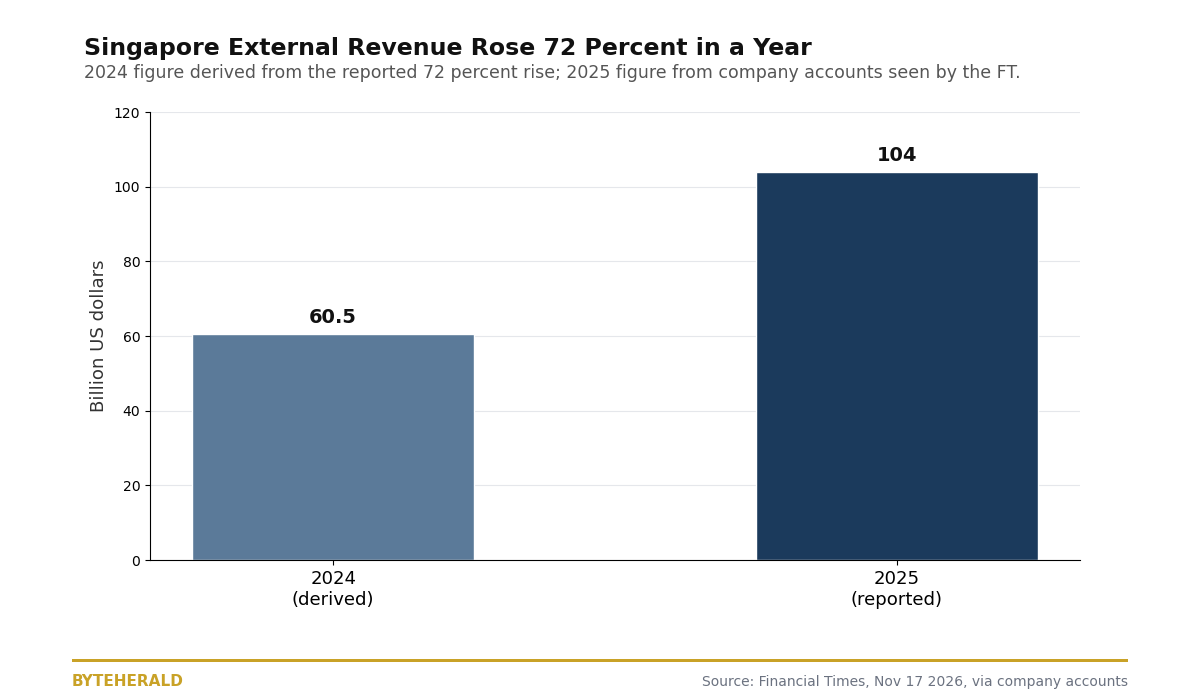
The 72 percent rise implies the 2024 figure was about $60.5 billion, by ByteHerald arithmetic from the reported growth rate, which means the Singapore-booked business added roughly $43.5 billion in a single year. That is the scale of the line Nvidia stopped disclosing: a business that grew by nearly three-quarters in twelve months and accounted for nearly half of the company's worldwide revenue, and then disappeared from the public breakdown.
Billing address is not delivery address
The first thing to understand about the $104 billion is what it does not measure. Singapore is a billing location, not a delivery location, so the figure counts revenue invoiced to Singapore-based entities, and it does not show where the chips were delivered or used. A customer headquartered elsewhere can be billed through Singapore, and a chip billed in Singapore can end up in a data center in another country entirely. Nvidia's defence, as reported, is that the figure was a crude proxy for the real question, how many of its chips reach China, and that firms routinely reshape segment reporting. That defence is fair as far as it goes, and it is also the reason the number's disappearance matters: the crude proxy was the only public figure outsiders had for gauging how many AI chips move through the hub that US export controls target.
The change itself was a methodology switch. Nvidia moved from reporting geographic sales by a customer's billing address to reporting them by the customer's headquarters, and Singapore, which had sat prominently in the geographic breakdown under the old method, vanished from it. The company has declined to comment on the reasons for changing its reporting methodology, according to the FT's reporting. The switch took effect during 2025, the same year the Singapore figure reached $104 billion, so the last year of growth in the line is also the last year anyone outside the company will see it.
Why it matters now
The timing is what turns a reporting change into a story about export controls. US authorities are investigating Megaspeed, a Singapore-based data center company and a major Nvidia customer, over suspicions that it helped divert advanced chips to China, and new US rules require data centers in Southeast Asia to obtain licences for advanced American AI chips. Singapore has been identified as a hub for indirect Chinese semiconductor imports, and the FT's figure is the last Singapore number anyone outside Nvidia will hold unless the company or Washington publishes end-use data.
The disclosure also arrives in a week when Nvidia's own numbers are under unusual scrutiny. The company reported third-quarter fiscal 2027 revenue of $115.8 billion, up 103 percent from a year earlier, in its first quarterly earnings report since the ouster of former chief executive Jensen Huang. The disclosure adds to that scrutiny: the SEC is reported to be investigating Nvidia, and Huang has pitched a return that the board has rejected, as we reported in SEC Probes Nvidia, Huang Pitches Return, Board Says No. The export-control backdrop, the two-sided system of US chip curbs and China's own draft controls on model weights and source code, is mapped in The Great Decoupling: Every AI Export Control, Mapped.
What would settle it
Three things would answer the question the $104 billion raises and none of them is a bigger headline number. The first is end-use data: where the chips billed through Singapore were actually delivered and installed, which only Nvidia or Washington can publish. The second is a restored breakout: Nvidia reporting Singapore again, under either methodology, so the line can be tracked over time. The third is the outcome of the Megaspeed investigation, which will show whether the diversion suspicions were a real channel or a false alarm. Until one of those arrives, the $104 billion is a fact about invoicing, not a fact about smuggling, and anyone who treats it as either has gone further than the accounts allow.
By ByteHerald Staff. The Financial Times reported on November 17, 2026, that Nvidia's Singapore subsidiary booked $104 billion of external revenue in 2025, up 72 percent from the year before and nearly half of the company's global sales, that the subsidiary's total revenue in the twelve months to January 2026 was $117.8 billion including $13.6 billion of sales to another Nvidia company, that the subsidiary reported $53 million of profit for the year, and that Nvidia stopped breaking out Singapore after switching its geographic reporting from customer billing addresses to customer headquarters and has declined to comment on the reasons for the change. Seoul Economic Daily reported on November 18, 2026, that Nvidia's third-quarter fiscal 2027 revenue rose 103 percent year on year to $115.8 billion, and that Singapore has been identified as a hub for indirect Chinese semiconductor imports amid allegations involving Megaspeed. Traders Union reported on November 17, 2026, that new US rules require Southeast Asia data centers to obtain licences for advanced American AI chips.
Comments
Post a Comment