Seventy-two percent of Americans would oppose an AI data center in their community, according to a Quinnipiac University poll of 1,202 adults taken September 24 to 27, 2026. On November 3, voters in dozens of localities voted on more than 40 data-center measures. OpenAI's answer, unveiled the day before the election, was to stop calling them data centers. The company's new term is "compute campuses," used more than 30 times in a roughly 900-word announcement that said "data center" twice.
The opposition, counted
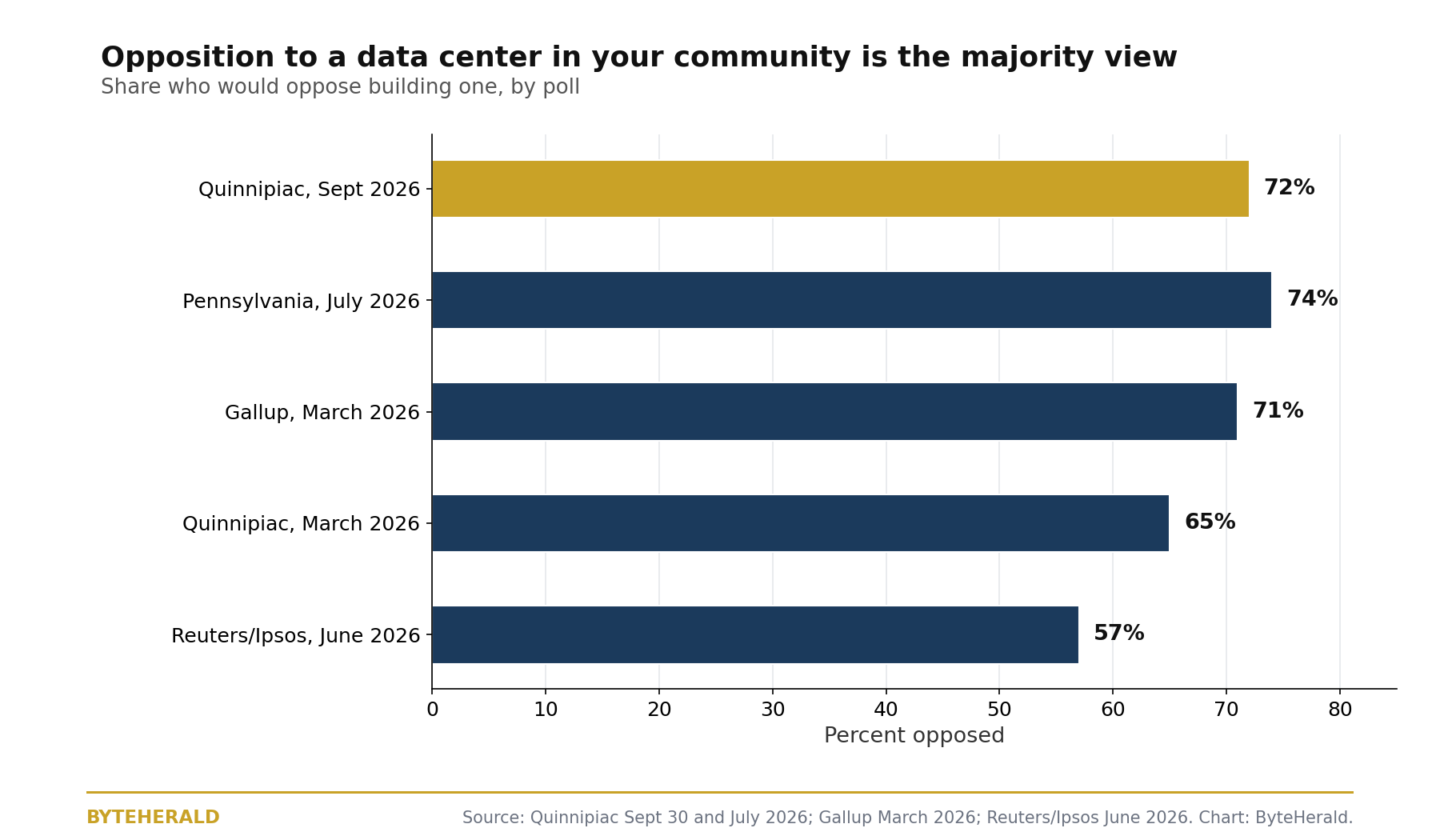
The opposition is not a single poll. It is a stack of them, all pointing the same way, and it has grown through the year. Quinnipiac asked the same question in March and September 2026, "Would you support or oppose the building of an AI data center in your community?" Opposition rose from 65 percent to 72 percent, support fell from 24 percent to 21 percent, and the share offering no opinion fell from 11 percent to 7 percent. A Reuters/Ipsos poll of 4,531 adults in June found 57 percent opposed. A Gallup survey in March found 71 percent opposed. In Pennsylvania, where the buildout is densest, Quinnipiac found 74 percent opposed in July, up from 68 percent in February. One correction before the numbers get repeated: the 73 percent figure circulating in coverage is the registered-voter subset of the same Quinnipiac sample, 1,032 voters inside the 1,202 adults; the headline figure for all adults is 72 percent, and mixing the two bases is how a real trend becomes a wrong number.
| Poll | Opposed | Sample |
| Quinnipiac, Sept 2026 | 72% | 1,202 adults |
| Pennsylvania, July 2026 | 74% | 895 registered voters |
| Gallup, March 2026 | 71% | National adults |
| Quinnipiac, March 2026 | 65% | National adults |
| Reuters/Ipsos, June 2026 | 57% | 4,531 adults |
The polls are backed by what people say in public. A database of 10,202 public comments at 417 local-government meetings this year, compiled by American Sentiment and reported by Tom's Hardware on November 2, found 90.5 percent negative and 7 percent positive, with water the top complaint, and 73 percent of the meetings heard no supporter at all. Pew Research Center coded 20,751 Facebook and Instagram political ads that mentioned data centers: in January, supportive ads outnumbered critical ones, 42 percent to 31 percent; by September, 61 percent were critical and 8 percent supportive. A Bloomberg analysis of Ballotpedia data counted more than 40 data-center measures on the November 3 ballots. These are stated attitudes and self-selected comments, not votes, but the direction is consistent across every instrument that has measured it.
What OpenAI actually offered
The rename arrived with a policy package, and the package is the substantive part. OpenAI's Grid Protectors Program, announced November 2, 2026, starts with a planned site in Effingham County, Georgia, where OpenAI says it will pay the full infrastructure costs and accept up to 1,000 megawatts of curtailment, cutting its own electricity use when the local grid is under strain. Axios reported on November 1 that the rename is part of a post-midterm policy and public-relations push run by Chris Lehane, OpenAI's chief global affairs officer, anticipating a more hostile regulatory environment. TechCrunch's Equity podcast noted on November 7 that OpenAI has also released what it calls a compute campus policy blueprint, and that the company will not require non-disclosure agreements, a practice that had kept project details from the communities hosting them. The Verge, which first counted the rename on November 3, found no earlier use of the term on OpenAI's website. Critics were unmoved. Holly Elmore, founder of PauseAI US, told The Verge that changing the name does not fix the problem and makes it seem like people's health and the environment are public-relations problems rather than environmental and climate concerns, and the NAACP's Center for Environmental and Climate Justice made the same point: a new label does nothing to reduce a building's power draw, water use, or noise.
The election behind the rename
The midterms gave the rename its timing. Democrats won historic victories on November 3, and data centers were on the ballot in two ways: directly, in the more than 40 local measures, almost all of which would have imposed restrictions or moratoriums on data centers and almost all of which passed, and indirectly, through candidates who campaigned on restricting them. In Texas, governor-elect Gina Hinojosa won after promising to focus on data-center restrictions once in office. Texas is where the backlash is loudest: our October reporting found the state's data-center buildout could erase 20 years of clean-air progress, with nitrogen oxide emissions rising 136 percent toward 2004 levels. The projects voters rejected join a ledger we have tracked all year: our October audit of announced AI datacenters found 509 gigawatts of planned capacity, of which 229 gigawatts would never be built, and the election adds a political reason to the list of reasons they stall. The other loser of the night, by TechCrunch's account, was Elon Musk, who donated about half a billion dollars to Republicans and, in the podcast's words, seems to have gotten basically nothing out of it, while his companies sit headquartered in a state that turned about as blue as it could possibly turn.
What the name cannot do
A rename is a communications move, and it should be judged as one. It does not change how much electricity a campus draws, how much water it uses, or how much noise it makes, and the critics are right that a label cannot fix those. What can fix them, or at least soften them, is in the policy package: paying the full infrastructure costs so residents do not carry them, accepting curtailment when the grid strains, and dropping the non-disclosure agreements that kept communities from seeing what was planned next door. The resource constraint is the same one our October ledger mapped: the industry's announced capacity keeps growing faster than the power and water to run it. Three things will tell whether the rename is a rebrand or a retreat: whether the curtailment commitments hold the first time a grid actually strains, whether other labs copy the term and the terms, and whether the 2028 cycle treats data centers as a national issue rather than a local one. The polls say the public has already decided what it thinks. The industry is still deciding what to call it.
By ByteHerald Staff. Quinnipiac University reported on September 30, 2026 that 72 percent of Americans would oppose an AI data center in their community, up from 65 percent in March, in a poll of 1,202 adults taken September 24 to 27, 2026 with a margin of error of plus or minus 3.5 points. OpenAI announced its Grid Protectors Program on November 2, 2026, starting with a planned site in Effingham County, Georgia, with full infrastructure costs paid by the company and up to 1,000 megawatts of curtailment, using the term "compute campus" more than 30 times in the announcement. The Verge reported on November 3, 2026 that the announcement said "data center" twice, that the term had no earlier use on OpenAI's website, and that critics from PauseAI US and the NAACP's Center for Environmental and Climate Justice dismissed the rename as a public-relations move. Axios reported on November 1, 2026 that the rename is part of a post-midterm policy and public-relations push led by Chris Lehane. TechCrunch reported on November 7, 2026 that Democrats won historic midterm victories, that Texas governor-elect Gina Hinojosa campaigned on restricting data centers, and that Elon Musk donated about half a billion dollars to Republicans. A Bloomberg analysis of Ballotpedia data, reported on November 2, 2026, counted more than 40 data-center measures on the November 3 ballots.
Comments
Post a Comment