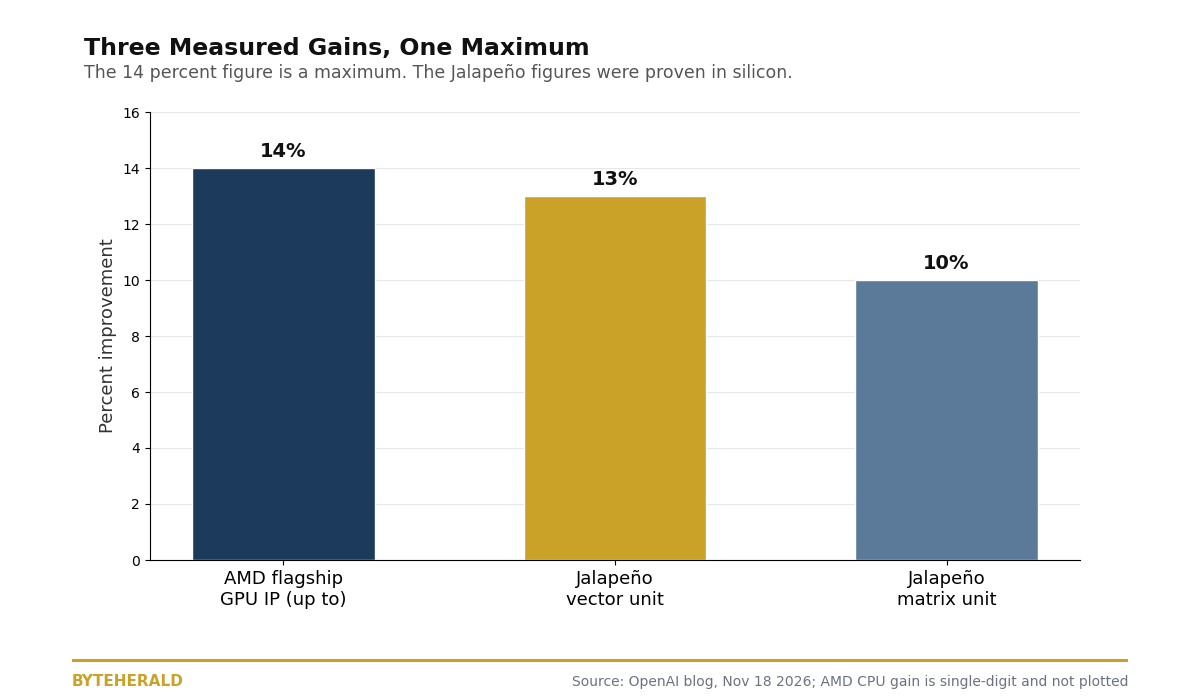
OpenAI said on November 18, 2026, that its models improved AMD's flagship GPU design by up to 14 percent in power, performance and area, in under five months, against baselines AMD engineers had spent years optimizing. The lab calls it roughly a year of progress achieved in less than five months, and says some of the changes are already in a chip design AMD has sent for manufacturing. The same approach cut about 13 percent of the area from one block of OpenAI's own first custom chip, and the gains were proven in silicon.
What OpenAI claims, in numbers
The claim has three parts, and they are not equally strong. The AMD work is the headline: up to 14 percent improvement in power, performance and area, the combined measure chip designers call PPA, on flagship GPU intellectual property, found by rewriting the SystemVerilog code that describes the chip's circuits. OpenAI says its models used Synopsys tools to verify that each rewrite preserved the block's behavior and to weigh the trade-offs in power, performance and area. AMD added other changes to its production design files for future versions, and verified single-digit percentage PPA gains across key blocks of its upcoming next-generation flagship CPU using designs written by the model.
| Workstream | What improved | Figure | How it was verified |
| AMD flagship GPU IP | Power, performance and area combined | Up to 14% | Synopsys tools; some changes in a design sent for manufacturing |
| AMD next-generation flagship CPU | Power, performance and area across key blocks | Single-digit percent | Verified by AMD |
| Jalapeño vector unit | Standard-cell area | About 13% smaller | Proven in silicon |
| Jalapeño matrix unit | Standard-cell area | About 10% smaller | Proven in silicon |
| Jalapeño multiplier redesign | Cell area, and latency from two cycles to one | About 15% less area | Proven in silicon |
| Jalapeño adder redesign | Cell area at the same two-cycle latency | About 15% less area | Proven in silicon |
The Jalapeño numbers are the strongest part of the claim, because they were proven in silicon. Jalapeño is OpenAI's first custom inference chip, and the lab started using GPT-4o to help design it in early 2025. The August 25, 2026, silicon results showed the chip moving from initial design to tapeout in nine months with AI assistance. A multiplier redesign used about 15 percent less cell area while cutting latency from two clock cycles to one, and an adder redesign cut cell area by about 15 percent while keeping its two-cycle latency. Those are the kind of concrete, measured savings that a chip designer can check, and they are the reason the AMD claim is worth taking seriously rather than dismissing as marketing.
The test that ranks the models
OpenAI also ran a cleaner experiment, and it is the more interesting result for anyone judging how fast models are getting at chip design. The lab tested five model generations, GPT-6.2 Astra, GPT-6 Astra, GPT-6.1 Sol, GPT-5.6 Sol and GPT-5.5, on two open-source 32-bit RISC-V cores, PicoRV32 and Ibex, asking each to increase throughput. With a comparable budget of about 112,000 tokens per run, GPT-6.2 Astra had the highest average score on both cores, and on PicoRV32 its score was about twice GPT-6 Astra's. All five models scored higher when they designed a core from written requirements than when they tried to improve the existing design, and the full evaluation ran 9,881 scored runs across both tasks, both cores and all token budgets.
OpenAI is candid about what the test does not prove. Designing from a specification let the models omit features found in the original cores, such as performance counters and additional instructions, which may do little for throughput on the test workloads and could explain part of the score advantage. Requiring those features, setting a tighter limit on circuit area, and checking timing after physical synthesis would make the test more representative of production chip design. That honesty matters, because the RISC-V test is the only part of the announcement that compares models against each other on identical tasks, and it is the part a competitor could reproduce.
What the numbers do not prove
The 14 percent figure is a maximum, not an average, and OpenAI does not break it down by power, speed or area. A 14 percent combined PPA gain could mean a large area saving with no speed gain, or a speed gain bought with more power, and the announcement does not say which. The AMD work also carries no statement from AMD itself: every figure in the announcement comes from OpenAI, and the post is the only public account of the collaboration. That is a real limitation, because AMD's engineers are the ones who could say which blocks improved and by how much.
There is also a commercial relationship that has to be disclosed. OpenAI and AMD announced a multi-year partnership on October 6, 2025, under which OpenAI agreed to use six gigawatts of AMD GPUs, and OpenAI received warrants to buy up to 160 million AMD shares at a penny each, vesting as its purchases scale toward six gigawatts and AMD's stock clears set price targets. A follow-up agreement on November 16, 2026, added 457 megawatts of AMD-powered data center capacity from TensorWave for six years. OpenAI is therefore reporting gains on the hardware of a company in which it holds a potential stake of about 10 percent, and that does not make the numbers wrong, but it means an independent account from AMD would carry more weight than OpenAI's alone.
What PPA means, and how to read a chip claim
PPA stands for power, performance and area, the three quantities every chip design trades against the other two. A smaller circuit uses less power and leaves room for more circuits, but it may run slower. A faster circuit may use more power or take more area. A PPA improvement means the design got better on the combined measure, not necessarily on all three at once, which is why a single percentage without a breakdown is a starting point for questions rather than an answer. The honest way to read a chip claim is to ask four questions: is the baseline a real production design or a weak one, is the figure a maximum or an average, was it verified in silicon or only in simulation, and who measured it. OpenAI's announcement answers the first three for Jalapeño, where the baseline was its own production chip and the gains were proven in silicon, and answers only the first for the AMD work, where the baseline was heavily optimized but the figure is a maximum and the measurer is OpenAI itself.
The wider race to design chips with AI
OpenAI is not the only lab using models to design chips. Anthropic's Mythos model cut the software work to run a model on AMD's MI355X GPUs from up to twelve months to about three days, a claim we reported on November 16 as part of the frontier compute deals, and Anthropic has told investors its 15-person chip design team already uses Claude for engineering and design work on its own custom chips. On a chip design benchmark released last month by the startup ChipAgents and Nvidia, Anthropic's Claude Fable 5.1 scored best, but at 16.6 percent, which the benchmark's own framing treats as a start rather than a finish. OpenAI is also partnering with Synopsys to train GPT-Synopsys, a model that uses Synopsys electronic design automation tools the way expert chip designers do, which would put the workflow in the hands of designers who do not work at OpenAI. The race is now between two different promises: Anthropic's, that a model can do the software work of bringing up a chip in days, and OpenAI's, that a model can improve the chip itself. Both are claims about the same future, in which the machines that run AI also design the machines that run AI, and both will be judged the same way: by silicon, not by announcements.
By ByteHerald Staff. OpenAI reported on November 18, 2026, in a blog post, that its models achieved up to 14 percent improvement in power, performance and area on AMD's flagship GPU intellectual property in under five months, that some changes were included in a design AMD sent for manufacturing, that AMD verified single-digit percentage gains on its next-generation flagship CPU, and that model-proposed changes cut standard-cell area by about 13 percent in the vector unit and 10 percent in the matrix unit of its Jalapeño chip, proven in silicon. The same post reports that GPT-6.2 Astra had the highest average score on two open-source RISC-V cores at about 112,000 tokens per run, about twice GPT-6 Astra's score on PicoRV32, across 9,881 scored runs, and that OpenAI is partnering with Synopsys to train GPT-Synopsys. The Decoder reported on November 18, 2026, that the 14 percent figure is a maximum OpenAI does not break down by power, speed or area, and that the post carries no statement from AMD. Nasdaq reported in November 2026 that OpenAI holds warrants for up to 160 million AMD shares at a penny each under the October 6, 2025, partnership, vesting as purchases scale toward six gigawatts, and that Meta holds a similar warrant from February 2026. TensorWave announced on November 16, 2026, a six-year agreement for 457 megawatts of AMD-powered data center capacity for OpenAI.
Comments
Post a Comment