United States investment in information processing equipment and software reached a 1,765 billion dollar annual rate in the third quarter of 2026, according to data from the Bureau of Economic Analysis published through the Federal Reserve Bank of St. Louis on October 29, 2026. The number is real, and it is being misread in two ways: it is an annual rate, not a quarter of spending, and it covers all information processing equipment and software, not artificial intelligence alone.
What the series actually measures
The series is private fixed investment in information processing equipment and software, seasonally adjusted at an annual rate, from the Bureau of Economic Analysis national accounts. That definition carries three corrections to the social media version of the story. First, "private fixed investment" means spending by businesses on long-lived assets, not total tech spending, and not venture funding. Second, "seasonally adjusted annual rate" means the quarter's pace, multiplied as if it continued for a full year, so the cash actually spent in the quarter at that pace is roughly a fourth of the headline, about 441 billion dollars. Third, the category is information processing equipment and software in general: computers, peripherals, and software of every kind, including systems that have nothing to do with AI models or data centers.
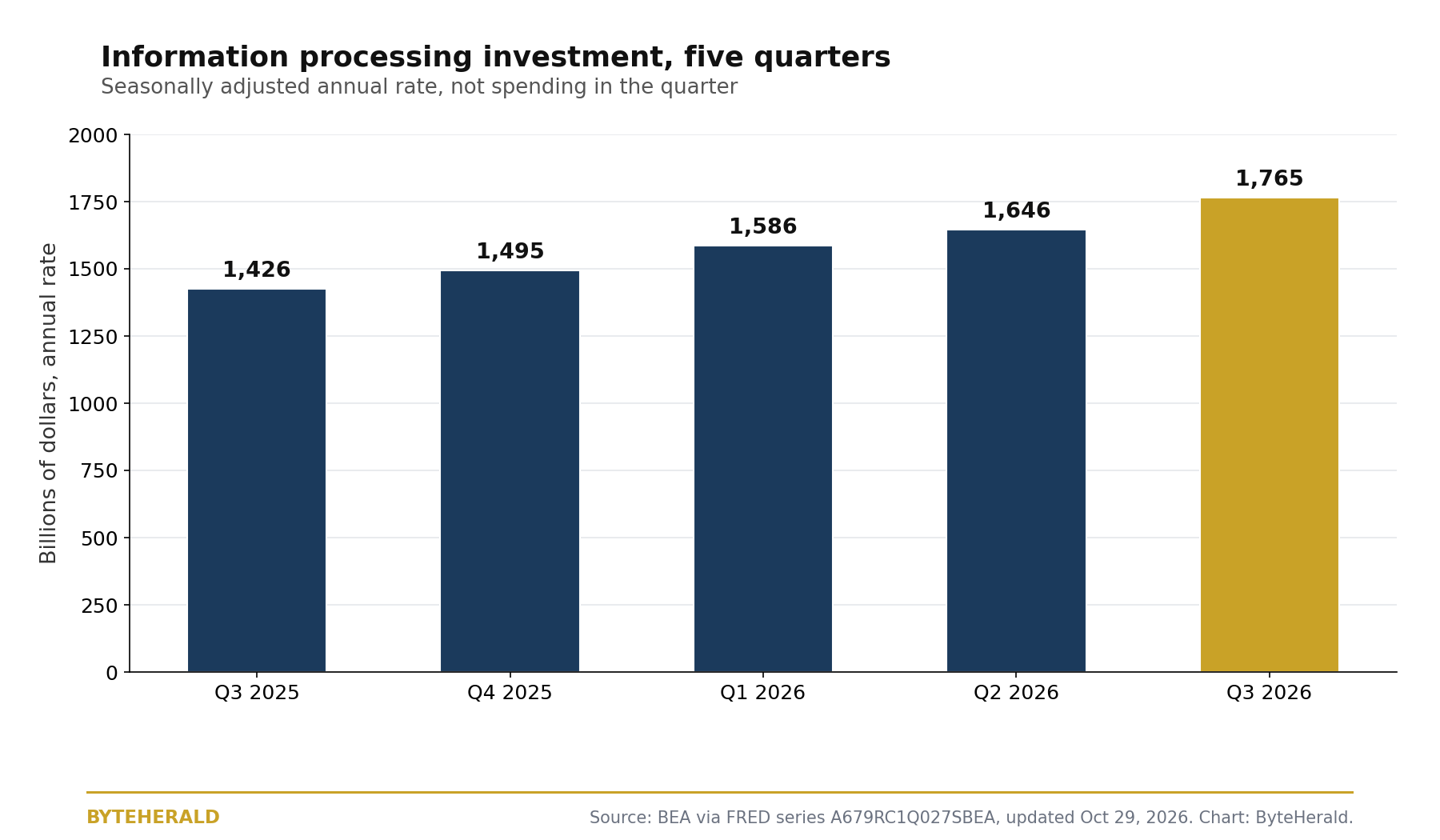
None of that makes the rise small. The series stood at 1,426 billion dollars in the third quarter of 2025, then 1,495 billion in the fourth quarter, 1,586 billion in the first quarter of 2026, and 1,646 billion in the second quarter, before reaching 1,765 billion in the third quarter. ByteHerald's arithmetic from those published levels gives a third quarter increase of about 120 billion dollars over the second quarter, or about 7.3 percent in one quarter, and about 339 billion dollars, or about 23.8 percent, above the same quarter a year earlier. The Bureau's advance estimate for third quarter growth, released the same day, separately credited information processing equipment, mainly computers and peripheral equipment, as leading the increase in equipment spending. Readers who want the company-level side of the same boom should compare this national series with ByteHerald's October 30, 2026, ledger of five companies' capital plans, which is a different universe: guidance from five firms, not spending by the whole economy. See The $828 Billion Capex Ledger: Five Companies, One Year, Added Up.
The five-quarter climb, in one chart
| Quarter | Annual rate, billions of dollars |
|---|---|
| Q3 2025 | 1,426 |
| Q4 2025 | 1,495 |
| Q1 2026 | 1,586 |
| Q2 2026 | 1,646 |
| Q3 2026 | 1,765 |
Every figure in the table is the published Bureau series as carried by the Federal Reserve Bank of St. Louis, rounded to whole billions. The Bureau labels the series as subject to revision, and the next release is scheduled for November 25, 2026, so the third quarter figure is an advance reading, not a final count.
Why the AI label is the error that matters
Calling the whole series "AI investment" flatters the AI story and misleads anyone trying to size it. A hospital buying ordinary servers, a retailer upgrading point-of-sale software, and a cloud provider buying AI accelerators all land in the same Bureau category. AI demand is clearly part of the surge: the Bureau's own account of the quarter singled out computers and peripheral equipment as leading the increase in equipment spending. But the category does not separate AI from everything else, so no one can read an "AI total" off this series alone. Any post that does is inventing a breakdown the data does not contain.
The same caution applies to history. Posts circulating on November 1, 2026, compared the third quarter pace with the dot-com peak and with 1983, but the Bureau series as published does not, on its own, support a clean AI-only comparison with either era, because the mix of equipment and software inside the category has changed completely since then. The defensible claim is narrower and still striking: American businesses are investing in computing equipment and software at a pace never recorded in this series, and the pace accelerated in the third quarter.
What this number does and does not prove about payoff
A rising investment series proves spending, not returns, and that distinction is where the debate should live. ByteHerald reported on October 18, 2026, on a Gartner warning that trillions of AI spending may never pay off, a reminder that a boom in buying is compatible with a bust in returns if the systems bought do not earn their keep. For that warning in full, see Gartner: $3.5 Trillion of AI Spending May Never Pay Off. The Bureau series cannot settle that argument, because it records what was bought, not what it earned. It can, however, discipline it: anyone claiming AI spending has collapsed, or that it has already paid for itself, has to explain a series that rose about 24 percent in a year.
The honest summary, then, is three sentences long. Businesses invested in information processing equipment and software at a 1,765 billion dollar annual rate in the third quarter of 2026. That pace is a record for this series and a sharp acceleration from a year earlier. It is not a measure of AI alone, and it is not proof that the spending will pay. Everything else, including the next revision on November 25, 2026, is commentary.
By ByteHerald Staff. U.S. Bureau of Economic Analysis, via the Federal Reserve Bank of St. Louis FRED series A679RC1Q027SBEA, updated October 29, 2026, published the quarterly levels used here: 1,426 billion dollars in Q3 2025, 1,495 billion in Q4 2025, 1,586 billion in Q1 2026, 1,646 billion in Q2 2026, and 1,765 billion in Q3 2026, in billions of dollars at a seasonally adjusted annual rate, with the next release scheduled for November 25, 2026. U.S. Bureau of Economic Analysis, advance estimate of third quarter 2026 gross domestic product, October 29, 2026, credited information processing equipment, mainly computers and peripheral equipment, with leading the increase in equipment spending.
Comments
Post a Comment