United Airlines said on November 11, 2026, that it will stop personal AI assistants from booking flights on its systems, becoming the first large United States airline to write the ban into its Contract of Carriage. The airline revised the contract the same day, and the new rule covers agents that reach United through a travel agency as well as agents on its own website.
What the rule actually bans
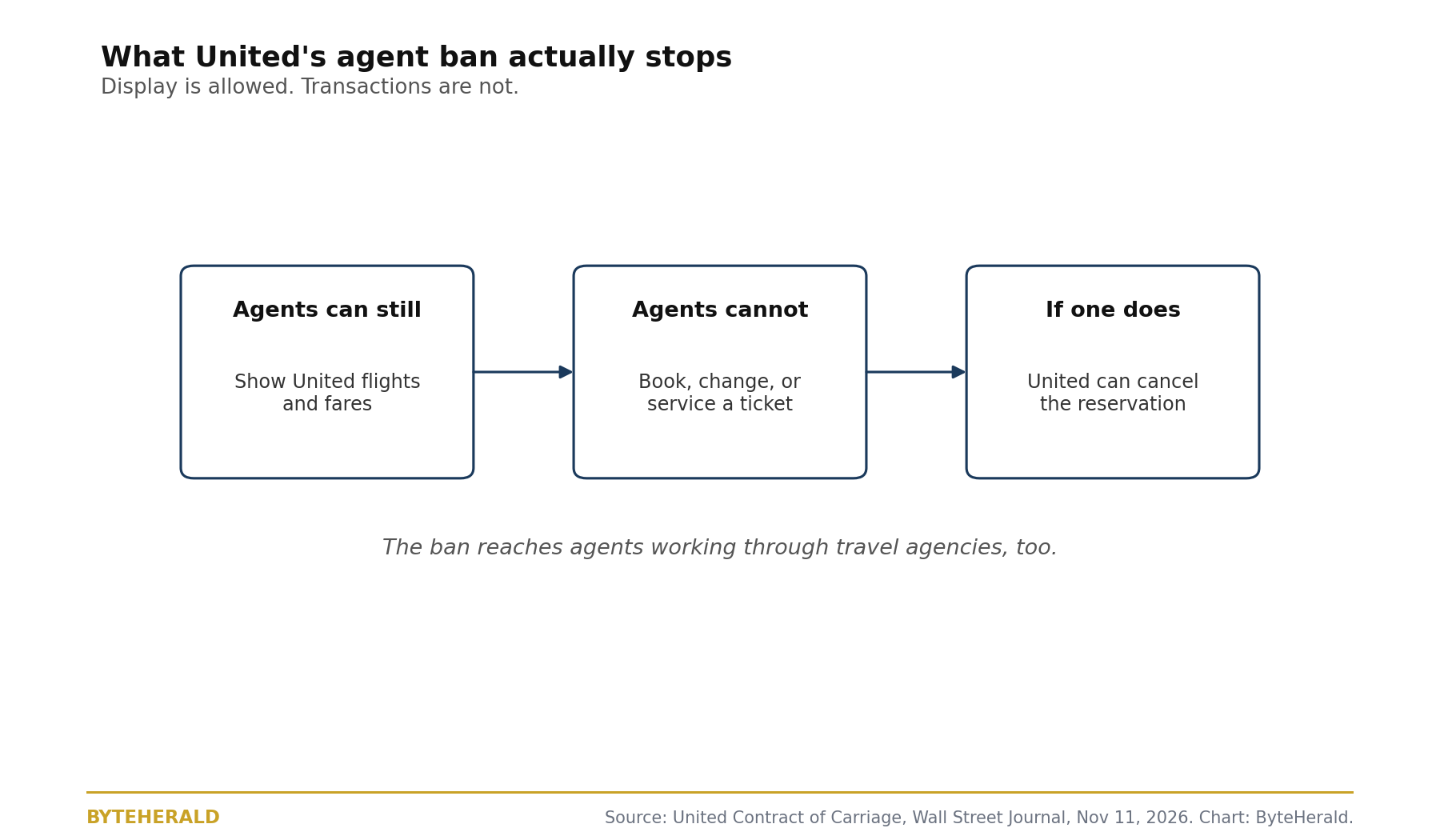
The new Rule 6.J.6 of the Contract of Carriage bans "the use of AI Agents to make, modify or service a Ticket, and/or to purchase any service or product," according to View from the Wing, which first reported the change. A companion change to Rule 5.H lets United cancel reservations made, modified or serviced by AI agents. The rule reaches assistants that reach United through a travel agency or another intermediary, and a customer watching or approving each step does not get around it. What the rule does not ban is window shopping: AI assistants can still show United flight options and prices, the Wall Street Journal reported, they just cannot complete a transaction.
The reason Kirby gave
United gave three reasons. Third-party agents could expose customers' sensitive information, including a MileagePlus login and payment details. They could make purchases a customer did not intend. And automated steps such as check-in could breach Federal Aviation Administration and Department of Transportation rules, including the requirement that a traveler attest that checked bags hold no prohibited items. Chief executive Scott Kirby was blunter at a Chicago event on November 10, the Journal reported. "To be honest, I don't want to create another middleman," Kirby said, while adding that AI can be useful for airline operations. United said it is not yet seeing many bookings made by AI agents, and that it will update its Digital Trust Center to explain the rules and to guide customers who find unintended changes made by an assistant.
The middleman problem
Kirby's remark is the honest part of the announcement, and it points to the question the rule does not settle. The ban tries to close the intermediary route, but a booking that arrives from an online travel agency looks like an agency booking, and United has not said how it would tell that an agent drove it. An agent booking through an agency is still a middleman, and it costs United more than a direct booking, since the agency takes its cut. That is the tension at the heart of the rule: the airline wants the booking direct, and the agent's whole pitch is to sit between the traveler and the checkout. The question of who gets paid when software buys the ticket is the one we mapped in our pillar on the agentic commerce money trail, which priced the fee stack an agent sits in.
Who else is already blocking agents
United is the first airline to put the ban in its contract, but it is not the first big company to shut agents out. The Verge reported on October 17, 2026, that Delta blocks agent ticket booking, that JPMorgan Chase and Charles Schwab confirmed blocking agent access to customer accounts, and that Yelp admits only agents that pay for its data licensing program. Amazon has been blocking Meta Muse since September 20, and its suit against Perplexity over agentic shopping reached the Ninth Circuit, which ruled in August 2026, according to Cooley's summary of the decision. Engadget's report on the ban noted the same pattern, with United joining JPMorgan Chase and Amazon in blocking agents over security and privacy concerns. We mapped the full lockout in our pillar on who blocks AI agents and what it costs, and United's move extends the same pattern from websites and bank accounts to the checkout page of a major airline.
What travelers should do
Use the agent to compare fares, then book on United's own site or app. Do not hand your MileagePlus login or payment details to an outside assistant. If an agent already booked a ticket for you, check the reservation on United's site, because the airline says it can cancel it. The agent is still useful for the search. It is no longer useful for the purchase.
By ByteHerald Staff. The Wall Street Journal reported on November 11, 2026, that United will prevent personal AI assistants from accessing its systems to book tickets, that agents can still show flight options and prices but cannot transact, that chief executive Scott Kirby said at a Chicago event on November 10 that he does not want to create another middleman, and that United is not yet seeing many bookings from AI agents. View from the Wing reported on November 11, 2026, that the revised Contract of Carriage adds Rule 6.J.6 banning the use of AI agents to make, modify or service a ticket or purchase any service or product, and that Rule 5.H lets United cancel reservations made, modified or serviced by AI agents, including agents working through a travel agency. Engadget reported on November 11, 2026, that United joins JPMorgan Chase and Amazon in blocking agents over security and privacy concerns, and that allowing an agent to complete a booking could violate Department of Transportation and Federal Aviation Administration rules.
Comments
Post a Comment