Employment of US software developers aged 22 to 25 fell nearly 20 percent from its late-2022 peak to July 2025, while developers aged 35 to 49 in the same occupations kept growing, according to payroll data analyzed by the Stanford Digital Economy Lab in its working paper "Canaries in the Coal Mine?" The figures went viral on November 15, 2026, after The Kobeissi Letter shared them, and they land as the sharpest single datapoint yet in the argument over what AI is doing to entry-level work: the youngest developers are losing ground while their older colleagues are not, and the split opened right after ChatGPT arrived.
The numbers, by age
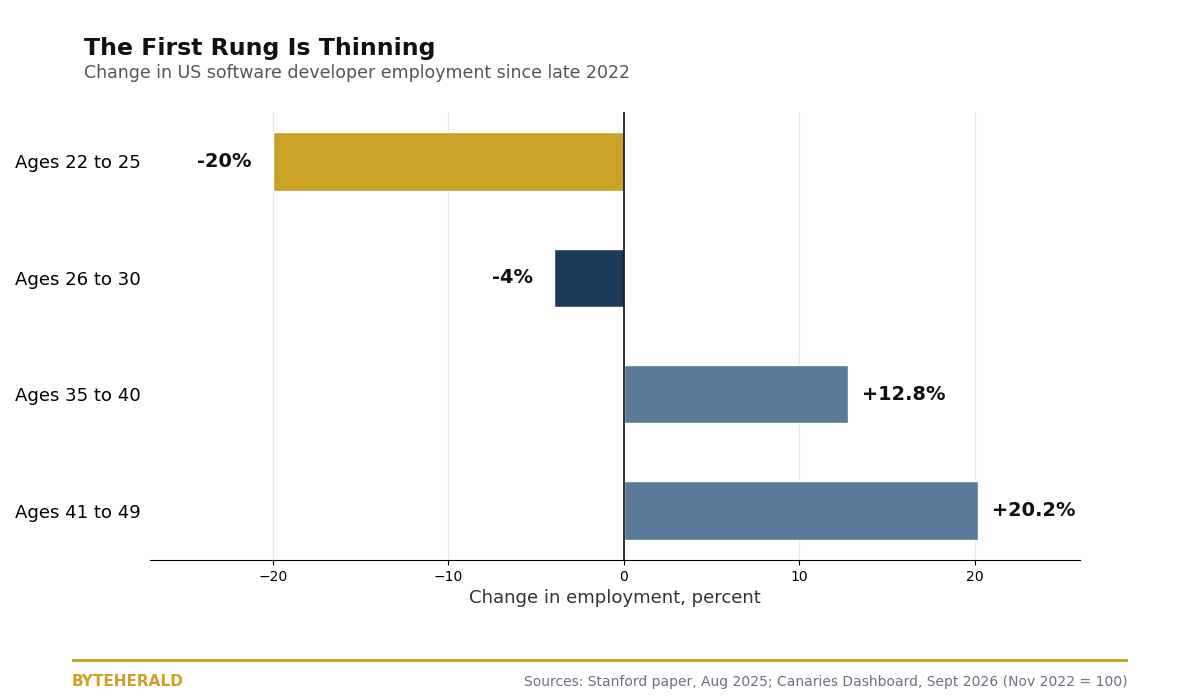
The Stanford paper, by Erik Brynjolfsson, Bharat Chandar and Ruyu Chen, first published on August 26, 2025, uses monthly payroll records from ADP, the largest US payroll provider, covering firms that employ more than 25 million workers, with records running from January 2021 through July 2025. The main analysis sample is 3.5 to 5 million workers a month. The age split is the headline. Software developers aged 22 to 25 saw employment fall nearly 20 percent from the late-2022 peak to July 2025. Developers aged 26 to 30 fell about 4 percent. On Stanford's Canaries Dashboard, which sets November 2022 employment to 100, software developers aged 35 to 40 stood at 112.8 in the September 2026 snapshot, up 12.8 percent, and developers aged 41 to 49 stood at 120.2, up 20.2 percent. The paper's 6 to 9 percent range covers older workers across the most AI-exposed occupations generally, not developers in one age band. The two groups moved together for years, then split right after ChatGPT launched in November 2022.
| Age group | Change in developer employment | Window |
| Ages 22 to 25 | Nearly minus 20% | Late-2022 peak to July 2025 |
| Ages 26 to 30 | About minus 4% | Late-2022 peak to July 2025 |
| Ages 35 to 40 | Plus 12.8% | September 2026 snapshot (November 2022 = 100) |
| Ages 41 to 49 | Plus 20.2% | September 2026 snapshot (November 2022 = 100) |
The developer numbers sit inside a broader finding. Early-career workers aged 22 to 25 in the most AI-exposed occupations have experienced a 13 percent relative decline in employment since late 2022, even after controlling for firm-level shocks, while older workers in the same occupations and workers in less-exposed occupations continued to grow. The word relative matters: the 13 percent is measured against less-exposed peers, not against zero. In plain levels, employment of 22 to 25 year olds in the highest-exposure occupations fell about 6 percent in absolute terms over the same period. The two numbers describe the same fact from different angles, and they must not be swapped: 20 percent is the absolute fall for young developers specifically, 13 percent is the relative fall for all early-career workers in AI-exposed occupations.
How the decline happened: fewer hires, not more firings
The mechanism is the part of the paper that changes how the story should be told. The divergence operates primarily through reduced hiring of young workers rather than increased separations, the authors find, and the adjustment is occurring through employment rather than base compensation, with little difference in salary trends by age or exposure. Companies are not firing their junior developers. They are not hiring them in the first place, and they are not cutting the pay of the ones they keep. The decline is also concentrated in occupations where AI usage primarily substitutes for human tasks. Where AI usage primarily complements workers, employment is flat or rising, especially for experienced workers.
That pattern is why the authors call young workers canaries in the coal mine. AI replaces codified knowledge, the book-learning that forms the core of formal education, and young workers supply relatively more codified knowledge than tacit knowledge, the judgment and tricks that accumulate with experience. A model that can write the routine code a junior developer used to write does not need to replace a senior developer, whose value sits in the decisions around the code. The first rung of the ladder thins because the bottom of the job is the part a model can already do, and the hiring data shows companies acting on exactly that logic.
The other side of the ledger
The Stanford finding is real, but it is not the whole labor market, and four counterpoints belong beside it. The Bureau of Labor Statistics, in its 2025-35 projections published in August 2026, projects software developer employment to grow 10 percent over the decade, adding about 175,000 jobs, with about 106,100 openings a year, against 3 percent growth for all occupations. James Bessen of Boston University, analyzing Bureau of Labor Statistics data in a March 2026 report, finds about 2.5 million software developers employed in the United States in February 2026, a historic high, up more than 400,000, or 19 percent, since ChatGPT launched in 2022. And Federal Reserve economists Leland Crane and Paul Soto, in a March 2026 study, find that aggregate programmer employment growth fell about 3 percentage points a year after ChatGPT, implying roughly 500,000 fewer jobs than the prior trend would have produced over three years, while stressing that programmer employment continued to grow, only more slowly, and that the gap did not open until mid-2024.
| Source | What it finds | What it means |
| Stanford, ADP payroll, Aug 2025 | Developers 22-25 down nearly 20% since late 2022 | Entry-level hiring is thinning fast |
| BLS projections, Aug 2026 | Developers up 10%, about 175,000 jobs, 2025-35 | The occupation still grows over the decade |
| Bessen, Boston University, Mar 2026 | 2.5M developers in Feb 2026, a record, up 19% since 2022 | Total developer employment has never been higher |
| Crane and Soto, Federal Reserve, Mar 2026 | Growth down about 3 points a year, about 500,000 fewer jobs than trend | A growth shortfall, not a net job loss |
| Challenger, Gray and Christmas, Sep 2026 | 120,136 announced cuts citing AI, Jan-Sep 2026, vs 54,836 in all of 2025 | Announcements, not confirmed layoffs |
These findings are not contradictory. They describe different slices of the same market: total developer employment is at a record high, the occupation is still projected to grow, and at the same time the entry level is shrinking, because the growth is going to experienced workers while the hiring door narrows for the young. The Challenger count makes the same point from the layoff side: employers cited AI in 120,136 announced US job cuts from January through September 2026, about 21 percent of all announced cuts, more than double the 54,836 for all of 2025, but those are announcements in which the employer names AI as the reason, not an independent count of jobs lost, and the monthly count had already fallen to 3,961 by September.
What "relative decline" actually means
The Stanford paper's most quoted number is also its most misread, so the method deserves a plain explanation. ADP payroll records show who is employed, month by month, at firms that use ADP to run payroll. The authors sort occupations by how exposed their tasks are to generative AI, using two measures: one based on task susceptibility to GPT-4, and one from Anthropic's Economic Index, which classifies real Claude conversations as automating or augmenting human work. They then compare employment by age before and after late 2022, when ChatGPT appeared. A relative decline means young workers in the most exposed occupations fell behind young workers in the least exposed ones by that much, after controlling for firm-level shocks, so the gap cannot be explained away by saying tech firms in general stopped hiring. The authors also test the obvious alternatives and report that the pattern holds when technology firms and computer occupations are excluded, when interest-rate exposure and remote work are controlled for, and that AI exposure did not predict employment outcomes for young workers in earlier periods, including the COVID-19 unemployment spike.
The limits are stated by the authors themselves and should travel with the numbers. The facts are descriptive indicators, not causal estimates, and the authors caution that other factors may be partly responsible. The ADP sample covers only businesses that use ADP payroll, not the entire US labor market, and the patterns are more pronounced in the ADP sample than in national survey benchmarks. The results also attenuate when education is controlled for, and show some divergent trends that predate generative AI. None of that makes the 20 percent wrong. It makes it a strong signal from one large payroll dataset, not a census of the whole economy, and the honest reading is the authors' own: consistent with the hypothesis that generative AI has begun to affect entry-level employment.
The update since the first paper
The paper has not stood still. The Stanford page now carries a revision dated August 12, 2026, using payroll data through June 2026, which finds that employment of young workers aged 22 to 25 in AI-exposed occupations now stands 19 percent below where it would be had it kept pace with that of their less-exposed peers, and that the divergence has widened steadily since the finding was first documented in August 2025. The same dashboard figures highlighted by The Kobeissi Letter show the other end of the age curve moving the other way, with employment among developers aged 41 to 49 up about 20 percent over the same period. The ladder is not collapsing. It is tilting, with the bottom rung thinning and the top rungs still rising, and the question for graduates, hiring managers and policymakers is the same one the paper poses: who builds the senior engineers of the next decade if the junior jobs that trained them stop being offered. Our earlier synthesis of the displacement evidence, AI Job Displacement: What the Data Actually Says, puts this study beside six others, and the Stanford finding is the one that has held up best as the data has lengthened.
By ByteHerald Staff. Brynjolfsson, Chandar and Chen of the Stanford Digital Economy Lab published "Canaries in the Coal Mine?" on August 26, 2025, using monthly ADP payroll records covering firms employing more than 25 million workers from January 2021 through July 2025, and found that employment of software developers aged 22 to 25 declined nearly 20 percent from the late-2022 peak to July 2025, that developers aged 26 to 30 fell about 4 percent, and that early-career workers in the most AI-exposed occupations experienced a 13 percent relative decline in employment even after controlling for firm-level shocks. The Stanford Digital Economy Lab revised the paper on August 12, 2026, with data through June 2026, finding that employment of young workers aged 22 to 25 in AI-exposed occupations stands 19 percent below where it would be had it kept pace with less-exposed peers. Stanford's Canaries Dashboard, in its September 2026 snapshot with November 2022 set to 100, puts software developers aged 35 to 40 at 112.8 and aged 41 to 49 at 120.2. The US Bureau of Labor Statistics, in its Occupational Outlook Handbook projections last modified August 27, 2026, projects software developer employment to grow 10 percent from 2025 to 2035, adding 174,700 jobs, with about 106,100 openings a year, against 3 percent growth for all occupations. James Bessen of Boston University reported in March 2026, analyzing Bureau of Labor Statistics data, that about 2.5 million software developers were employed in the United States in February 2026, a historic high, up more than 400,000, or 19 percent, since ChatGPT launched in 2022. Leland Crane and Paul Soto of the Federal Reserve reported in March 2026 that aggregate coder employment growth fell about 3 percentage points a year after ChatGPT, implying roughly 500,000 fewer jobs than the prior trend over three years, while coder employment continued to grow. Challenger, Gray and Christmas reported in October 2026 that US employers cited AI in 120,136 announced job cuts from January through September 2026, about 21 percent of all announced cuts, against 54,836 in all of 2025.
Comments
Post a Comment