Alphabet shares closed down 12.6 percent on October 29, 2026, wiping about 500 billion dollars off its market value, its worst day since its 2004 initial public offering, after search revenue grew 12 percent, down from 17 percent in the second quarter, while AI spending pushed free cash flow to negative 9.07 billion dollars. The day was not a verdict on one bad number. It was the market deciding, all at once, that a great Cloud quarter could not carry a slowing search business and a spending plan that keeps getting bigger.
The day in numbers
Class A shares, traded as GOOGL, closed at 283.82 dollars, down 41.07 dollars or 12.64 percent. Class C shares, traded as GOOG, closed down 12.29 percent. Intraday, the stock fell to a low of 280.36 dollars, down 13.71 percent from the prior close of 324.89 dollars, and Bloomberg put the market value wiped out at 511 billion dollars as of 9:35 a.m. in New York. At the close, the loss was about 500 billion dollars. The distinction between the intraday figure and the close figure matters, because later reports quote both, and only the close figure describes the full session.
| Measure | October 29, 2026 |
|---|---|
| GOOGL close | 283.82 dollars, down 12.64 percent |
| GOOG close | Down 12.29 percent |
| Intraday low | 280.36 dollars, down 13.71 percent |
| Market value wiped, intraday | 511 billion dollars at 9:35 a.m. New York time |
| Market value wiped, close | About 500 billion dollars |
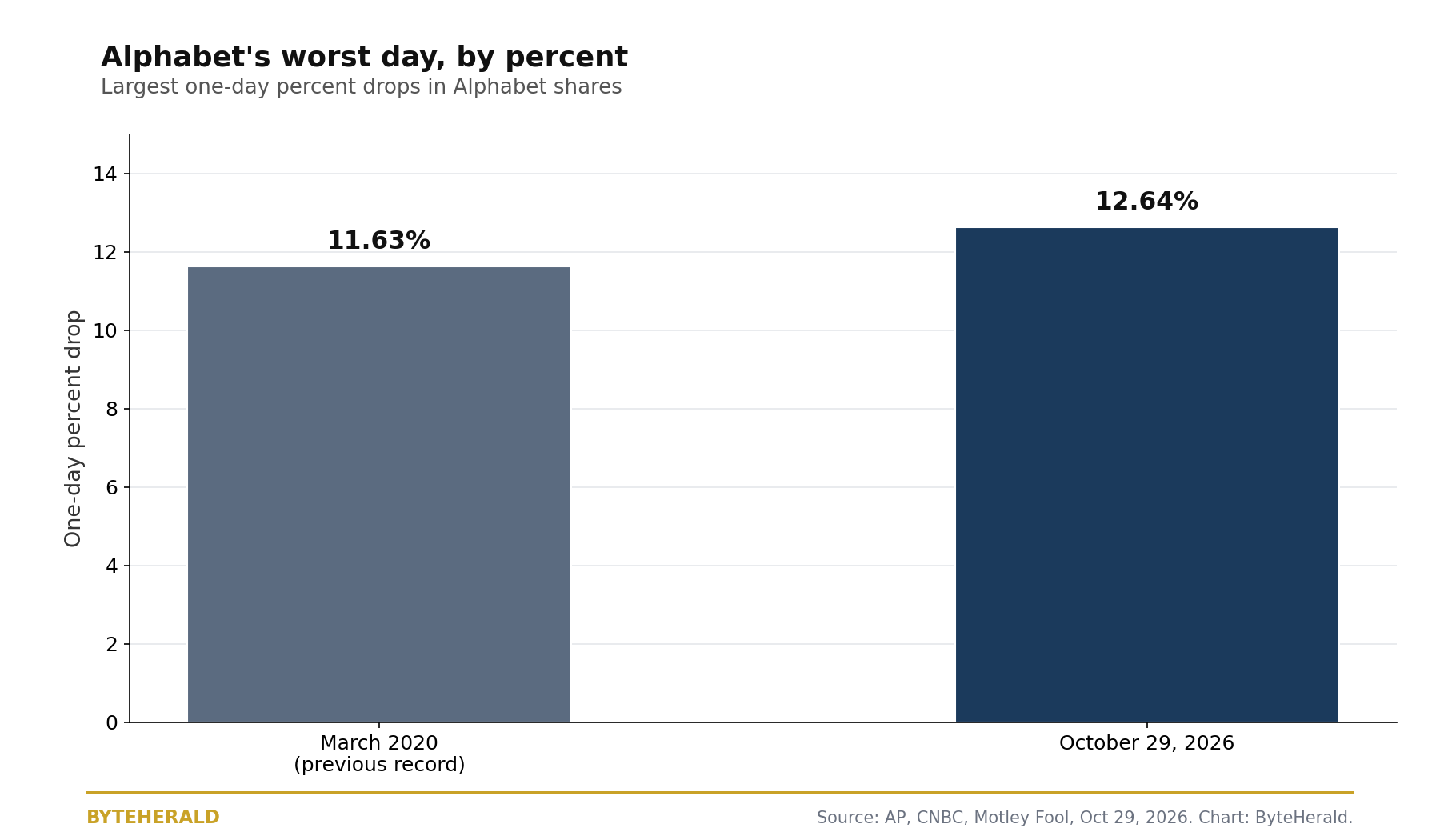
| Previous Alphabet one-day record | Down 11.63 percent in March 2020 |
| Largest one-day dollar loss, any company | Nvidia, about 589 billion dollars on January 27, 2025 |
That table puts Alphabet's day second on the dollar ranking and first on its own percent ranking. The dollar ranking is dominated by company size: only a company worth trillions can lose 500 billion dollars in a day. The percent ranking is the cleaner record, because it does not depend on size. Alphabet broke its own percent record, set during the March 2020 market panic, on an ordinary earnings reaction, which is why analysts called it historic rather than just large.
What the report actually said
The selloff reacted to the third-quarter report Alphabet released after the market close on October 28, 2026, which we covered in full in our Alphabet earnings bridge. That report is the right place for the full bridge. The short version a reader needs for this day is in the table below, because the market did not punish the whole report. It punished specific lines in it.
| Third-quarter line | Result | Why it mattered on October 29 |
|---|---|---|
| Total revenue | 127.6 billion dollars, up 25 percent | Below the 128.2 billion dollars analysts expected |
| Search and other revenue | 63.35 billion dollars, up 12 percent | Down from 17 percent growth in the second quarter, and below estimates |
| Google Cloud revenue | 30.7 billion dollars, more than doubled | Beat estimates of 29.1 billion dollars, but did not offset search |
| Adjusted earnings per share | 2.67 dollars | Below the 3.02 dollars Wall Street expected |
| Reported earnings per share | 2.12 dollars | Includes an 8.7 billion dollar equity loss, largely on SpaceX |
| Free cash flow | Negative 9.07 billion dollars | Far below the expected shortfall of 2.70 billion dollars |
| Capital spending, quarter | 51.4 billion dollars | Exceeds operating cash flow of 42.3 billion dollars |
Search is the story
Search advertising is roughly half of Alphabet's revenue and the engine that finances its AI buildout, so a miss there carries more weight than a miss anywhere else. Search revenue had missed estimates this quarter, grew at the slowest pace in five quarters, and was virtually flat against the previous quarter. Overall services revenue of 96.3 billion dollars also missed the 98.4 billion dollars expected, and YouTube advertising of 11.2 billion dollars fell below projections. On the earnings call, Chief Business Officer Philipp Schindler tied the slowdown to AI Mode, the version of Google Search built around the Gemini chatbot, according to Business Insider reporting of the call. That attribution is important and limited at the same time: it comes from the company's own executive on its own call, not from an independent measurement of AI Mode's effect, and the company did not publish a number for how much AI Mode cost search revenue.
JPMorgan analysts, in a note quoted in the coverage, put the general lesson plainly: the results show the margin for error when a hyperscaler spending hundreds of billions on AI infrastructure posts disappointing results in its core business. In other words, the spending was already priced in as a bet. The bet only works if the core business keeps paying for it. When the core business wobbles, the same spending reads as risk instead of ambition.
Spending is the other story
Alphabet kept its full-year capital spending forecast at 195 billion to 205 billion dollars and said spending would rise significantly in 2027, without saying by how much. That open-ended commitment landed on top of a quarter in which capital spending of 51.4 billion dollars already exceeded operating cash flow of 42.3 billion dollars, producing the negative 9.07 billion dollars of free cash flow. It was the second quarter in a row of negative free cash flow, something the company had never reported since going public, according to the coverage. By the end of the third quarter, future commitments to buy computing power and energy totaled 924 billion dollars, and upcoming obligations such as data-center leases that had not yet commenced reached 152 billion dollars, bringing total future obligations above 1 trillion dollars. To help finance the buildout, Alphabet raised about 12.4 billion dollars through common stock issuance and about 28.7 billion dollars through debt in the quarter, which dilutes existing holders and adds future interest payments.
None of that means the spending is wasted. It means the market now wants a date and a return, and Alphabet gave it neither on this call. Details on the 2027 increase are due on the next earnings call, which makes that call the next real test, not the next headline about AI spending.
What did not break
Cloud is the counterweight, and it deserves its own paragraph rather than a footnote. Google Cloud revenue of 30.7 billion dollars beat estimates, and Cloud profit of 11.1 billion dollars beat the 9.8 billion dollars expected. Management also pointed to interest in its TPU chip architecture from Anthropic, Apple, Meta, and Oracle, as well as financial firms such as Citadel Securities and Jump Trading. A reader who only saw the stock chart would conclude that Alphabet's AI business failed. The report says something narrower: the AI infrastructure business is growing fast, and the search business that pays for it grew more slowly than expected. Both facts are true, and the stock fell because the second fact governs the first one's funding.
The same week gave the selloff company. ServiceNow, which reported a revenue beat and still fell 27 percent to its worst day on record, shows that October 29 was not only an Alphabet story. If you want the single-company version of that verdict, read our ServiceNow report, because its cause was different, a guidance deceleration rather than a search slowdown, and comparing the two is how you tell a sector mood from a company problem.
What this day does not prove
A one-day move, even a record one, does not prove that AI is killing search, that Alphabet's spending will never pay back, or that the stock is cheap or expensive now. Bernstein lowered its price target to 325 dollars from 385 dollars and kept a Market Perform rating, which is a downgrade of expectations, not a verdict that the business is broken. The honest read is a list of open questions, not a conclusion. Does search growth re-accelerate next quarter, or does AI Mode keep compressing it. Does Cloud growth stay above 100 percent, or was this quarter's doubling a peak. How much does 2027 spending actually rise, and what return does management promise for it. Until those questions have answers, the 500 billion dollar figure should be quoted as what it is: the market's one-day repricing of a company that is still worth more than 3.4 trillion dollars, not a cash loss, not a bankruptcy, and not a forecast.
By ByteHerald Staff. Alphabet third-quarter 2026 earnings release, October 28, 2026, reporting revenue of 127.6 billion dollars, Cloud revenue of 30.7 billion dollars, capital spending of 51.4 billion dollars, and a full-year capital spending forecast of 195 billion to 205 billion dollars. Motley Fool, October 29, 2026, reporting the GOOGL close at 283.82 dollars, down 12.64 percent, search revenue up 12 percent to 63.4 billion dollars from 17 percent growth in the second quarter, operating cash flow of 42.3 billion dollars, and stock and debt issuance of 12.4 billion and 28.7 billion dollars. Business Standard, October 29, 2026, reporting the intraday drop of more than 13 percent, 511 billion dollars wiped as of 9:35 a.m. New York time, services revenue of 96.3 billion dollars against 98.4 billion dollars expected, future commitments of 924 billion dollars plus 152 billion dollars in uncommenced leases, and a second straight quarter of negative free cash flow. Associated Press via SourceFirstNews, October 29, 2026, reporting the 12.6 percent Class A drop as the worst session since trading began, the previous 11.63 percent record in March 2020, and Bernstein's price target cut to 325 dollars from 385 dollars. Business Insider, October 29, 2026, reporting that Chief Business Officer Philipp Schindler tied the search slowdown to AI Mode on the earnings call.
Comments
Post a Comment