Amazon's AWS revenue grew 39.3 percent to 45.98 billion dollars in the third quarter of 2026, its fastest pace in nearly five years, yet trailing twelve-month free cash flow swung to a 42.4 billion dollar outflow as CEO Andy Jassy said Amazon will spend meaningfully more in 2027 than the roughly 220 billion dollars planned for 2026. Growth won the quarter. Cash flow lost the argument.
Amazon's two quarters in one report
Amazon reported third-quarter 2026 results after the market close on October 29, 2026, and the parent-company print was slightly soft while the cloud print was strong. Net sales reached 201.94 billion dollars, up 12 percent, against 202.31 billion dollars expected by analysts polled by LSEG. Earnings per share came in at 1.89 dollars against 1.96 dollars expected. Net income was 20.69 billion dollars, down from 21.19 billion dollars a year earlier. Operating income, by contrast, rose 61 percent to 28.1 billion dollars, a 13.9 percent margin that Amazon described as its highest ever.
| Measure, third quarter 2026 | Reported | Expected or prior |
|---|---|---|
| Net sales | 201.94 billion dollars, up 12 percent | 202.31 billion dollars expected (LSEG) |
| Earnings per share | 1.89 dollars | 1.96 dollars expected (LSEG) |
| Net income | 20.69 billion dollars | 21.19 billion dollars a year earlier |
| Operating income | 28.1 billion dollars, up 61 percent | 13.9 percent margin, described as highest ever |
| AWS revenue | 45.98 billion dollars, up 39.3 percent | 45.29 billion dollars expected; fastest in nearly five years |
| AWS operating income | 17.8 billion dollars, 38.7 percent margin | Majority of total operating profit |
| Advertising revenue | 19.64 billion dollars | 20.82 billion dollars expected |
| Fourth-quarter sales guide | 240 to 247 billion dollars | Midpoint below the 244.5 billion dollar expectation |
AWS is the reason the quarter still reads as an AI story. The unit grew 39.3 percent, its fifth consecutive quarter of acceleration on the reported figures, and beat the 45.29 billion dollar expectation. Jassy said AWS has reached a 184 billion dollar annual revenue run rate. Advertising, the other high-margin line, missed, at 19.64 billion dollars against 20.82 billion dollars expected, with Prime Day timing cited in coverage as part of the explanation. The fourth-quarter guide did not rescue the parent print: a range of 240 to 247 billion dollars for the holiday quarter has a midpoint below what analysts had modeled, even though operating income guidance of 28.5 to 33.5 billion dollars sits above the 25 billion dollars of a year earlier. Shares fell in after-hours trading, with reports putting the drop at roughly 5 to 7 percent as trading continued, rather than one settled figure.
The cash-flow swing, charted
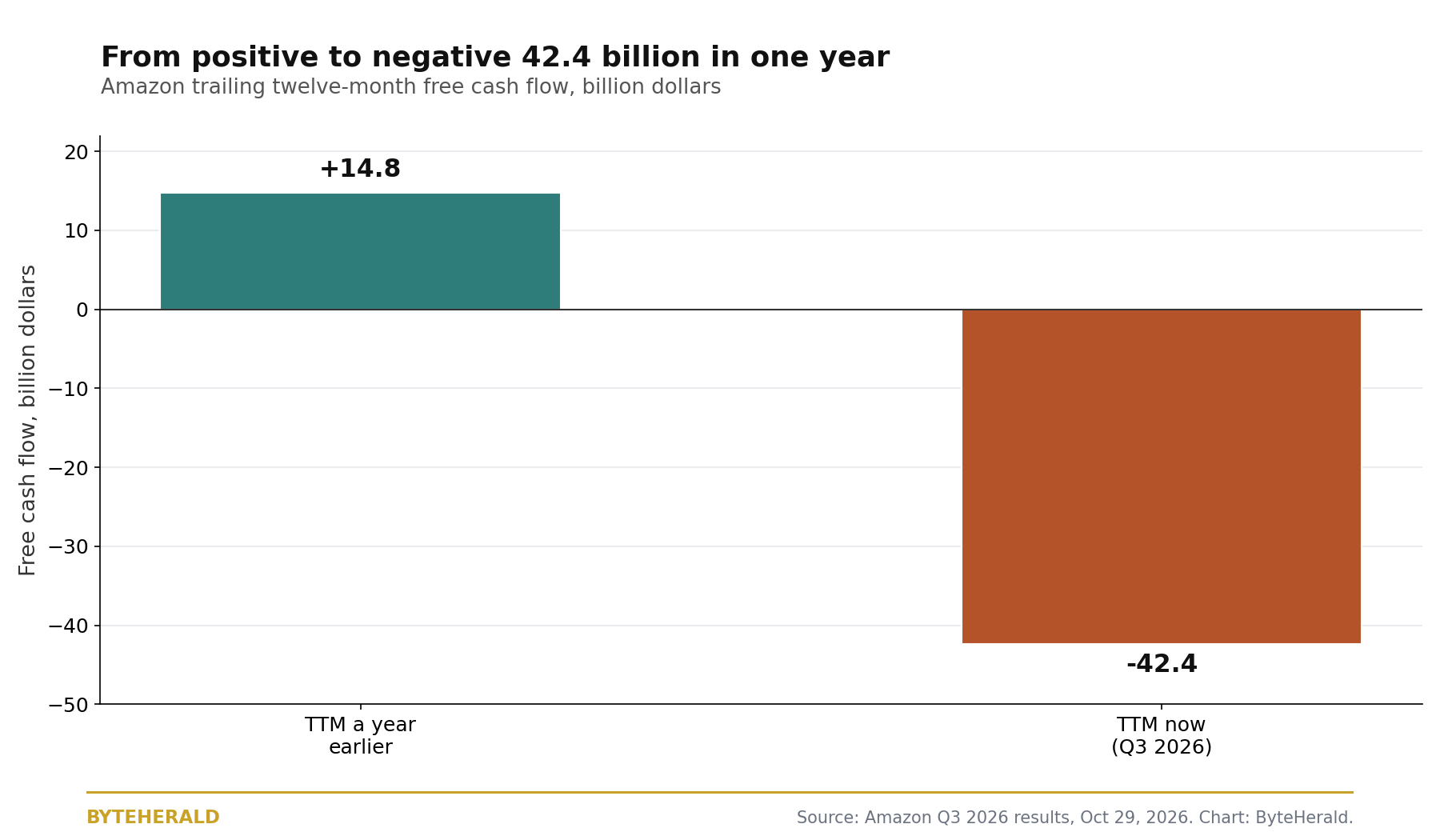
The number that moved the conversation was not in the income statement. It was in the cash statement. Amazon spent 77.3 billion dollars on property and equipment in the third quarter alone, against 35.1 billion dollars a year earlier, and held its 2026 capital spending plan at about 220 billion dollars, up from 128 billion dollars spent in all of 2025. Trailing twelve-month free cash flow swung to an outflow of 42.4 billion dollars, against an inflow of 14.8 billion dollars a year earlier. That swing, 57.2 billion dollars from positive to negative, is the cost of the buildout made visible in a single line.
Amazon's defense is that the spending follows demand it can already see. Jassy said AWS capacity is largely sold out for 2027, with a substantial portion of 2028 also committed, and that customers needing the largest AI deployments reserve capacity well ahead, in blocks from hundreds of megawatts to as much as a gigawatt. The contracted backlog stands at 578 billion dollars, more than double a year ago. He projected AWS revenue growth of more than 40 percent in both 2027 and 2028, said there is a clear line of sight to attractive financial returns, and added that Amazon can fund the plan. The market's reply, visible in the after-hours fall, is that a backlog is a promise and free cash flow is a fact, and the fact just went negative by more than 40 billion dollars.
What "meaningfully more" means, and what it does not
Jassy's phrase for 2027 was deliberate and unquantified: Amazon expects to spend meaningfully more in 2027 than the roughly 220 billion dollars planned for 2026, with no dollar figure attached. Analysts surveyed by StreetAccount had already expected capital spending to creep above 280 billion dollars in 2027 before this report, which gives the phrase a rough frame without turning it into a company forecast. This article does not treat that analyst expectation as Amazon's guidance, because it is not. What Amazon did guide is the demand side: AWS growth above 40 percent in 2027 and 2028, against 39.3 percent in the third quarter of 2026, which means the company is promising acceleration on top of its fastest growth in nearly five years, funded by spending it has not yet quantified.
That combination is the test for the whole hyperscaler earnings week. Microsoft's quarter showed a cloud business growing fast with capital spending held in check, and its shares barely moved. Alphabet's quarter showed a paper loss and a capital spending surge, and its shares fell sharply. Amazon now sits between those two readings: the strongest cloud acceleration of the three, and the most negative cash-flow swing. The question for the next two quarters is not whether AWS demand exists, because the backlog answers that. It is whether the spending converts into operating profit at the pace Jassy promises, or whether the backlog is being bought with cash the business is not yet generating.
The shopping wall stays up
One smaller disclosure in the quarter connects Amazon to a fight it is winning on its own terms. Amazon blocked Meta's Muse shopping agent this quarter, while reporting that more than 400 million customers used its own assistant, Alexa for Shopping, in the past 12 months, with interactions up 570 percent. That is the same two-sided pattern mapped in our audit of which sites block AI agents and which license them: outside agents are kept out, the house agent is promoted, and the advertising business that outside agents would bypass stays inside. Deutsche Bank analysts put the key question plainly in coverage of the quarter: whether Amazon can let third-party agents in on terms that keep its advertising business profitable. The earnings answer so far is that it has not needed to, because its own assistant is growing fast enough to carry the shopping-agent story alone.
Amazon also confirmed on the earnings day that fewer than 250 people in its devices software team were let go, against a backdrop of more than 57,000 job cuts since 2022, about 16 percent of its corporate workforce, and said it plans to hire more than 300,000 seasonal, part-time, and full-time staff in the United States for the holidays. Those two facts belong in the same paragraph because they describe the same company: shrinking the corporate cost base while expanding the seasonal workforce that serves the holiday quarter it just guided below expectations. Neither fact changes the cloud story, but both explain why the parent print felt softer than the AWS print.
The test the next two quarters will settle
Three rules carry over from this report. First, separate the cloud print from the parent print: AWS can accelerate while total sales miss, and the stock trades on both. Second, put free cash flow next to capital spending, not next to revenue: a business can grow sales 12 percent, grow operating income 61 percent, and still burn cash, because the buildout is a cash decision before it is a profit decision. Third, treat an unquantified spending promise as a question, not a number: "meaningfully more" tells investors the direction and the intent, and the dollar figure, when it comes, is what the cash-flow line will be judged against. Amazon's quarter passed the demand test and failed the cash test. The next two quarters decide which test mattered.
By ByteHerald Staff. Amazon's third-quarter 2026 release as reported October 29, 2026, gave net sales of 201.94 billion dollars up 12 percent against 202.31 billion dollars expected, earnings per share of 1.89 dollars against 1.96 dollars expected, net income of 20.69 billion dollars against 21.19 billion dollars a year earlier, operating income of 28.1 billion dollars up 61 percent at a 13.9 percent margin, AWS revenue of 45.98 billion dollars up 39.3 percent against 45.29 billion dollars expected, advertising revenue of 19.64 billion dollars against 20.82 billion dollars expected, and fourth-quarter sales guidance of 240 to 247 billion dollars. Coverage of the release and call, published October 29, 2026, gave third-quarter property and equipment spending of 77.3 billion dollars, trailing twelve-month free cash flow of negative 42.4 billion dollars against positive 14.8 billion dollars a year earlier, 2026 capital spending of about 220 billion dollars against 128 billion dollars in 2025, a contracted backlog of 578 billion dollars, an AWS annual revenue run rate of 184 billion dollars, and CEO Andy Jassy's statements that Amazon will spend meaningfully more in 2027 and that AWS growth will exceed 40 percent in 2027 and 2028. Pre-results coverage, published October 28, 2026, gave the StreetAccount expectation that 2027 capital spending would exceed 280 billion dollars, which is an analyst expectation, not Amazon guidance. Coverage of the quarter, published October 29, 2026, carried Deutsche Bank analysts' question about whether Amazon can admit third-party agents on terms that keep its advertising business profitable, and gave the Alexa for Shopping figures of more than 400 million customers in the past 12 months with interactions up 570 percent, the blocking of Meta's Muse shopping agent, the fewer-than-250 devices software team cuts, the more-than-57,000 job cuts since 2022, and the plan to hire more than 300,000 seasonal staff for the holidays.
Comments
Post a Comment