On October 17, 2026, DeepSeek's V4.1-Flash-1017 checkpoint became the highest-ranked open-weight model on LMArena's Code Arena: WebDev leaderboard, reaching 1670 points and displacing Moonshot's Kimi K3 (Max). It sits 12th overall, ahead of Claude Opus 5 (High) and within about 10 points of GPT-6 Sol (Max), while charging roughly one-tenth of Kimi K3's API price. That is the headline: the top open slot in web development now costs $0.30 per million input tokens.
The move on the leaderboard
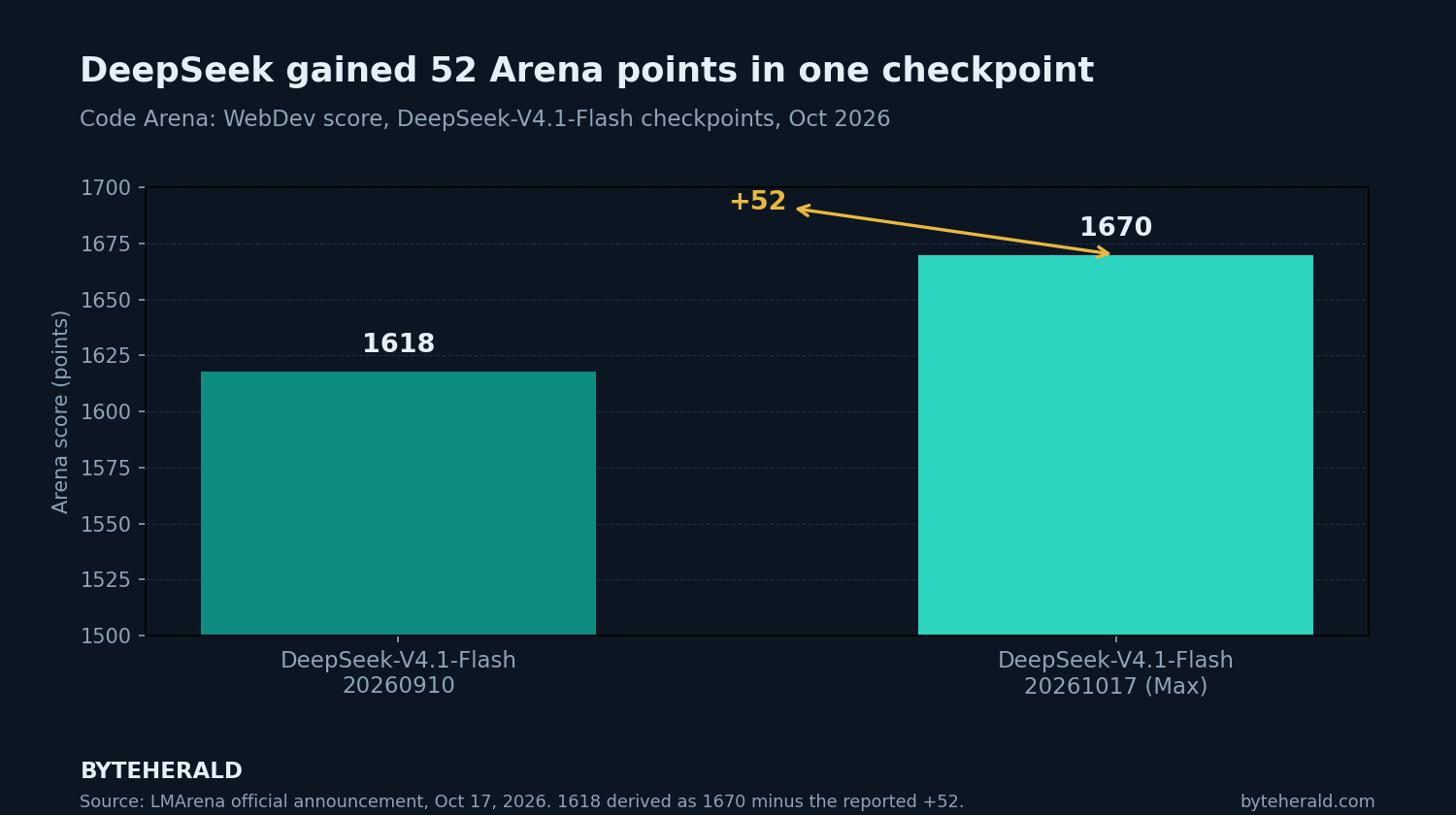
The announcement came from LMArena itself, which noted the new checkpoint gained 52 points over its September predecessor, DeepSeek-V4.1-Flash-20260910. That September model had entered the WebDev board on September 10; the October 17 checkpoint jumped straight past Kimi K3 (Max) for the open-weight lead. The full standing picture, as reported by LMArena:
| Model | Arena score | Rank | API price ($/1M, in/out) | Weights |
|---|---|---|---|---|
| DeepSeek-V4.1-Flash-20261017 (Max) | 1670 | #12 overall, #1 open | $0.30 / $1.20 peak ($0.15 / $0.60 off-peak) | Open, MIT license |
| Kimi K3 (Max) | Below 1670 | Dethroned (was #1 open) | $3.00 / $15.00 | Open, custom Kimi K3 License |
| GPT-6 Sol (Max) | Within ~10 pts of 1670 | Above DeepSeek | Not in the announcement | Closed |
| Claude Opus 5 (High) | Below 1670 | Below DeepSeek | Not in the announcement | Closed |
This is the second half of the 1017 checkpoint's week. Yesterday we covered the same model's DeepSWE v1.1 result, where it edged past Claude Opus 5 on an agentic coding benchmark. One checkpoint, two different arenas: agentic software engineering and human-judged web development. The WebDev result is arguably the more interesting of the two, because it comes from thousands of head-to-head human votes rather than a vendor's test harness.
The price gap, measured
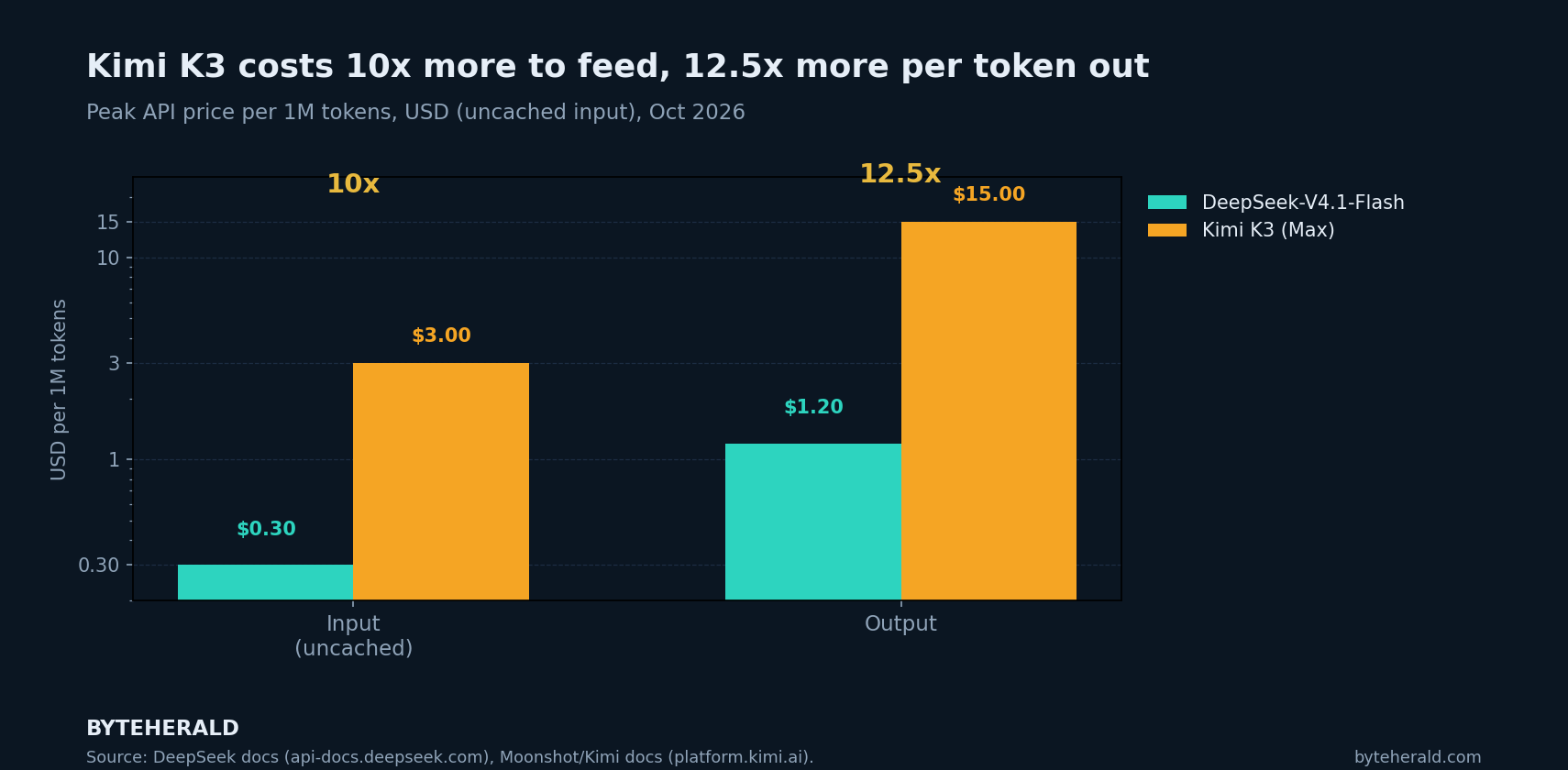
The "10x lower cost" line needs the actual arithmetic, because token pricing has two lanes and DeepSeek has time-of-day pricing. At peak rates, DeepSeek-V4.1-Flash charges $0.30 per million input tokens and $1.20 per million output tokens; Kimi K3 charges $3.00 and $15.00. That is exactly 10x on input and 12.5x on output. DeepSeek's off-peak window (most hours of the week, at half price) widens the gap to 20x on input and 25x on output. Kimi's one reprieve is cache-hit input at $0.30 per million, which narrows the input gap for coding workloads that resend the same repository context every turn.
Value is where the open-weight story keeps winning. When we measured 28 models across SWE-Bench Verified and blended catalog cost in October, open models beat closed ones on value by roughly 60x while closed labs kept the capability crown. This result fits the same pattern, with a twist: DeepSeek is not merely cheaper than other open models, it now outranks the premium open flagship that cost ten times more to run.
What "Flash" means when a lab says it
Flash is not a version number; it is a product tier. Every major lab now ships a fast, cheap lane alongside its flagship: Gemini Flash, GPT mini-class models, Kimi's own mid tiers. The recipe is consistent: a mixture-of-experts backbone that activates a small fraction of its parameters per token (DeepSeek's V4.1 Flash activates about 8 billion of 552 billion on input, 16 billion on output), aggressive engineering around inference speed, and a price designed to be the default choice for anything that is not the hardest problem you have.
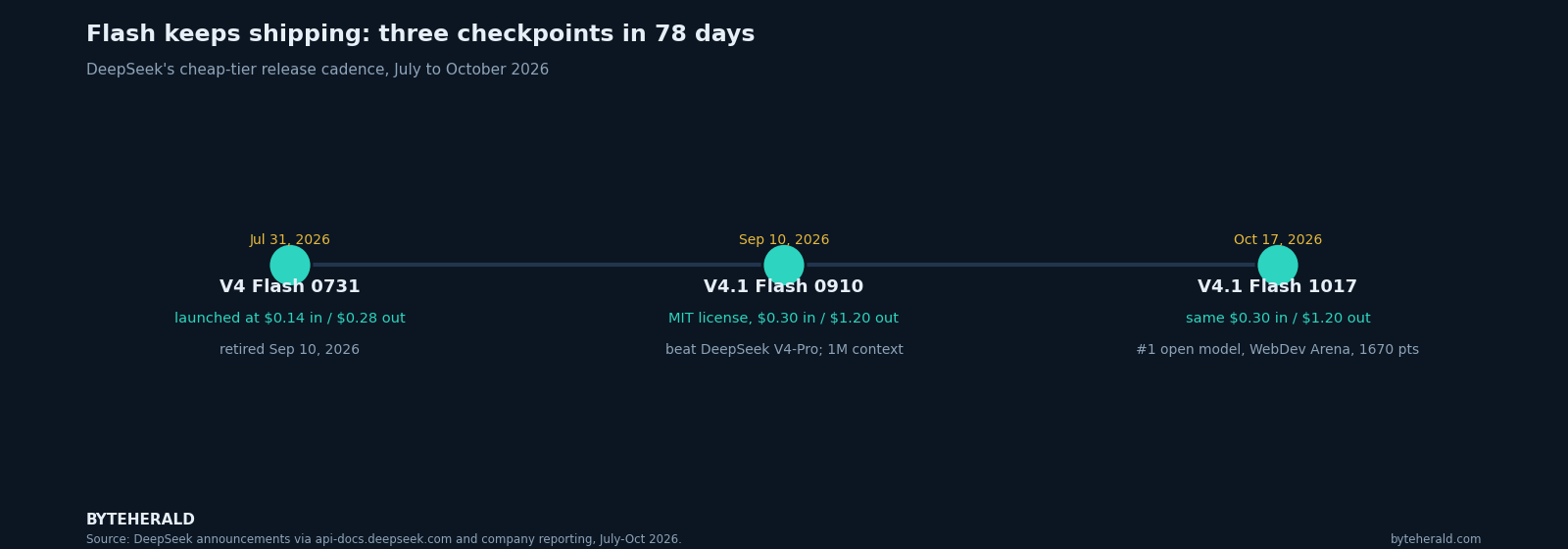
What makes DeepSeek's Flash lane unusual is the cadence. V4 Flash launched July 31, 2026 at $0.14 input and $0.28 output. V4.1 Flash arrived September 10 with an MIT license and a 1-million-token context, claiming to beat the company's own flagship V4-Pro. The 1017 checkpoint landed October 17 at unchanged prices and took the WebDev crown. Three checkpoints in 78 days, each one free to adopt through the same deepseek-flash alias, each one pushing more quality into the same cheap slot.
The business logic is the opposite of a loss leader. A cheap tier that keeps getting better converts developers once and compounds: every agent, every coding assistant, every web-dev tool that defaults to the Flash lane is token volume that never reaches the premium tier. The pricing strategy is market-making, and the arena result is its proof of quality.
How the WebDev arena actually works
LMArena's Code Arena: WebDev is a live, community-driven leaderboard, not a fixed test set. Developers submit a web development prompt, two models generate working apps side by side (React, TypeScript, and Tailwind in a live sandbox), and human voters pick the stronger output. Those preference votes feed a Bradley-Terry model that produces the Arena Score, chess-rating style: you climb by beating strong opponents, not by passing a checklist.
That design is why builders trust it more than static benchmarks for this task. A static suite can tell you whether code compiles; a side-by-side vote tells you whether the app looks right, handles the edge case you did not specify, and reads like code you would keep. The weakness is the flip side: brand-new checkpoints arrive with fewer votes, so early positions can be volatile, and the board reflects what voters ask for, which skews toward consumer-facing web work. Read a 52-point jump as a strong signal, not a final verdict.
One more caveat from the field: raw arena scores measure capability, not reliability. In August, an independent test by Composio ran the earlier V4 Flash through 240 real-agent workflows across eight harnesses and got a 53.8% pass rate, with the same model scoring very differently depending on the harness and tool configuration. Orchestration quality moves results as much as the model does. If you are evaluating for production, test in your own harness, on your own prompts, not on the leaderboard's.
The judgment call: who switches
Switch if your workload is web development scaffolding, UI iteration, or any agentic loop where token volume dwarfs difficulty. At $0.15 per million input tokens off-peak, a Flash-class model that outranks a $3.00 model on human-judged web work is not a trade-off; it is a free upgrade. The same applies to open-weight self-hosting: the MIT license means you can run it yourself without per-token fees if you have the hardware, something Kimi K3's custom license restricts for very large commercial users. We compared the open-weight field's specs, licenses, and benchmark claims in October, and the license gap between these two models was already the deciding factor for some teams.
Do not switch if your bottleneck is frontier reasoning on hard, novel problems. Closed models still sit above everything open on this same board: the Flash model is 12th overall, not 1st, and the closed frontier holds the capability crown. Separately, developers on X are reporting that the 1017 checkpoint shows unusually strong motion-design output (3D detail, UI transitions), which is worth a look for front-end work but remains anecdotal, not measured.
The deeper read is about where pressure now sits. When the number-one open model costs $0.30 per million input tokens, the price of "good enough" keeps falling, and every lab pricing a premium open tier has to justify the gap in public, on a board everyone can see. Kimi K3 is the first to face that question. It will not be the last.
By ByteHerald Staff. Leaderboard data from LMArena's official announcement (October 17, 2026) and the live Code Arena: WebDev leaderboard; API prices from DeepSeek's official pricing docs and Moonshot/Kimi's official pricing docs. All three charts are ByteHerald's original compilations; the 1618 figure is derived as 1670 minus LMArena's reported +52; claims that could not be verified were dropped.
Comments
Post a Comment