Meta says it has finally reached the frontier. On Monday, Meta Superintelligence Lab released Muse Wonder and Muse Wonder Full, the company's first frontier AI models, fourteen months after Zuckerberg began overhauling the AI effort. The launch pitch is simple: Meta now stands shoulder to shoulder with OpenAI and Anthropic on benchmarks. The evidence is more complicated. Below is ByteHerald's claims tracker: every major Meta claim about Muse Wonder, what Meta actually disclosed, and where verification stands.
The claims tracker
Verification status key: Confirmed = independently corroborated or directly observable; Partially disclosed = Meta asserted it with supporting material, but key evidence comes only from Meta itself; Not disclosed = no evidence offered.
| Meta's claim | What Meta actually disclosed | Verification status |
|---|---|---|
| "Our first frontier AI models" | Meta Superintelligence Lab's Oct 12 announcement; company blog calls them "the next step on our scaling ladder and a major leap toward personal superintelligence." TechCrunch characterizes it as Meta's first frontier attempt. | Confirmed (announcement) |
| "State-of-the-art for personal and professional agentic tasks" | Framing in Meta's launch materials: the models are positioned for long-running agents, powered by "active memory" and "active focus" that keeps working toward goals and checks in before consequential actions. | Partially disclosed, capability claim, no independent agent-benchmark evidence yet |
| "Comparable to Claude Fable 5.1 and GPT-6 Astra" on benchmarks | Results from Meta's own testing, published in the model card. Meta's SWE-Marathon figure: Muse Wonder Full at 57.5 vs Claude Opus 5.5 at 46.3. | Partially disclosed, self-reported; model card released, but no third-party replication of Meta's numbers |
| Memory gains: "active memory" retains and synthesizes information across days, weeks, months | Meta highlighted MemoryBench (continual learning and memory construction): Muse Wonder outscores Fable, Opus, and Astra, in Meta's own testing. | Partially disclosed, mechanism described; the benchmark scores are Meta-run |
| Independent validation of the frontier claim | Meta did not publish independent evals. Artificial Analysis, one independent benchmarker, scored Wonder Full at 56 on its Intelligence Index, two points behind Claude Opus 5.5 Max (58), and the standard Wonder at 52. It "mostly backs" Meta's claim, but the scorecards don't line up neatly. | Partially disclosed, one independent index supports it; other independent evals not yet available |
| Available on the Meta Model API | Wonder is live on the Meta Model API with a 1M-token context window; Muse Wonder Full is not served through the API. | Confirmed |
| Pricing: $4 per million input tokens, $20 per million output tokens | Confirmed for Wonder via the API, roughly equivalent in cost to GPT-6 Sol or Claude Opus 5.5. Wonder Full has no API pricing at all; it is limited to Muse Code subscribers. | Partially disclosed, standard-tier pricing set; the flagship model's pricing undisclosed |
| Powering the Muse agent and Muse Code | Both models will power the Muse personal AI agent, rolling out to paid subscribers first, and Muse Wonder is available in Muse Code. In-app use of Wonder requires a paid monthly Muse plan; the exact Muse rollout timeline is unclear. | Partially disclosed, availability announced, timelines vague |
| Weights / open-source status | Nothing announced. Meta built its reputation on open weights from Llama through Llama 4, but neither a release nor a refusal was stated for Wonder. | Not disclosed |
| Training data and eval methodology | Meta said the models were trained at its gigawatt-scale Prometheus data center. The data mix, scale, and third-party eval methodology were not disclosed. | Not disclosed (compute partially disclosed) |
Why this launch matters
Whatever the caveats, this is a structural event. The frontier club, OpenAI, Anthropic, Google, xAI, just gained a fifth member, and it's the one with three billion people on its apps. Meta's stock rose about 4% on the news, per market reporting, as investors bet the company's heavy AI spending finally has a monetizable flagship. Meta spent a year poaching researchers and billions of dollars to rebuild; Wonder is the first public proof that the overhaul produced something at the cutting edge.
The distribution angle is the one rivals can't copy. Meta's personal AI agent, Muse, already shows stronger 7-day retention than ChatGPT, and Wonder will now power that agent for paying subscribers. OpenAI and Anthropic have to earn distribution; Meta can ship a frontier model straight into apps its users already open every day. That is the real story of this launch: not the benchmark scores, but the pipeline.
What "frontier" even means here
"Frontier" is not a certified label, it's Meta's own framing, and outlets like TechCrunch and Wired are repeating the company's characterization, not a measurement. The meaningful definition is relative: within a few points of the best models from OpenAI and Anthropic on widely-used evals. By that bar, the independent evidence is genuinely close. Artificial Analysis put Wonder Full at 56, level with Claude Sonnet 5.5 Max and two points behind Opus 5.5 Max, a real jump from Muse Spark 1.3's 48 just six weeks ago.
At $4/$20 per million tokens, Wonder also sits in the same price band as GPT-6 Sol and Opus 5.5, Meta is pricing like a frontier competitor, not discounting like a challenger. How that cost structure actually compares across the frontier tier is worth tracking: our price comparison of the frontier models puts Mistral Large 4, GPT-6, Claude, and Gemini side by side, and Wonder now belongs in that table.
The honest gaps
Three things a careful reader should not gloss over. First, Meta's headline comparisons, "comparable to Fable 5.1 and GPT-6 Astra", are all self-reported from the model card; no independent lab has replicated them, and independent coverage against Gemini 4 is explicitly described as "unclear." Second, the model posting the best numbers, Wonder Full, is the one developers can't call: no API access, Muse Code subscribers only. The API-served model is the weaker variant. Third, the open-weights question: Meta spent three years being the open-weights champion of the industry, and it has said nothing about whether Wonder continues that tradition or ends it. That silence is itself a data point.
One more line for the roadmap watchers: Meta reportedly teased a future model codenamed Watermelon, no details, no date, and it deserves no more than this sentence until there are.
Meta's scaling ladder, in one chart
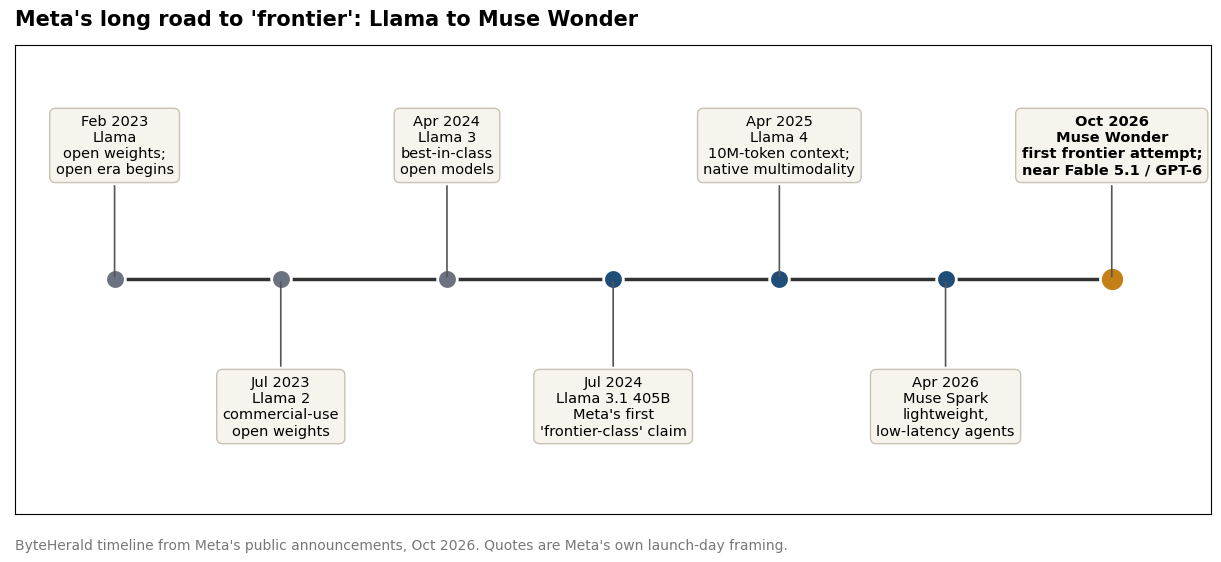
Wonder looks abrupt only if you ignore the ramp. From Llama's research release in February 2023 through Llama 3.1's "frontier-class" 405B claim in mid-2024 and the lightweight Muse Spark in April 2026, Meta has been escalating its capability claims on a roughly annual cadence, the timeline above shows each step with Meta's own framing. We placed it in the longer industry context in our complete timeline of every major AI model release from 2024 through 2026. If Meta holds the pattern, Wonder is a midpoint, not an endpoint.
By ByteHerald Staff. Claims verified against TechCrunch, the aibreakfast benchmark synthesis (citing Artificial Analysis), Meta's Oct 12 launch materials, and ByteHerald's own chart data, Oct 12, 2026. "Confirmed / Partially disclosed / Not disclosed" statuses reflect evidence available at publication; they are a ByteHerald editorial assessment, not legal or technical certification. This is original reporting and analysis.
Comments
Post a Comment