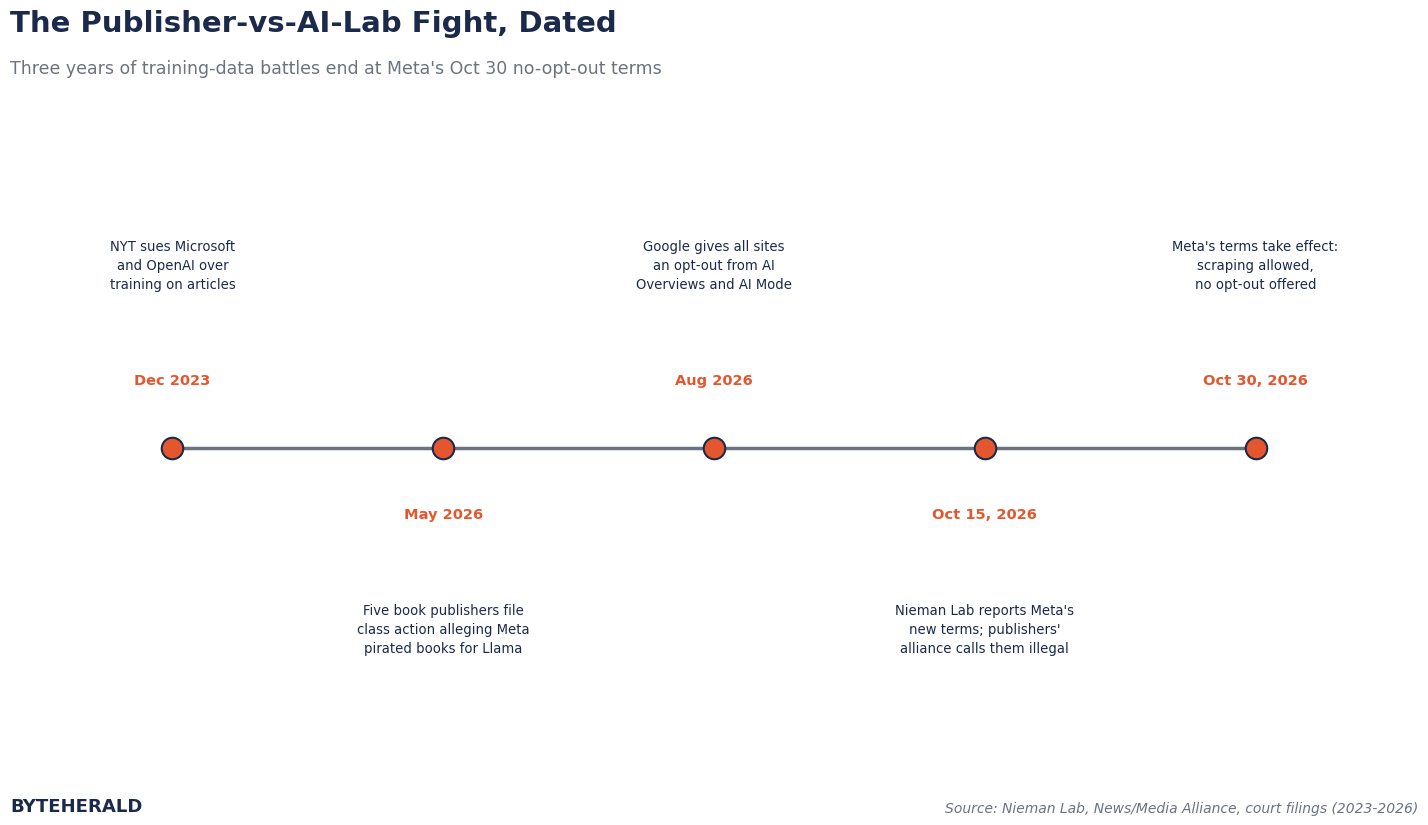
On October 30, 2026, Meta gains a contractual right to send web scrapers after your website, and if you run a news organization, you almost certainly cannot refuse. That is the plain reading of Meta's updated commercial terms of use, first reported by Nieman Lab on October 15: the new language authorizes Meta to deploy automated software, including scrapers, bots, spiders and crawlers, against any domain associated with a Meta business account, and to use whatever it collects to "train" Meta products, a category Meta's own terms define as including "AI at Meta". Three legal experts who reviewed the terms at Nieman Lab's request say the clause reads as permission to train Meta's AI models on publishers' content. Meta disputes that reading, says the update only consolidates existing language, and insists nothing about its crawling will change.
What the new language actually says
The key paragraph sits in the terms' "Licenses and Rights You Provide Meta" section. It authorizes Meta, or anyone acting on its behalf, to use automated software to access, index, cache, analyze, collect, retrieve or crawl the domains, pages and URLs associated with a user's products or services, create test credentials to get in, and periodically pull updates. The permitted uses explicitly include developing, improving, researching and training Meta products. Two things are new compared with the old terms. First, the trigger: the previous generative-AI ad terms, effective May 2024, allowed crawling only of URLs supplied in connection with ads; the new terms cover any site "associated with" a business account, which sweeps in virtually every news organization. Second, the word "train" is now written directly into the permission, alongside a "test credentials" clause that Cornell law professor James Grimmelmann says could technically let Meta sign up as a fake user to get past registration walls. Meta declined to answer Nieman Lab's questions about whether that extends to paywalls.
| Old terms (gen-AI ad terms, May 2024) | New commercial terms (effective Oct 30, 2026) | |
|---|---|---|
| Crawl scope | URLs supplied in connection with ads | Any domain or URL associated with your products or services |
| Uses listed | Ad-related purposes | Provide, develop, improve, research, train, maintain integrity |
| Bots named | Ad crawling | Scrapers, bots, robots, spiders, crawlers, user agents |
| Credentials | Not mentioned | Meta may create "test credentials" |
| Opt-out | Not at issue | None: "stop all access or use of our Products for business or commercial purposes" |
Why publishers are furious
The expert reactions are unusually blunt. Media and IP attorney Matt Topic called it "a remarkable provision to bury in [the] terms of service," noting it hands Meta material that would cost many millions of dollars in a licensing market, and advised publishers to assume a court would enforce it. Grimmelmann went further: for news publishers, the terms "clearly" permit Meta to train AI on any content from their sites and possibly deploy that content in competition with them. University of Wisconsin law professor Benjamin Sobel compared the structure to "tying" in antitrust law: to use the Meta products that require accepting the commercial terms, a business must also accept the scraping permission. The News/Media Alliance, the publishers' trade group, called the terms "outrageous and probably illegal" and "a clear abuse of the company's market power," asking whether a Taylor Swift or Shutterstock business account would hand Meta the right to scrape their copyrighted material too. Meta's public response has two parts: a spokesperson said the update merely consolidates crawling language previously scattered across terms, and communications chief Andy Stone disputes the analysis, saying content owners can use robots.txt flags to indicate their preferences. The experts' counter is that a signed contract can be argued to supersede a voluntary robots.txt file, which is exactly the legal question now heading for October 30. This is the second permission-expansion story in two days: on October 15 we mapped how ChatGPT's Chrome extension asks for the keys to your browser, and the pattern is the same, collection rights widening faster than consent mechanisms.
How AI training-data licensing actually works
Strip away the news cycle and the durable question is simple: can a website owner stop an AI lab from training on their content? The honest answer is: barely, and through four imperfect tools. The first is robots.txt, a voluntary file that asks bots to stay out; Meta publishes instructions for blocking its crawlers, but compliance is voluntary and a contract clause like the new terms may override it. The second is licensing deals, where labs pay for content; Topic's "many millions of dollars" comment is the market price Meta's clause would let it skip. The third is the courts: fair-use questions around AI training remain unsettled, with a class action filed in May by five book publishers alleging Meta pirated millions of books to train Llama still winding through the system. The fourth is platform opt-outs, and here the precedent cuts against Meta: as of August 2026, Google gives every website an explicit opt-out from AI Overviews and AI Mode, while Meta offers its business users no equivalent choice. Whether a court enforces a contract override of robots.txt is exactly the kind of cross-border legal question we mapped across seven jurisdictions: the US leans on fair use, the EU leans on opt-out rights, and neither has produced a final answer for AI training.
Your options before October 30
For a publisher with a Meta business account, the menu is short and every item costs something:
| Option | What it costs you |
|---|---|
| Keep the business account | You accept the scraping permission as written |
| Delete the business account | You lose Pages, ads, and Business Suite distribution; one independent publisher told Nieman Lab his community is "totally entrenched on Facebook" and he may quit anyway |
| Block Meta's crawlers in robots.txt | Meta says it honors the file; three lawyers say the signed terms may supersede it |
| Negotiate a license directly | Realistic only for the largest publishers; everyone else takes the standard terms |
ByteHerald's reading
Two things can be true at once. Meta may genuinely intend this as a consolidation of existing crawling rights, and the new language may still function as a litigation shield: several publisher-versus-lab lawsuits are live in federal courts, and a signed permission clause is an argument no other lab currently has. The "tying" framing is the one to watch, because it converts a copyright fight into an antitrust fight, and antitrust fights draw regulators. The irony Meta will have trouble explaining: the same month it began charging some accounts for the right to post links, through its Meta One subscription, it wrote itself a free pass to crawl the content behind those links. Watch October 30, and watch the first publisher that tests whether robots.txt still means anything once a contract says otherwise.
By ByteHerald Staff. Terms language and reporting details from Nieman Lab's October 15 investigation (Andrew Deck), the News/Media Alliance statement, and Meta's public responses; legal analysis paraphrased from the three cited experts. Availability and terms as published; check Meta's live commercial terms before acting. Timeline graphic is ByteHerald's original compilation.
Comments
Post a Comment