Microsoft offered voluntary buyouts to about 60,000 employees on October 26, 2026, about 27 percent of its 223,000-person global workforce, while forecasting 175 billion dollars in capital spending for calendar 2026. The quotable answer is this: Microsoft is not cutting 60,000 jobs, it is offering 60,000 people a paid choice to leave, and how many accept is unknown, because the last time it made a similar offer, just over 30 percent of eligible workers took it.
Who is eligible, and who is not
Eligibility is narrower than the headline number suggests, and the exclusions describe Microsoft's priorities better than the offer does. Staff at vice president level and below on select teams in the United States, Canada, India, and the United Kingdom are eligible, according to reporting from Business Insider and Bloomberg cited by TechCrunch. Teams named in reporting include AI Experiences, Copilot, finance, human resources, Xbox, and Windows and Devices. Excluded groups include employees working on data centers, sales, and marketing, according to the same reporting. The pattern is legible: the company is protecting the teams that build and sell AI infrastructure, and offering exits to the teams around them. Chief People Officer Amy Coleman told staff the offer gives eligible employees who may be considering a future outside the company a new choice to make that transition now with support, and gives participating organizations another way to adapt their workforce to changing needs.
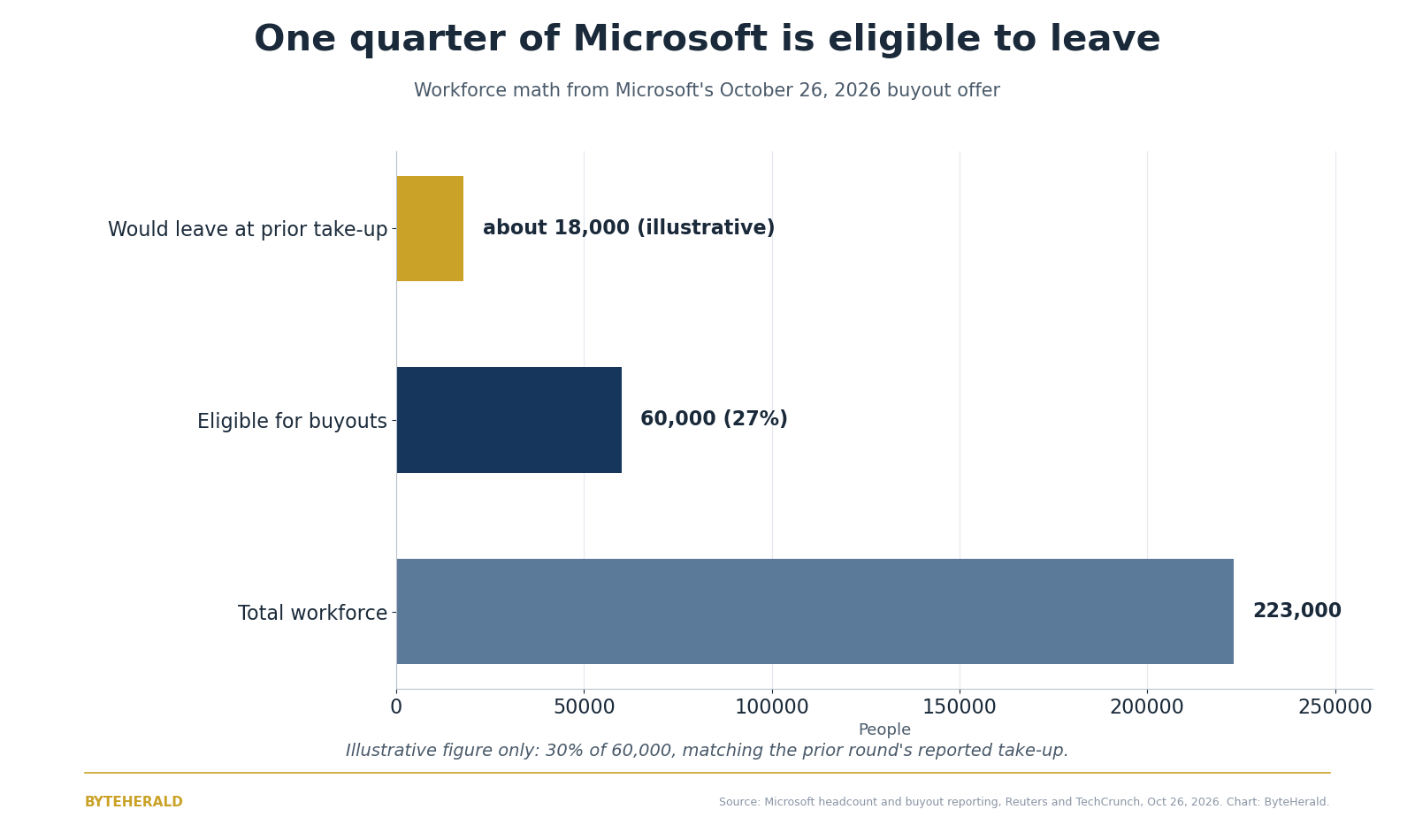
The arithmetic matters because the 60,000 figure will be misquoted as a layoff count within days. Microsoft had 223,000 full-time employees at June 30, 2026, down from 228,000 at the end of 2025. Sixty thousand out of 223,000 is 26.9 percent. If take-up matches the prior round, when more than 30 percent of about 8,750 eligible retirement-age workers accepted, about 18,000 people would leave. That figure is illustrative, not a forecast: this round is far larger, covers different teams and countries, and the terms are described only as similar to a standard severance package. A voluntary offer at this scale is a workforce reshaping tool, not a headcount announcement, and the real number will only be known when acceptances close.
| Item | Figure | Source and date |
|---|---|---|
| Eligible workers | About 60,000 | Microsoft offer, October 26, 2026 |
| Global workforce | 223,000 full-time | Annual filing, June 30, 2026 |
| Eligible share | About 27 percent | ByteHerald arithmetic: 60,000 divided by 223,000 |
| Prior round take-up | More than 30 percent | About 8,750 eligible workers, earlier in 2026 |
| Illustrative departures | About 18,000 | ByteHerald arithmetic: 30 percent of 60,000, not a forecast |
| Calendar 2026 capital spending | 175 billion dollars forecast | Microsoft forecast, reported October 26, 2026 |
| July 2026 job cuts | 4,800 jobs, about 2.1 percent | Microsoft announcement, July 2026 |
Why now: the spending side of the same story
The buyout offer only makes sense next to the spending plan it funds. Microsoft has forecast 175 billion dollars in capital expenditure for calendar 2026, mostly data centers and chips, and reports quarterly results after markets close on Wednesday, October 28, 2026. Shares were up about 10 percent on the year and rose about 1 percent on Monday, October 26, 2026. The company is not cutting because it is short of money; it is cutting people costs while raising infrastructure costs, and asking investors to read both moves as one strategy. That strategy has a name in Microsoft's own framing: adapt the workforce to changing needs while the build-out continues. The tension in that framing is the story. A company that can spend 175 billion dollars on machines and still needs to shrink its payroll by a quarter of its workforce, even voluntarily, is telling you where it thinks value will come from next: capacity first, headcount second. The same capital logic drove Meta's 95 billion dollar stock sale on the same day: when AI capacity costs this much, every other line in the budget gets renegotiated, including headcount.
The history makes the scale of this round clear. Earlier in 2026, Microsoft offered buyouts to about 7 percent of its US workforce, about 8,750 people, and in July it cut 4,800 jobs, about 2.1 percent of the global workforce, including a large number in Xbox. This round is roughly seven times the earlier buyout pool and about twelve times the July cuts, and it is the first to span four countries at once. The step change in size is the news, not the existence of buyouts: Microsoft has been reshaping its workforce all year, and this offer is that program at full scale. Readers who want the wider pattern should read our survey of the enterprise AI pullback, where budgets, not headcount, were the first constraint to tighten. Microsoft's offer is the headcount version of the same squeeze.
What the offer is not
Start with the two corrections that matter most, because both will be wrong in tomorrow's headlines. The offer is not 60,000 departures. Eligibility is an invitation, and the prior round's take-up shows most eligible workers stayed, so the departure count will be far smaller than the eligibility count, whatever it turns out to be. The offer is also not a retreat from AI. The excluded teams, data centers, sales, and marketing, plus the 175 billion dollar spending forecast, point the other way: Microsoft is concentrating staff where AI is built and sold. Underneath both corrections sits a single signal worth keeping. A company with rising shares and record-scale infrastructure spending is still choosing to pay people to leave rather than carry its current workforce shape into the AI build-out, and that choice, at this scale, says how the largest AI spenders now value headcount against capacity. Nothing in the reporting ties eligibility to AI replacing specific roles, and Microsoft's memo frames the offer as flexibility and workforce adaptation, so that third claim should not be added to the first two.
What happens next
The next two disclosures will matter more than today's announcement. The first is earnings on Wednesday, October 28, 2026, when Microsoft reports quarterly results after markets close and investors can test whether the 175 billion dollar spending forecast still holds. If the forecast holds, the buyout reads as reallocation. If it is cut, the buyout reads differently, as an early sign that the build-out itself is being repriced. The second disclosure is the acceptance outcome: how many of the 60,000 eligible workers actually take the offer, and whether Microsoft reports that number at all. A take-up near the prior round's 30 percent would mean about 18,000 departures on the illustrative math in this article. A far lower take-up would mean the offer was mostly signaling, and a far higher one would mean the workforce reshaping is deeper than the memo suggests. Until one of those numbers lands, the honest summary stays narrow: 60,000 people were offered a paid choice, the spending plan beside it is 175 billion dollars, and everything else is still unknown.
By ByteHerald Staff. TechCrunch reported on October 26, 2026 that Microsoft is offering buyouts to around 60,000 employees, according to Business Insider and Bloomberg reporting, that staff at vice president level and below on select teams in the United States, Canada, India, and the United Kingdom are eligible, that data center, sales, and marketing staff are excluded, and that earlier in 2026 more than 30 percent of about 8,750 eligible workers accepted a similar offer. Reuters reported on October 26, 2026 that Microsoft is offering voluntary buyouts to about 60,000 employees, more than a quarter of its global workforce, to contain costs and fund AI investments, that eligible teams include AI Experiences, Copilot, finance, human resources, Xbox, and Windows and Devices, that the company forecast 175 billion dollars in capital expenditure for calendar 2026, that it had 223,000 full-time employees at June 30, 2026, and that it cut 4,800 jobs in July 2026, about 2.1 percent of its workforce, and that shares had risen about 10 percent on the year and rose about 1 percent on Monday, October 26, 2026. La Nacion reported on October 26, 2026 that the offer covers about 27 percent of Microsoft's global workforce, that Chief People Officer Amy Coleman described the offer in a staff blog post, and that Microsoft planned buyouts for about 8,750 people in May 2026. Gulf News reported on October 26, 2026 that Microsoft had 223,000 employees globally at the end of June, down from 228,000 at the end of 2025, and that about 27 percent of the workforce is eligible for the new offer.
Comments
Post a Comment