Your RTX 3090 has been running its AI math at half speed for years, and the fix costs nothing. A new open source Linux kernel module called gpu-unlock removes a speed limit Nvidia built into its Ampere consumer cards, restoring the FP16 and BF16 instruction issue rate that the same silicon runs at in professional cards. On an RTX 3090 Ti, the project's own dense matrix tests rise from 87.50 to 157.41 TFLOPS in BF16, a gain of about 80 percent, with no VBIOS flash and no patched driver.
The project, gpu-unlock 1.0.0 by developer Zagitta, appeared on GitHub on October 18, 2026, and collected more than 6,000 stars within a week. That attention is easy to understand. The RTX 3090 and its siblings are among the most widely owned cards repurposed for local AI, bought for gaming and put to work on language models, image generation, and fine tuning. If a free software change makes them materially faster at exactly the math those workloads use, every owner wants to know whether the claim survives contact with real benchmarks.
What the unlock actually changes
Tensor Cores do the matrix multiplication at the heart of AI work. On Ampere GeForce cards, FP16 and BF16 operations that accumulate results in higher precision FP32 are issued at a reduced rate compared with professional cards built on the same silicon. The project writes new hardware speed selector values, resets the card, and hands control to the unmodified Nvidia driver. It runs as a kernel module loaded from initramfs before the driver binds, which is why it does not need rework every time Nvidia ships a new driver.
Three things the unlock is not matter as much as what it is. It is not a VBIOS flash, so nothing on the card is permanently rewritten. It is not a patched driver, so the stock driver runs untouched after the reset. And it is not automatic: nothing happens unless the user adds a kernel boot parameter naming the target cards, which keeps the change opt in rather than silent.
The numbers, recomputed
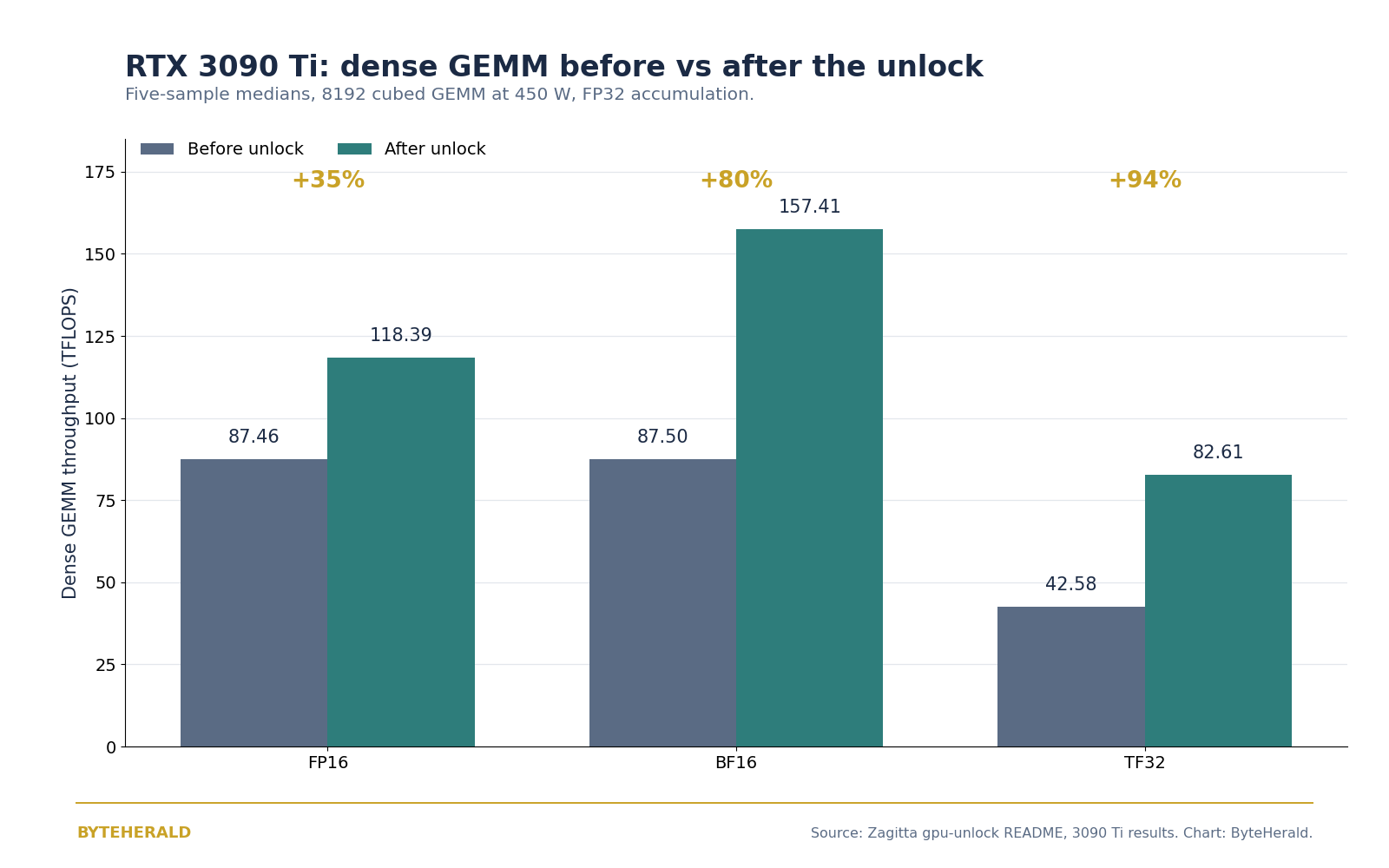
The project's headline benchmark is a 3090 Ti running dense 8192 cubed GEMM at 450 watts, reported as five sample medians with FP32 accumulation. ByteHerald recomputed the gains from the project's own before and after figures, and the chart below shows them.
| Precision | Before | After | Gain (ByteHerald arithmetic) |
|---|---|---|---|
| FP16 | 87.46 TFLOPS | 118.39 TFLOPS | 35 percent |
| BF16 | 87.50 TFLOPS | 157.41 TFLOPS | 80 percent |
| TF32 | 42.58 TFLOPS | 82.61 TFLOPS | 94 percent |
Community reports in the project's compatibility table widen the picture and narrow the certainty at the same time. Reported BF16 GEMM gains run from 25 percent to about 80 percent depending on card and power limit, with the lowest figure coming from a card capped at 225 watts. The RTX 3090 sits in a 25 to 67 percent range across its reports, the RTX 3080 in a 70 to 73 percent range, the RTX 3070 in a 73 to 81 percent range, and the 12GB RTX 3060 at about 80 percent. The project itself warns these figures come from each report's own benchmark and are not directly comparable, a caveat this article keeps attached to every number in it.
Notebookcheck's independent reporting adds two useful real world data points. One RTX 3090 report put BF16 matrix multiplication at 129.6 TFLOPS, up from 77.5, with TF32 rising from 40.2 to 69.8. Separately, ComfyUI image generation on a 3090 Ti ran roughly 47 to 59 percent faster across several BF16 heavy workloads. Those are community and press reports, not controlled ByteHerald tests, and they are labeled as such here.
What does not speed up
The honest boundary of this story is as important as the headline. Language model prefill, the phase that processes a long prompt, improves by a reported 14 to 36 percent in cited reports. Token generation, the phase that produces output one token at a time, stays practically unchanged because it is limited by memory bandwidth, not by issue rate. INT8 work stays about the same. Gaming gains are unproven: no verified gaming benchmark in the project's reports shows a frame rate increase, and this article claims none.
One card in the table fails outright, and the failure is instructive. The OEM 20GB RTX 3080 Ti completes the unlock procedure but keeps running BF16 at half rate, which means the speed selector change does not take effect on that variant. The RTX 3070 Ti has not been tested with this module at all, though the same unlock was reported working from a UEFI port on Windows. The GA103 chip has no reports yet. A tool that admits its misses is more trustworthy than one that hides them, and buyers should check the compatibility table for their exact PCI ID before trying anything.
Why Nvidia ships the limit at all
This is market segmentation expressed in silicon settings. The same GA102 die family serves both a consumer flagship and professional cards that cost several times more, and the issue rate is one of the dials that separates the two products. Nothing in the project suggests the consumer silicon cannot do the work: reports that compared outputs before and after found them bit identical, which is the strongest evidence that the limit is a product decision rather than a physical one. That framing matters for the evergreen question underneath the news, which is how much of a card's capability a buyer actually owns at purchase.
Local AI is where this lands hardest. The current wave of small, capable open models runs well on consumer cards, and our earlier coverage of the 4GB model tier showed how much capability now fits in a few gigabytes of memory. A faster issue rate does not add memory, so it cannot rescue a card that is VRAM starved, but for matrix heavy work that already fits, it removes a bottleneck the owner never asked for. Readers weighing a local setup should also read our hardware map for large open models, which covers what different cards can actually run: Meta's 816B open model runs on 2 Macs, and the hardware map behind that claim.
Who should try it, and who should wait
The clear beneficiaries are Linux users running matrix heavy local work: model prefill, image generation pipelines like ComfyUI, and batch inference. The clear wait-and-see group is everyone else: Windows users, for whom this module is not a supported path; gamers chasing frame rates, for whom no gain is demonstrated; and anyone whose card is their only display output and cannot tolerate experimental boot behavior. The module re-applies the unlock after suspend to RAM, adds about a second to resume, and does not cover hibernation. The display card's screen goes blank from reset until the driver takes over. Those are small costs, but they are real, and experimental kernel code that runs before the graphics driver deserves a backup and a free afternoon, not a rushed install before a deadline.
The wider signal is that consumer hardware still contains headroom its vendors did not sell. Modders found this one in a speed selector register; the next one may sit somewhere else entirely. For now, the measured story is narrower and better than the hype: a free, reversible, opt in change that makes specific AI math much faster on specific cards, and does nothing at all for everything else. That is worth knowing precisely because it is not a miracle.
By ByteHerald Staff. Zagitta gpu-unlock project README, October 18, 2026, 3090 Ti dense GEMM medians (FP16 87.46 to 118.39 TFLOPS, BF16 87.50 to 157.41, TF32 42.58 to 82.61), per card reported gains, and the 3080 Ti OEM partial failure. Notebookcheck, October 2026, RTX 3090 community report (BF16 77.5 to 129.6 TFLOPS, TF32 40.2 to 69.8) and ComfyUI 3090 Ti gains of 47 to 59 percent. The Verge and Hacker News discussion of the project, October 25, 2026, framing the unlock as a Linux kernel module technique.
Comments
Post a Comment