On October 29, 2026, the market punished two software companies that reported earnings by 20 percent or more and two that reported nothing by about 5 percent, which shows the verdict was about forward contracted revenue, not about the quarter just reported. Both reporters beat their headline revenue and earnings expectations. Both still fell harder than any company that simply got caught in the downdraft. That split is the whole scoreboard, and it is the only honest way to answer whether AI is killing software or whether investors just stopped paying any price for slowing guidance.

The scoreboard: October 29 closes
The scoreboard uses closing prices, because closes are the only figures every company shares on the same basis. Intraday snapshots published during the session differ from closes, sometimes by several points, and this article never presents a snapshot as a close. Where close reports disagree by a few tenths of a point, the article names the close report it uses.
| Company | October 29 close | Reported earnings that week | What the market reacted to |
|---|---|---|---|
| ServiceNow | Down 27 percent, close 109.67 dollars | Yes, October 28 | Fourth-quarter contracted growth guidance of 18.5 percent, down from 21 percent |
| Fortinet | Down 20.1 percent, close 139.10 dollars | Yes, October 28 | Full-year service revenue guidance cut, despite a raised total revenue outlook |
| Salesforce | Down 5.4 percent, close 228.96 dollars | No | Sector contagion; no company-specific news that day |
| Workday | Down 5.4 percent | No | Sector contagion; no company-specific news that day |
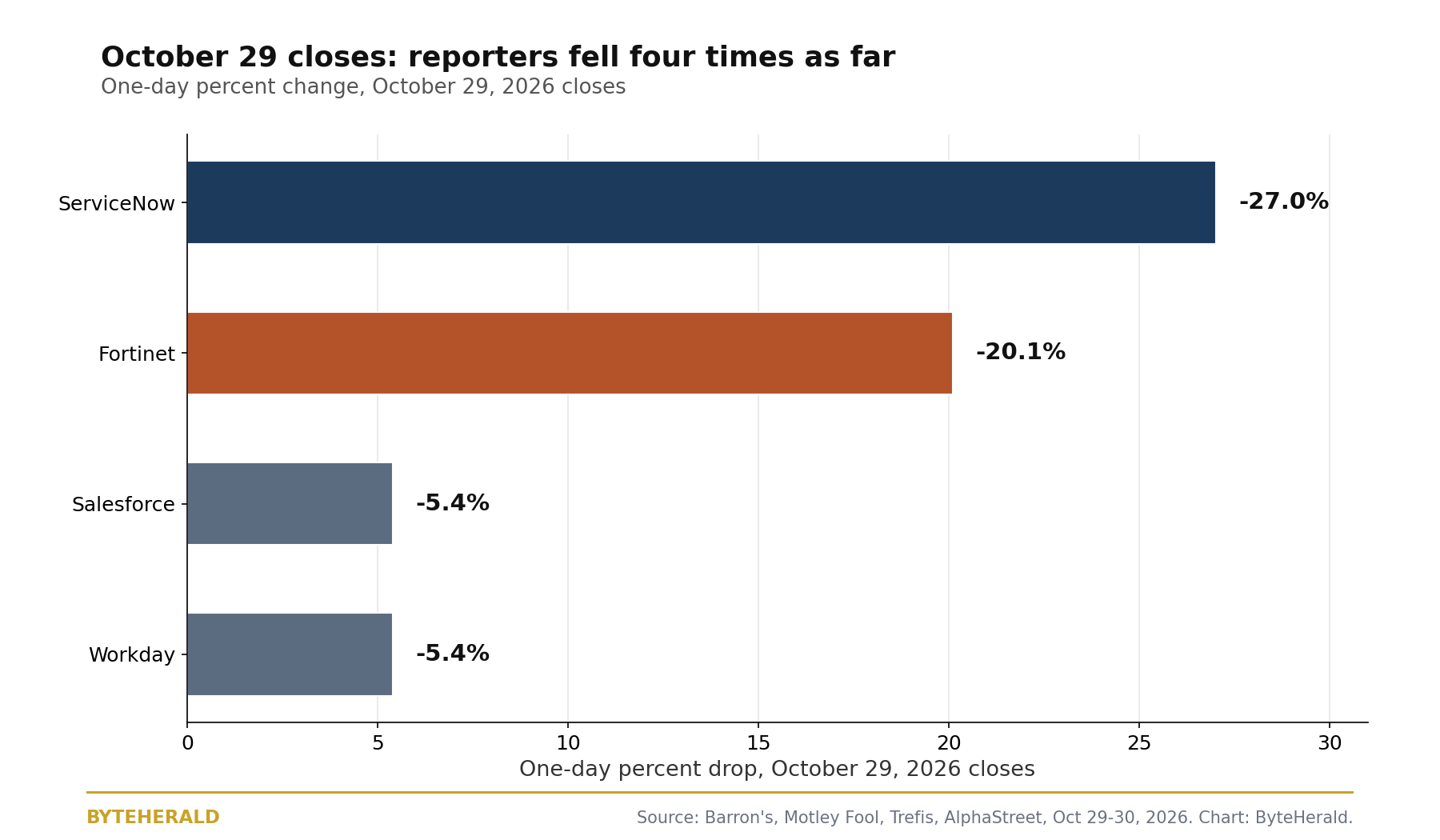
Read the chart as two groups, not four independent moves. The reporters fell 20 percent or more. The non-reporters fell about 5 percent. If the market believed AI had just made all enterprise software worthless, the groups would have fallen together. They did not. The punishment tracked whether a company had just given investors a forward number to judge, and whether that number slowed.
ServiceNow: the guidance cut that cost 27 percent
ServiceNow announced third-quarter results on October 28, 2026, and shares traded on them on October 29, falling 27 percent to close at 109.67 dollars, the largest percentage decline on record for the stock, and the worst performer in the S&P 500 that day. The quarter itself was strong. Total revenue reached 4.106 billion dollars, up 20.5 percent. Subscription revenue reached 3.988 billion dollars, up 21 percent. Current remaining performance obligations, the contracted revenue expected over the next 12 months, stood at 13.65 billion dollars, up 20.5 percent, or 21 percent in constant currency. The company even raised its full-year subscription revenue guidance to between 15.78 billion and 15.79 billion dollars, and raised its AI annual contract value target to 1.7 billion dollars.
The market punished the next quarter, not this one. ServiceNow guided fourth-quarter current remaining performance obligation growth to 18.5 percent in constant currency, down from 21 percent in the third quarter. Adjusted earnings of 1.00 dollar per share also missed the 1.02 dollars analysts expected, by two cents, and the chief financial officer said strong early renewals in the third quarter contributed about half of that quarter's beat and pulled deals out of the fourth quarter. Management also cited about 100 basis points of combined headwind from shifting some revenue to services and from a higher mix of contracts with termination-for-convenience clauses. Morgan Stanley's note, quoted in the coverage, said the deceleration suggests AI adoption is not yet translating into better growth for the overall business. That sentence is the thesis in miniature: AI momentum inside the company, measured by the raised 1.7 billion dollar target, did not translate into faster contracted growth overall, and the stock paid for the gap.
If you want the full single-company version, including the quarter bridge and the OpenAI deal counterpoint, read our ServiceNow deep dive. This scoreboard uses it as one row, not as the whole story, because the point of a scoreboard is comparison, and a single row cannot test a thesis.
Fortinet: the service line that cost 20 percent
Fortinet reported after the market close on October 28, 2026, and shares closed on October 29 at 139.10 dollars, down 34.98 dollars or 20.09 percent from the prior close of 174.08 dollars. The headline quarter beat expectations on both lines: revenue of 2.08 billion dollars, up 20 percent, against 2.06 billion dollars expected, and adjusted earnings of 0.91 dollars per share against 0.86 dollars expected. Billings rose 29 percent to 2.34 billion dollars. The company even raised its full-year revenue outlook to between 8.125 billion and 8.215 billion dollars and its billings outlook to between 9.57 billion and 9.72 billion dollars.
The market punished the recurring line, not the headline. Product revenue grew 37 percent, down from 52 percent in the second quarter. Service revenue, which makes up more than 65 percent of Fortinet's revenue and an even higher share of gross profit, grew only 13 percent. Management cut its full-year service revenue forecast to between 5.15 billion and 5.17 billion dollars, from between 5.18 billion and 5.22 billion dollars, a cut of about 40 million dollars at the midpoint, or under 1 percent. Management attributed part of the shortfall to timing: new large enterprise customers whose services switch on in stages, and large expansion deals that folded existing service contracts into enterprise agreements. Management also said the first quarter of 2026 was the low point for service revenue growth, pointing to service billings up 26 percent. The market's answer was that a small cut to the most valuable line matters more than a raise to the total, because the total includes product sales that do not repeat the way services do.
| Guidance item | Before October 28 | After October 28 | Market reading |
|---|---|---|---|
| ServiceNow Q4 contracted growth | 21 percent in Q3 | 18.5 percent guided for Q4 | Deceleration, punished with a 27 percent fall |
| ServiceNow full-year subscription revenue | Lower range | 15.78 to 15.79 billion dollars, raised | Raise ignored; forward contracted growth mattered more |
| Fortinet full-year service revenue | 5.18 to 5.22 billion dollars | 5.15 to 5.17 billion dollars, cut | Small cut to the recurring line, punished with a 20 percent fall |
| Fortinet full-year total revenue | Lower range | 8.125 to 8.215 billion dollars, raised | Raise ignored; service growth mattered more |
| Salesforce and Workday guidance | No new guidance that day | No new guidance that day | No forward number to punish, so about a 5 percent contagion fall |
The two that reported nothing
Salesforce closed at 228.96 dollars, down 5.4 percent, and Workday fell 5.4 percent, according to AlphaStreet's close report, with no company-specific catalyst for Salesforce that day. The broader session confirms the pattern rather than breaking it. Datadog fell 5.7 percent. Atlassian fell more than 7 percent. Palo Alto Networks and Zscaler fell smaller amounts in intraday reporting. The S&P 500 Software and Services Index had risen only 5 percent in 2026 to that point, less than half the gain of the broader S&P 500, which means software was already lagging before this day, and October 29 widened a gap that already existed.
Salesforce also carried its own sentiment overhang, which should be named without being overstated as a cause. The company announced on October 20, 2026, that it agreed to acquire Braze for about 5.66 billion dollars in enterprise value, an all-cash deal that has weighed on sentiment since, because investors often punish large software acquisitions when the price looks full. That overhang may have made Salesforce an easier sale on a bad sector day. It does not explain Workday's identical fall, and it does not explain why the reporters fell four times as far. Contagion explains the 5 percent group. Earnings guidance explains the 20 percent group. Keeping those two explanations separate is the discipline this scoreboard exists to enforce.
The thesis test: what would prove it wrong
A scoreboard earns its keep only if it states what would falsify it. Three tests do that here. First, if non-reporters had fallen as far as reporters, the verdict would have been sector-wide, not guidance-specific, and the thesis would fail. They did not. Second, if the reporters had missed their headline quarters, the falls could be blamed on weak quarters rather than forward guidance, and the thesis would fail. They beat their headline quarters. Third, if the next earnings round shows contracted and service growth re-accelerating, and the stocks recover a large share of October 29, the thesis would need revision toward timing rather than structural slowdown. Fortinet's next test is its fourth-quarter report in February 2027, where service revenue growth is the measure to watch. ServiceNow's next test is whether fourth-quarter contracted growth lands at or above the guided 18.5 percent. Until those prints arrive, the honest statement is narrow: on October 29, the market paid for forward contracted revenue and discounted everything else, including headline beats and raised full-year outlooks.
The hyperscaler backdrop belongs in this article only as context, not as a row, because Alphabet is not a software application company. Alphabet's own record day, with search slowing and spending rising, is covered in our Alphabet earnings report, and it shows the same spending-versus-growth tension from the other side of the market: the company building the AI infrastructure, rather than the companies selling software on top of it. The two stories rhyme. They are not the same story, and merging them into one scoreboard would blur exactly the distinction this article is trying to keep sharp.
How to read a close scoreboard
Three method notes prevent the most common misreadings. First, closes are used throughout, and intraday snapshots are labeled as such whenever they appear. Reuters reported Fortinet down 26 percent and ServiceNow down 23 percent during the session, before the closes of 20.1 percent and 27 percent were known. A reader who quotes the Reuters figures as closes will get both companies wrong, in opposite directions. Second, close reports for Salesforce ranged from about 4.3 percent intraday to 5.4 percent at the close, so this article uses the AlphaStreet close figure of 5.4 percent and says so, rather than averaging incompatible snapshots into a false precision. Third, one day is a snapshot, not a trend. The scoreboard is dated October 29, 2026, and its value is that it freezes one session's judgment in comparable form. The next earnings round, not the next headline, is what updates it.
By ByteHerald Staff. ServiceNow third-quarter 2026 earnings release, October 28, 2026, reporting total revenue of 4.106 billion dollars, subscription revenue of 3.988 billion dollars, current remaining performance obligations of 13.65 billion dollars, and fourth-quarter contracted growth guidance of 18.5 percent. Barron's, October 29, 2026, reporting ServiceNow closed down 27 percent at 109.67 dollars, its largest percentage decline on record, with an intraday low of 108.68 dollars. Fortinet third-quarter 2026 earnings release, October 28, 2026, reporting revenue of 2.08 billion dollars, adjusted earnings of 0.91 dollars per share, service revenue growth of 13 percent, and a full-year service revenue forecast cut to 5.15 billion to 5.17 billion dollars. Motley Fool, October 29, 2026, and Trefis, October 30, 2026, reporting Fortinet closed at 139.10 dollars, down 20.09 percent from 174.08 dollars. AlphaStreet, October 29, 2026, reporting Salesforce closed at 228.96 dollars, down 5.4 percent, Datadog down 5.7 percent, and Workday down 5.4 percent, with no company-specific catalyst for Salesforce that day. Reuters via ChannelNewsAsia, October 29, 2026, reporting intraday moves and that the S&P 500 Software and Services Index had risen only 5 percent in 2026, less than half the broader index gain.
Comments
Post a Comment