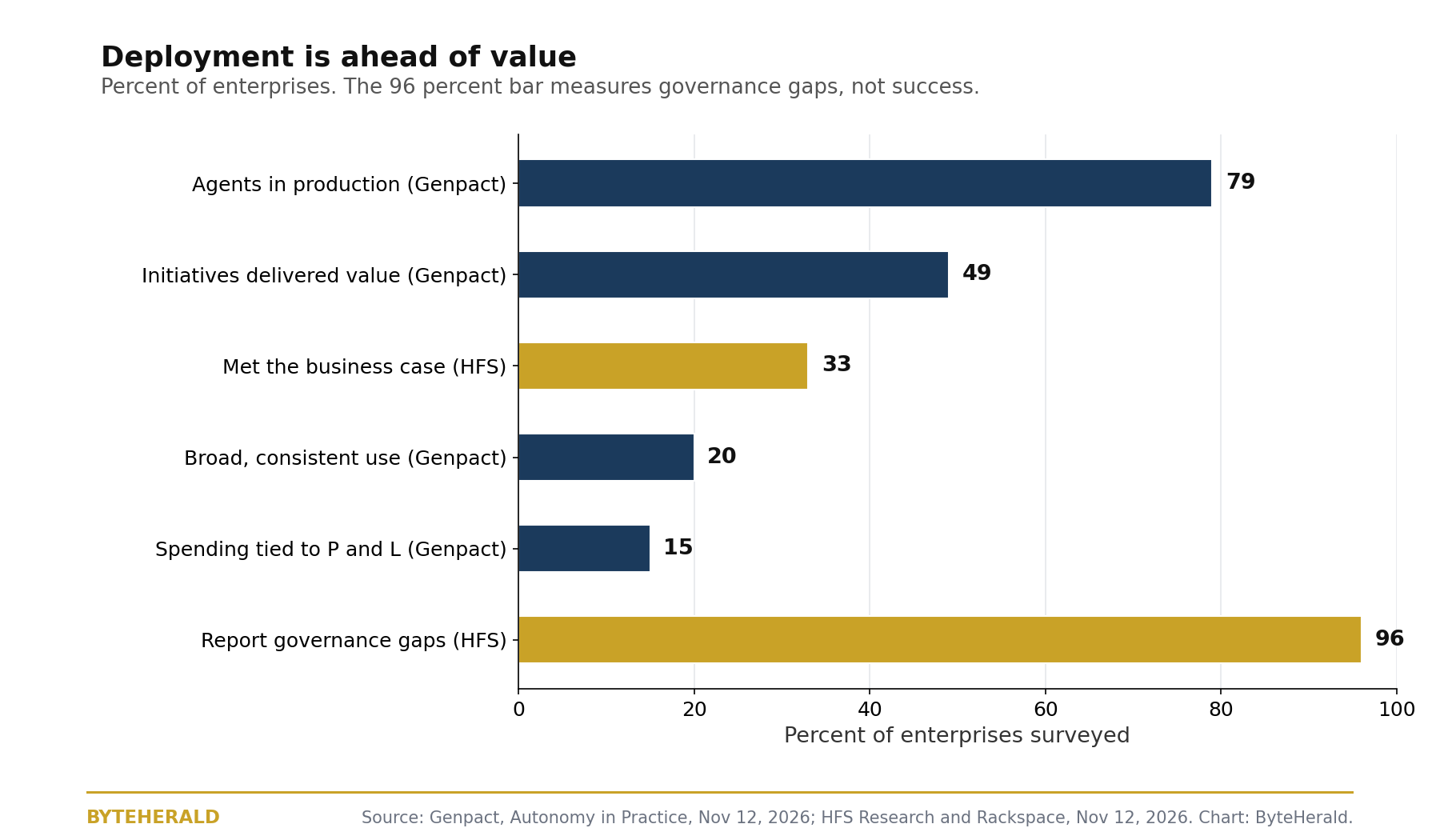
Two surveys released on November 12, 2026, measured the same problem from opposite ends, and they agree. Genpact asked more than 2,000 enterprise executives and found 79 percent have AI agents in production, but only 15 percent have fully tied their AI spending to profit-and-loss outcomes. HFS Research and Rackspace asked 502 senior AI decision-makers and found only 33 percent have met or exceeded the business case for their most significant AI program, while 96 percent report significant governance gaps. The agents are live. The money is not proven.
The two surveys, side by side
Genpact's report, Autonomy in Practice, is based on a survey of more than 2,000 enterprise executives at companies with annual revenue from 1 billion dollars to more than 50 billion dollars, across 17 industries and 14 business functions, supplemented by interviews with enterprise leaders. The HFS Research study, conducted with Rackspace and titled Run Your AI as One, or Keep Paying for Parts That Never Add Up, surveyed 502 senior enterprise AI decision-makers between August and September 2026, and the survey was blind, naming no vendor, platform, or provider. The samples are different sizes and different populations, which is exactly why their agreement matters: two independent polls land on the same gap.
| Measure | Genpact (2,000+ executives) | HFS + Rackspace (502 decision-makers) |
| AI agents in production | 79% | n/a |
| Using agents broadly and consistently | 20% | n/a |
| AI spending fully tied to P&L outcomes | 15% | n/a |
| Initiatives that delivered expected value | 49% (average, past 24 months) | n/a |
| Met or exceeded the business case | n/a | 33% (28% for multi-function deployers) |
| Report significant governance gaps | n/a | 96% |
| Governance failures a bigger threat than tech failures | n/a | 78% |
What tied to P and L actually means
Being in production and being in the profit-and-loss statement are different achievements, and the distance between them is the story. An agent in production answers tickets, drafts documents, or triages claims. Tying that work to P&L means naming the owner of the gain, the P&L line it lands on, and the baseline it is measured against, so a cost saving or a revenue gain shows up as a number the finance team recognizes. Genpact calls the missing piece the autonomy dividend: the value that comes when AI-enabled gains translate into better business performance, not simply greater productivity. Only 15 percent of the companies it surveyed have made that translation completely.
The other Genpact numbers fill in the middle of the funnel. Only 20 percent use agents broadly and consistently across functions, which means most deployments are still pilots that escaped into production in one department. On average, just 49 percent of AI initiatives funded in the past 24 months delivered the value expected, so about half of the money spent in the last two years did not pay back what was promised. And 40 percent of decisions are now led or fully run by AI, which means the machines are making calls before the companies have agreed how to judge them. Genpact's top group, the 17 percent of enterprises at the top of its AI Maturity Index, which it calls AI Leaders, are further along in building what it calls Agentic Operations: an operating model that runs people and agents as one workforce.
Why the gap is governance, not technology
The HFS and Rackspace study names the obstacle directly: fragmented accountability for how AI performs, what it costs, and how it is controlled once deployed. Nobody owns the whole outcome, so nobody can prove it. The share of enterprises meeting their business case falls from 33 percent overall to 28 percent among those deploying AI across several functions, which is the opposite of what scale is supposed to do: the wider the deployment, the harder it is to show the return. And 78 percent of respondents view governance failures as a bigger threat to scaling AI than technology failures, which is a blunt verdict on where the bottleneck sits. The models work well enough to deploy. The operating model around them does not.
That diagnosis fits the pattern we have tracked all year. In October, Gartner's survey of 2,002 CIOs found only 13 percent reporting that AI had delivered measurable business value. The new surveys do not contradict that finding. They add a mechanism: the value leaks out through governance, through costs nobody owns, and through deployments that never get measured against a P&L line. The numbers differ because the questions differ, which is why the direction matters more than any single figure, and the direction has not changed in a year of surveys.
How to read the numbers honestly
Both surveys are self-reported, and both sets of percentages are rounded, which Genpact states in its release. Executives describing their own programs tend to overstate success, which makes the low numbers more striking, not less: if 33 percent is the generous reading, the unflattering reading is worse. The HFS sample is smaller and blind, which protects it from vendor cheerleading, while the Genpact sample is larger and covers bigger companies, which means its 79 percent production figure describes the largest enterprises, not the whole market. Neither survey publishes a margin of error, so treat the gap between 33 percent and 49 percent as two different questions with two different answers, not as a contradiction: one asks whether the single biggest program met its business case, the other asks what share of all funded initiatives delivered expected value.
The honest test for any company reading these surveys is a short one. Name the P&L line each AI program is supposed to move, name the person who owns it, and name the baseline it is measured against. If those three answers do not exist, the program is in the 85 percent that cannot prove the money, whatever its deployment dashboard says. If they do exist, the next question is whether the value survived contact with real costs, because the same surveys show governance gaps and unpredictable costs as the two reasons the case does not close, and token costs have already forced most enterprises to limit or redesign at least one deployment. The agents are not the hard part anymore. The accounting is.
By ByteHerald Staff. Genpact released its report Autonomy in Practice on November 12, 2026, based on a survey of more than 2,000 enterprise executives across 17 industries, finding that 79 percent of enterprises have AI agents in production, 20 percent use them broadly and consistently across functions, only 15 percent have fully tied AI investment to profit-and-loss outcomes, and on average 49 percent of AI initiatives funded in the past 24 months delivered the value expected. HFS Research, in collaboration with Rackspace, released its study Run Your AI as One, or Keep Paying for Parts That Never Add Up on November 12, 2026, based on a survey of 502 senior enterprise AI decision-makers conducted between August and September 2026, finding that 33 percent met or exceeded the business case for their most significant AI program, falling to 28 percent among multi-function deployers, while 96 percent report significant governance gaps and 78 percent view governance failures as a bigger threat to scaling AI than technology failures. PR Newswire published the Genpact findings on November 12, 2026, and GlobeNewswire published the HFS Research and Rackspace findings on November 12, 2026.
Comments
Post a Comment