If today's AI capabilities were widely adopted, AI could take on 27 to 52 percent of the researcher time needed to produce a new study, with a median of 38 percent across fields. That is the headline of Anthropic's study of 207,049 science sessions, published November 5, 2026, and the rest of the study is more interesting than the headline: scientists use AI least for the work they say matters most, the fields that gain the most are the ones that produce AI itself, and the fastest possible acceleration is about twice current speed, not ten times. This is the first field-by-field table of where AI helps science, what it cannot do, and where the claims outrun the evidence.
What Anthropic measured
Anthropic studied 207,049 research sessions on consumer plans, from August 2 to September 30, 2026: 128,914 from Claude Chat and Cowork, and 78,135 from Claude Code, the agentic coding tool. A language-model classifier read each session transcript and labeled it with a field and a research task from the SciNet taxonomy, which spans 34 fields, 318 subfields, and 7,262 tasks. Only the labels were retained and analyzed; no classifier extracted or stored open-ended details such as datasets, hypotheses, methods, or unpublished papers. The sample has a hard limit that shapes everything that follows: it covers consumer plans only, Free, Pro, and Max, and excludes programmatic Claude Code use, enterprise deployments, and API use. The study also ran a survey of 528 scientists, mainly in the life and health sciences, who already use AI. What follows is therefore a picture of how individual researchers on consumer plans use Claude, not of how institutions or the field as a whole uses AI.
Where scientists actually use it
Use concentrates in the formal sciences. On Claude, the three largest fields by session share are computer science at 11.9 percent, engineering at 8.4 percent, and medicine at 7.7 percent. On Claude Code, the concentration is sharper: despite making up only 4.3 percent of the world's researchers, computer science alone accounts for 32.7 percent of Claude Code sessions. At the subfield level, artificial intelligence and machine learning stand out, with 5.0 percent of Claude sessions and 15.2 percent of Claude Code sessions, despite making up only 1.2 percent of the world's researchers. The pattern is the same at every level of the taxonomy: fields where AI can perform many tasks well use Claude more, and fields held back by physical work, chemistry in a lab, medicine with patients, use it less. The table below gives the field shares the report publishes, against the share of the world's researchers in each field.
| Field or subfield | Share of Claude sessions | Share of Claude Code sessions | Share of world researchers |
|---|---|---|---|
| Computer science | 11.9% | 32.7% | 4.3% |
| Engineering | 8.4% | Not stated | Among the largest |
| Medicine | 7.7% | Not stated | Among the largest |
| Artificial intelligence and machine learning (subfield) | 5.0% | 15.2% | 1.2% |
The report also built a measure of how well AI can, in theory, perform each research task. The tasks AI is best suited to, the top 20 percent on that measure, get two to four times as much Claude use as the time researchers spend on them would predict. The tasks AI is least suited to, the bottom 20 percent, which include most physical work, get very little. Scientists, in short, use AI where it works best, and the usage pattern tracks capability rather than hype.
The mismatch: used least where it matters most
The sharpest finding in the report is not about fields but about tasks. Data analysis accounts for 33.7 percent of sessions on Claude and 48.1 percent on Claude Code, against 27.6 percent of researcher time. Writing and communication accounts for 32.0 percent of Claude sessions, against 16.0 percent of researcher time. The two categories where AI is most used are the ones where researchers already spend a minority of their time, and the categories where researchers spend most of their time are the ones AI touches least. Data gathering accounts for 28.6 percent of researcher time but only 11.5 percent of Claude sessions and 11.9 percent of Claude Code sessions. Ideation and hypothesis generation accounts for 7.1 percent of researcher time but only 4.2 percent of Claude sessions and 2.1 percent of Claude Code sessions. In the survey of 528 scientists, ideation and hypothesis generation ranked first for importance to research results. The gap is the story: the work scientists say produces the most important results is the work AI is used for least.
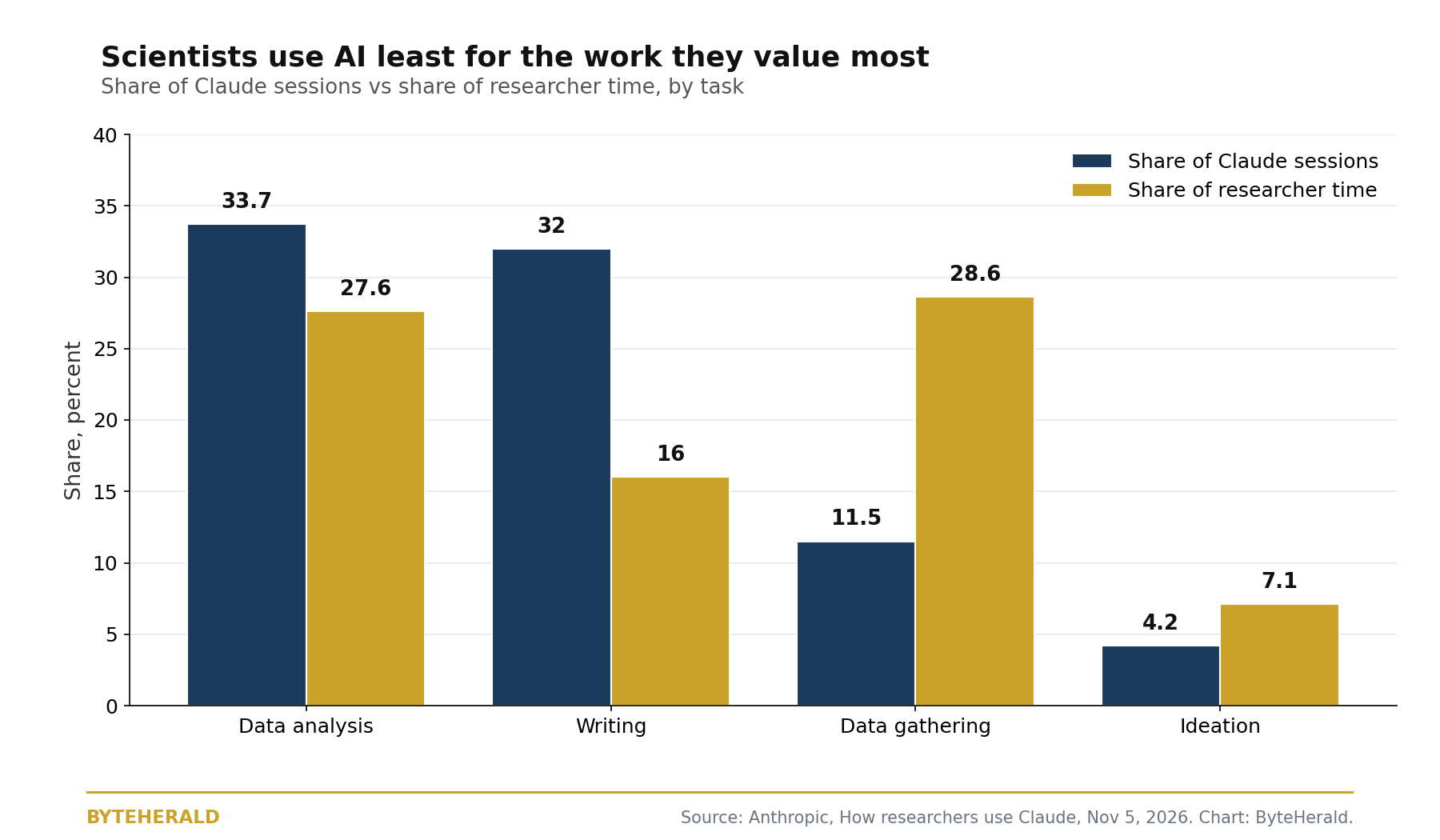
There is one exception, and it points to where the gap closes. On Claude Science, the platform built for research work, idea generation makes up about twice the share of use that it does on Claude, 8 percent against 4.2 percent, and biomedical sciences and biology together comprise over 50 percent of sessions. A tool designed for scientific work pulls usage toward the tasks scientists value, which suggests the mismatch is partly a tooling problem, not a capability problem. Anthropic says so itself: specialized AI tools designed for scientific work could narrow the gap between the research tasks scientists use AI for and the ones they consider most important.
The ceiling: twice as fast, not ten times
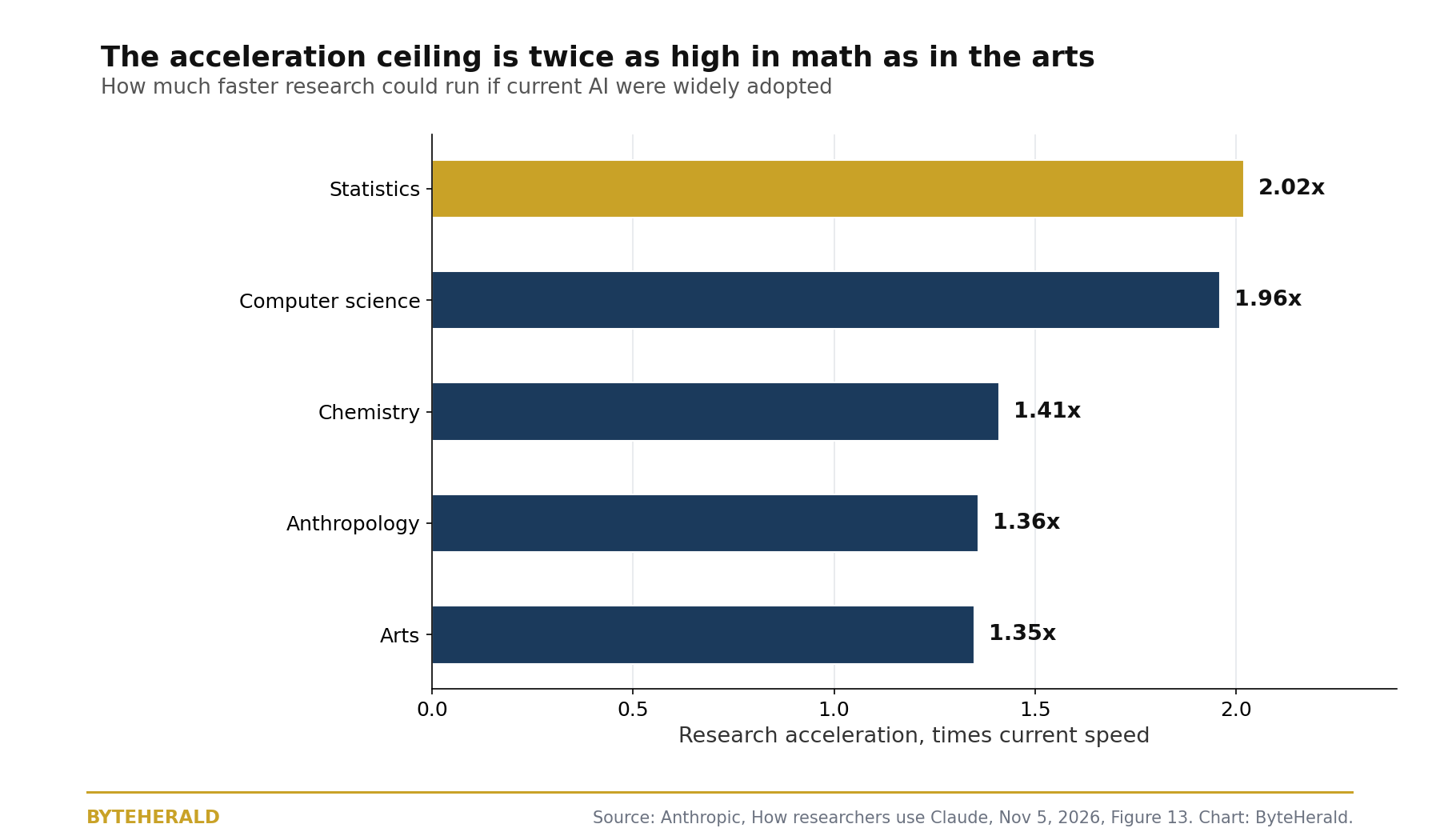
The report's scenarios are the part most likely to be quoted, and they need the most care. Anthropic built a simple model of how much AI could speed up research, and the first scenario, current capabilities widely adopted, says AI could take on 27 to 52 percent of the researcher time needed to produce a new study, with a median of 38 percent across fields. Those shares imply research accelerations ranging from 1.35 times in the arts, 1.36 times in anthropology, and 1.41 times in chemistry, to 1.96 times in computer science and 2.02 times in statistics. Even the most AI-ready fields, whose work is almost entirely cognitive, reach only about a twofold acceleration. The chart below shows the five fields the report names.
The second scenario is hypothetical, not a forecast: if AI could carry out all non-physical research work, output in fields such as computer science and statistics could rise as much as 15-fold, while output in bench sciences such as chemistry and biology, held back by physical bottlenecks, would rise three- or fourfold. The distinction matters. The 27 to 52 percent figure is a scenario from Anthropic's model, built on task-level capability ratings and time estimates, not a measured productivity gain in real research projects. The report does not say how much research Claude has actually produced. And because the fields with the largest potential for acceleration include the ones that produce AI itself, the gains could create a feedback loop, in which faster AI research produces more capable AI, which further accelerates research. That loop is the reason the ceiling matters: if AI research itself gets twice as fast, the models get better twice as fast, and the ceiling moves.
The case study: a proof in three days
The day after Anthropic published its study, a second result showed what the ceiling looks like in practice. Physical Superintelligence, a physics research lab, said on November 6, 2026 that its internal research system, running instances of a non-public Anthropic model on its own infrastructure, found a complete proof of the Aaronson-Ambainis conjecture, a quantum computing question open since 2008, on the third day of a run, and that the Lean proof assistant accepted it. The conjecture, posed by Scott Aaronson and Andris Ambainis, asks when quantum computers can be exponentially faster than ordinary ones, and the proof shows that certain exponential advantages require special patterns or structures in the input. The paper and the Lean 4 formalization are public on GitHub under an Apache 2.0 license, and the repository says the proof was re-checked with two independent implementations of Lean's kernel. Three caveats travel with the result. The model Anthropic provided is not public, and Anthropic did not respond to a request for comment on which model was used. The result is not peer-reviewed, and human experts still need to confirm that the formal statement matches the conjecture as Aaronson and Ambainis meant it. The human-readable paper is not itself machine-checked. The lab, which launched in September 2026 with $58 million in seed funding, says four Stanford University researchers who settled a special case in August are reading the proof and writing a shorter version for experts.
How to read the next claim
Science is now the field where AI companies make their boldest claims, and the claims need a reader's test, because the same week can produce a verified proof and an unverified announcement. We audited OpenAI's three claimed breakthroughs in October, and found the math and computer-science formalizations public while the physics artifacts were withheld. We read Harvard's study of AI peer review the same month, which found an AI judge preferred AI-written reviews in every comparison, a result that says as much about the judge as about the reviews. We audited the METR report on AI building AI faster, and found a 1.9-times acceleration claim with a robustness range of 1.1x to 2.9x wide enough to include almost no acceleration at all. Five questions separate a claim worth trusting from one worth waiting on. First, is it a measured gain or a scenario from a model? Second, who was in the sample, and who was left out? Third, does the study measure use, or quality? Fourth, is the artifact public, a paper, a formalization, a dataset, or only a press release? Fifth, who checked it, a proof assistant, a peer reviewer, or nobody yet? Anthropic's study passes the first four on its own terms and is honest about the fifth. The PSI proof passes the fourth and is waiting on the fifth. That is the standard the next announcement should be held to, and it is the standard this pillar was written to. The next announcement has already arrived: Anthropic chief executive Dario Amodei says AI will cure cancer within a decade, and doctors answered within a day.
By ByteHerald Staff. Anthropic published "AI for scientific discovery: How researchers use Claude" on November 5, 2026, studying 207,049 science sessions from August 2 to September 30, 2026, and reporting that AI could take on 27 to 52 percent of the researcher time needed for a new study, with a median of 38 percent across fields, that data analysis accounts for 33.7 percent of Claude sessions and 48.1 percent of Claude Code sessions against 27.6 percent of researcher time, and that computer science accounts for 32.7 percent of Claude Code sessions despite making up only 4.3 percent of the world's researchers. Physical Superintelligence announced on November 6, 2026 that its research system, running a non-public Anthropic model, proved the Aaronson-Ambainis conjecture, open since 2008, in three days, with the Lean proof assistant accepting the proof, and Business Insider reported on November 7, 2026 that Anthropic did not respond to a request for comment on which model was used. Anthropic's survey of 528 scientists found about 40 percent expect AI models to carry out full research projects on their own by 2030.
Comments
Post a Comment